
WTO data ranks eighth for giving trade questions a more precise home than a general search for exports. The World Trade Organization's current data entry point connects trade in goods, trade in services and other trade-related collections, while WTO Stats provides time series and documentation. That breadth matters because trade is not a single number with a single definition. A project may concern the value of merchandise flows, a volume index, commercial services or tariffs. The first task is to choose which of those questions you actually mean. A portal can offer them side by side without making them interchangeable.
Start by distinguishing a monetary value from a quantity or volume measure. A rise in the value of traded goods need not mean that the same percentage more goods crossed a border. Prices and valuation can affect the monetary total. Likewise, an index does not carry the same unit as a currency-denominated series. This guide does not calculate a current trade change or assign a cause; it identifies the reading task. Before exporting, copy the indicator's full name and unit, then check whether the period is annual, quarterly or monthly. Those details belong in the chart caption, not only in a file you may later forget.
Reporting perspectives and tariff categories
The reporter and partner dimensions deserve equal care. A country's recorded exports to a partner and that partner's recorded imports from it need not be identical observations. Differences in reporting, timing and valuation can matter. Do not treat a mismatch as proof of dishonesty or an arithmetic mistake without reading the relevant methodological notes. For a beginner's exercise, keep the reporting perspective fixed and compare the same type of flow over time. This produces a coherent first table and leaves the more demanding reconciliation of bilateral statistics for a project with enough documentation to explain the differences rather than merely display them.
Tariff information introduces another distinction: bound, applied and preferential rates do not answer the same question. The WTO's statistical tools identify different tariff categories, which should remain visible in any export. A rate attached to one product classification also should not become a claim about every shipment or the treatment of a particular transaction. We offer no customs or legal advice here. The educational point is that a familiar word such as tariff can label several measures. Preserve the category and reference period, then use the official documentation to understand the scope of the number rather than turning a headline into a universal rule.
Preserve the structure of a trade question
Eighth place favors more general beginner tasks elsewhere, but WTO is a stronger first choice for a clearly defined trade project. Its current data portal and statistical interface also demonstrate why a durable workflow should record dataset names rather than only the position of a button. Sites evolve. A written description of the indicator, reporter, partner, frequency and unit remains useful after navigation changes. If your project joins trade information to FAOSTAT production or World Bank indicators, document the classifications and periods separately. A shared country label alone does not settle whether the series can be combined without changing their meaning.
Try a deliberately small comparison: one reporting economy, one clearly named trade measure and a continuous set of periods. Keep any gaps and flags, then explain whether the result concerns value, volume, goods or services. A successful first chart should make that distinction obvious even to someone who has not used the portal. WTO earns its place because it supplies the subject-specific structure that a broad economic search often lacks. The reader's job is to preserve that structure. If the chart becomes simpler by deleting the details that define it, it has probably become less informative at the same time.
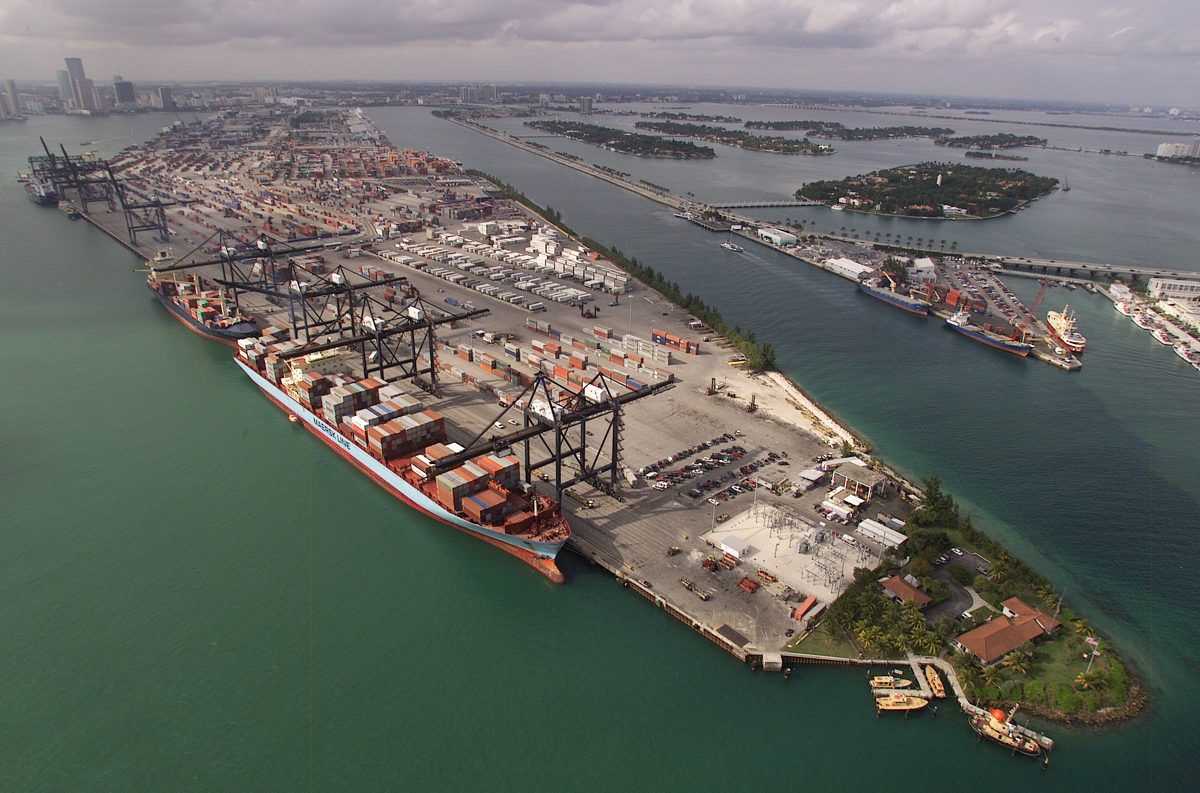
Photo: James R. Tourtellotte · Public domain. Miami container port; archival photograph, original date unknown; thematic archive illustration, not a portal screenshot or current statistical evidence. Existing optimized local image reused unchanged; original resize/recompression and source license retained.

