
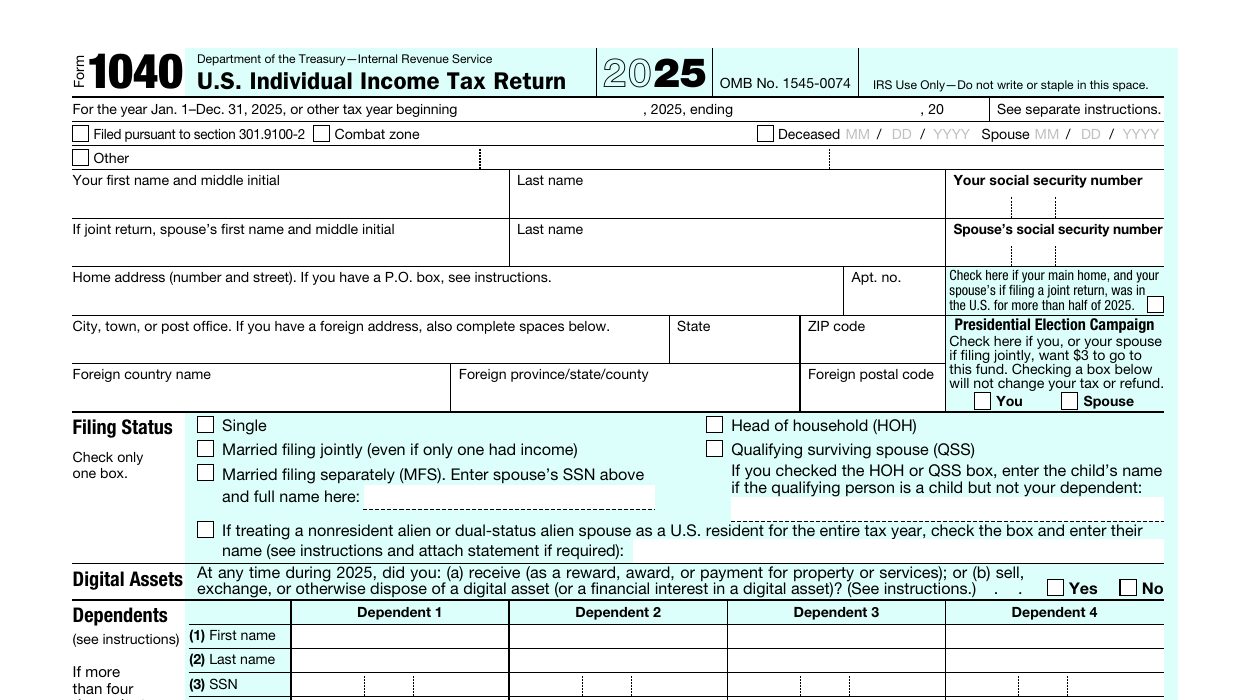
A letter or number on a tax document can tell you who prepared it, what it reports and how it relates to a federal return. It can also create confusion: a W-4 and a W-2 sound similar but do different jobs, while the 1099 family covers several kinds of payments. This guide explains ten common US federal forms so that readers can recognize their purpose before looking at their own records. It is an overview, not a filing checklist: not everyone will receive every form, and other documents can be important.
Our editorial ranking puts a form higher when understanding it helps a broad range of individual readers make sense of the rest of their paperwork. Form 1040 comes first because it is the individual income tax return around which many other records are organized. A W-2 and W-4 follow for their distinct connections to employment. The remaining information statements illustrate common income or expense categories. The order is a judgment about explanatory usefulness, not a measurement of how many taxpayers use each form or the amount of tax involved. The descriptions and linked IRS materials were checked on 20 November 2026.
Think of a return and an information statement as different parts of a conversation. The person filing a return reports information to the tax authority; an employer, financial institution, school or government agency may separately provide a statement describing certain transactions. A statement can help you check your records, but receiving one does not automatically answer every question about how a particular amount is treated. Likewise, the absence of a statement does not necessarily mean that no income or record exists. Read the instructions for the relevant tax year and keep the underlying records.
Forms W-2 and W-4 demonstrate why timing matters. An employee uses a W-4 to provide withholding information to an employer, while the employer uses a W-2 to report wages and withholding for a year. Withholding is money paid toward tax; it is not by itself the final tax calculation. The return brings together the information needed for that calculation. A person may also have a 1099 for interest or other payments in the same year, so the documents are not competing alternatives.
Statements can contain several boxes because different amounts may have different meanings. A bank's interest statement is different from a dividend statement; an education statement is not a guarantee of an education credit; and mortgage interest shown on a statement does not establish that a particular deduction is available. Compare names, identifying information, the relevant year and amounts with reliable records. If something appears wrong or a document is missing, the issuer and the IRS instructions can explain what to do next. Protect identifying numbers and avoid sharing full forms publicly.
The images in this guide show blank IRS forms for identification; they are not filled examples or substitutes for the current official documents. IRS forms, rules, thresholds and instructions can change, and a person's circumstances matter. Consult the IRS's current document guide and, when appropriate, a qualified professional for a specific situation. For another way to read financial information, see our guide to financial terms.
Image: Internal Revenue Service, US Department of the Treasury · Public domain in the United States; cropped, resized and recompressed.