
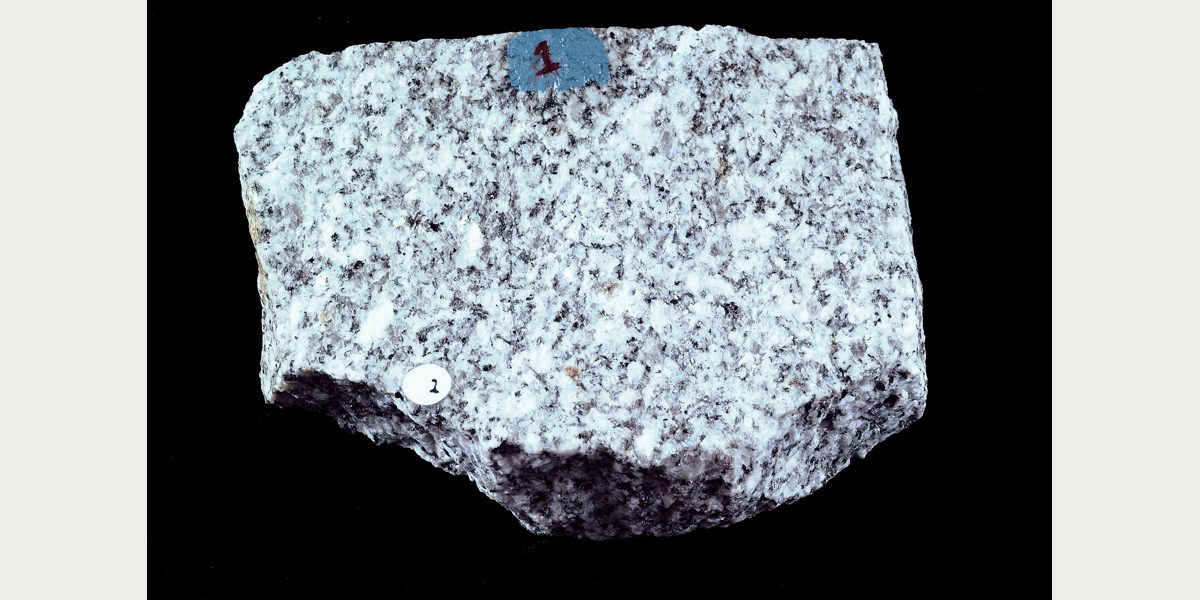
Granite is our first choice for a beginner's geology collection because a good labelled specimen lets you compare visible mineral grains without needing an elaborate test. Sandstone ranks second for making sedimentary texture approachable, and basalt third for the contrast it offers with granite. This is a ranking of teaching value in an introductory hand-specimen kit, not market value, beauty or the probability that a loose stone belongs to a particular type. We favour features a beginner can observe, useful comparisons with other samples, and lessons that transfer beyond one attractive specimen.
The scope is ten familiar rock types studied at a table with a hand lens, reviewed on 28 October 2026. It is not a shopping-price comparison or a field-identification certificate. A clearly labelled educational sample is more useful here than a mysterious polished souvenir. Rocks can vary considerably within the same named type, and weathering, lighting or a cut surface can change what a photograph seems to show. Our illustrations are examples, not colour standards. A dark stone is not automatically basalt, and a pale stone is not automatically limestone. Description should come before the name.
Begin with a notebook divided into observation and interpretation. Under observation, write what you can actually see: separate grains, rounded fragments, bands, pores or a glassy surface. Under interpretation, write the rock name and the reason you think it fits. Keeping the columns separate makes it easier to revise an identification without discarding useful work. A magnifier can help distinguish a granular surface from an apparently uniform one, but it cannot reveal every mineral or the whole history of a sample. The scientific habit we reward is explaining a conclusion, then recording what remains uncertain.
Our order also rewards comparisons. Granite and basalt provide a useful contrast between coarse and fine igneous textures, while sandstone and conglomerate let you compare the scale of sedimentary fragments. Slate, schist and gneiss introduce different expressions of metamorphic fabric. Pumice and obsidian are striking, yet narrower teaching examples: their distinctive textures are memorable, but they do not represent every volcanic rock. A learner interested mainly in volcanoes could reasonably move them much higher. Our broader introductory purpose gives everyday comparisons more weight than the most dramatic first impression.
Use the collection as a set of questions rather than ten labels to memorize. Which sample contains obvious pieces of older material? Which shows interlocking grains? Which has a fabric that continues across the rock, and which merely has a weathered line on its surface? Turn a labelled specimen in the light and compare more than one face. Sketching the relationships between features can be more informative than making the sketch look artistic. Do not infer a precise location, age or cooling rate from a single appearance; those conclusions require geological context and, sometimes, measurements beyond a beginner's kit.
For a larger-scale view of the processes, our volcanic landforms ranking connects rock textures with landscapes, while Mars landforms for learning geology explores observations made at another scale. Read this countdown from tenth to first, comparing the proposed exercise for each sample. The ranking is editorial judgment informed by geological descriptions, not a measured classroom trial. Would you begin with granite's visible grains, sandstone's sedimentary clues, or the memorable textures of volcanic glass and pumice?
Geological reference: NPS · NPS · NPS.
Photo: Biotite granite specimen · GeoDIL — Dexter Perkins · CC0. Downscaled on a neutral canvas, without cropping or upscaling; optimized JPEG. No endorsement implied.
