
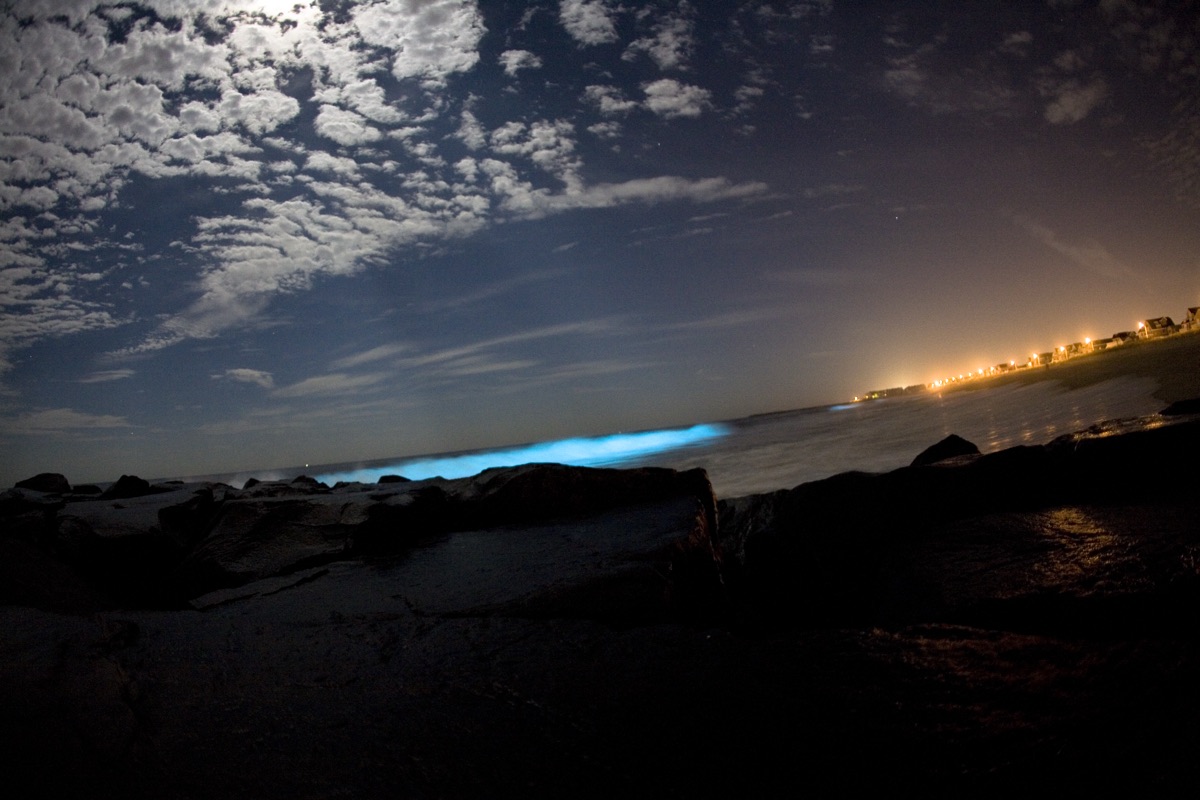
A blue flash in a breaking wave and a firefly's summer signal look very different, but they have something important in common: both involve light produced by living chemistry. Bioluminescence is the production of light by an organism through a chemical reaction. It is not the same as sunlight reflected from a shiny surface, nor is it necessarily the fluorescence seen when an organism absorbs one wavelength of light and emits another. The distinction matters when a photograph shows a spectacular color but cannot, on its own, reveal how that color was made.
This list introduces ten examples of luminous organisms, from microscopic plankton to deep-sea animals and familiar insects. The ranking is an editorial guide to the variety of light-producing partnerships, ecological roles and useful scientific explanations, not a measurement of brightness, rarity or evolutionary importance. Our first choice, luminous dinoflagellates, makes an often invisible plankton community visible in a breaking wave. A reader who values a partnership between species more highly could reasonably put the Hawaiian bobtail squid first.
Bioluminescence is especially common in the ocean, including the dim and dark water below the sunlit surface. NOAA describes it across groups such as fish, squid and gelatinous plankton. Many marine examples emit blue or green light, which travels relatively well through seawater, though the colors and chemistry vary. A glowing organism need not be a fish, and a glowing sea need not be full of animals: dinoflagellates are single-celled protists, some of which can light up when disturbed.
The purposes of light also vary. A flash can play a role in attracting a mate, misleading an attacker or revealing potential prey. Some animals have light organs on their undersides that help reduce their silhouette against the light coming from above, a strategy known as counterillumination. The fact that a behavior is observed does not mean researchers have settled every question about why a particular species uses it. Where a purpose remains a hypothesis, we describe it as such rather than as a proven intention.
Not all organisms make the light in precisely the same way. Some animals produce the chemistry in their own tissues. Others maintain luminous bacteria in specialized organs. A Hawaiian bobtail squid, for example, provides a home for bacteria whose light contributes to camouflage. A flashlight fish also houses glowing bacteria, but its light organ is associated with its eyes. These partnerships demonstrate that the visible glow and the organism responsible for its chemistry can be different members of the same relationship.
Conditions matter when people try to see a display. A field, a beach or a deep-sea habitat is not a guaranteed light show, and the presence of a glowing species does not make an unfamiliar organism safe to handle. Many of the deep-water examples require research equipment to observe. Photographs can record an animal under illumination rather than showing its own light, so the captions identify what each image actually depicts.
Our choices draw on explanations from NOAA Ocean Exploration, Smithsonian Ocean and Monterey Bay Aquarium. They span courtship, camouflage and defense rather than declaring one organism the world's brightest. Some broad names describe groups containing many species, and not every member of a group should be assumed to glow. We use named examples where the source supports them and avoid applying a feature to every jellyfish, worm or squid.
The countdown runs from ten to one. For another way to explore the natural world, visit our guide to NASA citizen science projects. Which living light would you most like to understand: a firefly's signal, a squid's bacterial partnership or the shimmer of plankton in a wave?
Photo: catalano82 · CC BY 2.0 · 2008-10-15. Resized and recompressed. Dinoflagellate light in breaking waves, photographed in 2008.
