
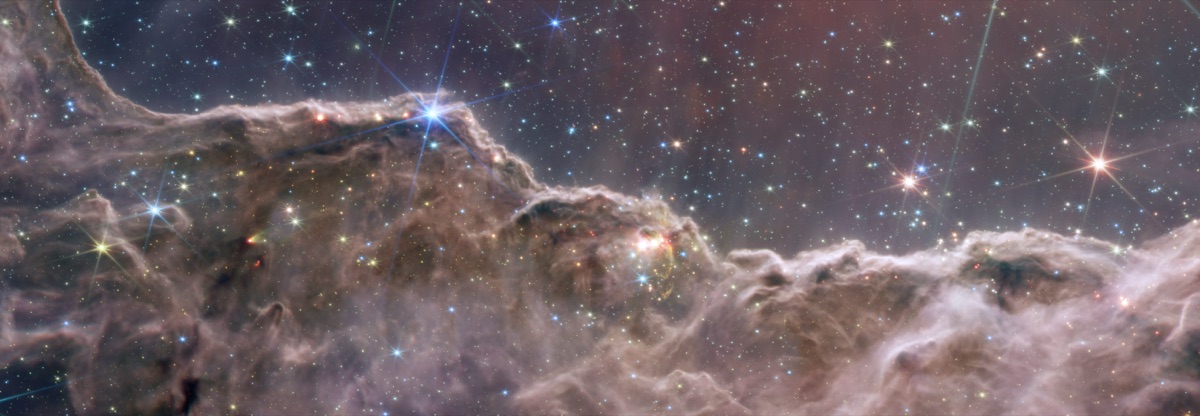
A James Webb Space Telescope image can look like a painting: bright stars, dark clouds, rings around planets and galaxies scattered across a black background. Yet the colors are a way of displaying measurements, not a claim that an astronaut would see the same scene with the naked eye. Webb observes primarily in infrared light, outside much of human vision. Image processors assign visible colors to selected wavelengths so that structures in the data can be compared and understood.
This guide chooses ten Webb views to introduce ten different astronomical ideas, from a nearby planet's atmosphere to the light of remote galaxies. We rank them by how clearly each image opens a door to understanding, the range of objects represented and the usefulness of comparing it with other observations. This is an editorial teaching order, not a scientific ranking of discoveries or a claim that one object is more important than another. Image credits, instrument context and sources are provided on each page. We reviewed the mission material on November 18, 2026; newer observations can refine an interpretation.
Webb is a partnership of NASA, the European Space Agency and the Canadian Space Agency. Its first full-color science images were released in July 2022. Its near-infrared camera, NIRCam, and mid-infrared instrument, MIRI, examine different ranges of infrared light. Some images below combine observations from both; others use one instrument. A composite can emphasize features that are less obvious in any single wavelength, but the processing choices matter. A red area is not automatically hotter, closer or younger merely because it appears red in a published picture.
The telescope observes light that has traveled from an object to its detectors. Distance therefore also means looking back in time: light from a distant galaxy has taken far longer to reach us than light from Jupiter. A deep field contains galaxies at many different distances, so it is misleading to assign a single age or distance to everything in the frame. Some curved streaks in the first deep field are background galaxies distorted by the gravity of the foreground cluster, an effect called gravitational lensing. The image is evidence for investigation, not a direct photograph of the entire universe at one instant.
Several famous views show regions where stars form. Dust and gas can obscure visible light, while infrared observations reveal different layers and sources. Even so, a bright point needs analysis before it can be identified as a particular kind of object. Other views show material expelled by a dying star, interacting galaxies or clouds in a planet's atmosphere. The shapes are real features in telescope data, but names such as Cosmic Cliffs and Phantom Galaxy are convenient descriptions, not literal landscapes or apparitions.
The list favors variety over choosing ten images of the same kind. A reader might reasonably put the Pillars of Creation first for their recognizable comparison with Hubble, or the first deep field first for its extraordinary collection of galaxies. We put the Cosmic Cliffs at number one because their ridge, young stars and surrounding gas make an approachable introduction to how infrared observations reveal a star-forming region. Another ordering would be equally possible under different criteria. These are selected views, not an exhaustive list of Webb's best science.
The pictures are observational composites processed by the credited teams; they are not simulations or predictions of what a future visitor would see. Their captions identify the particular view rather than treating every image of a target as identical. NASA's explanation of how Webb images are made is a useful companion. You can also explore our guide to Hubble images. Which view best helps you understand the universe, and what would you put first?
Image: NASA, ESA, CSA, and STScI · CC BY 4.0; resized and recompressed. Cosmic Cliffs: combined near- and mid-infrared data.