
Which version of Seattle's Legion of Boom deserves first place? Our answer is the 2013 Seahawks, followed by 2012 and then 2014. The order comes from a deliberately narrow rule: among Seattle's 2012–2015 seasons, fewer regular-season team points allowed per game ranks higher. This is a comparison of scoring prevention across a defined four-season window, not a complete measurement of defensive talent. The phrase Legion of Boom supplies the historical frame, while the statistic belongs to the entire team. It does not isolate the secondary or assign every point conceded to one defensive player. The 2015 figure, 17.3, leaves it outside our Top 3.
The topic has a timely entry point. At approximately 18:03 UTC on 3 November 2026, we inspected Google Trends Trending Now for the United States, past 24 hours, all categories, and explicitly selected descending search volume. “seahawks vs bears” was the highest group displayed, in the rounded 1M+ bucket with 700% growth. Other large groups included election results and several medical or personal-name queries. Those figures describe the displayed trend group and window, not monthly keyword volume or a Google Trends Explore score. We chose a lasting historical sports question rather than force a competitive ranking out of a medical concern or an unverified personal story.
Search interest does not establish a match result. Seattle's own report dated 2 November 2026 independently confirms a 34–17 loss to Chicago. That current game explains why a reader might arrive, but it does not decide this historical ranking. We do not use one new result to diagnose a whole modern team or pretend that a past unit predicts the next game. Instead, the article gives interested readers a clear comparison they can revisit after the news cycle moves on. Facts and links were checked on 3 November 2026, with the ranked seasons fixed at 2012–2015 rather than silently expanding whenever a newer team produces an interesting result.
A useful comparison must also separate the regular season from the playoffs. We keep postseason outcomes in the explanation, not in the ordering statistic. Otherwise a short championship run and a longer regular-season sample would be blended without a consistent denominator. Points allowed is a team scoreboard measure: field position, offensive turnovers, special teams and game circumstances can influence it. It is not an opponent-adjusted efficiency model, a film grade or proof that every defender on one roster was better than his counterpart on another. We prefer a rule readers can understand and challenge to a composite score whose weights are hidden.
The competing cases are real. The 2014 team reached the Super Bowl, while the 2012 team exited in the divisional round; a championship-journey ranking could therefore reverse their positions. The 2013 season combines our strongest scoring-prevention figure with a title, but the title is confirmation of its broader historical appeal, not an extra statistic inserted to guarantee a favorite wins. Keeping that distinction visible matters. A reader can accept every reported number and still argue that postseason achievement should be the first criterion. That would answer a different, worthwhile question, and it should produce a clearly relabeled ranking rather than an unexplained change to this one.
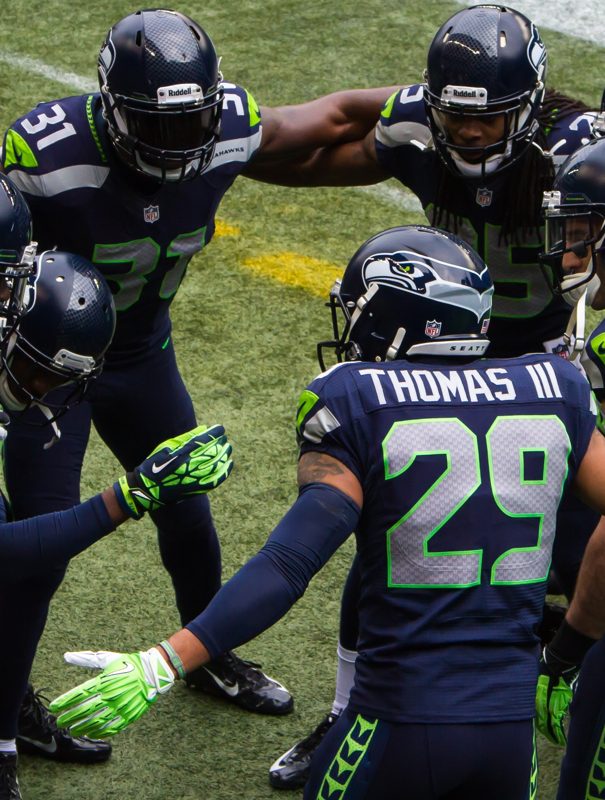
The photographs provide period context. The 2014 picture shows players at a Marine Week event near the practice field, not a game; the 2012 photograph features fullback Michael Robinson, not a claim that he played in the defensive secondary. The 2013 photograph shows the Legion of Boom in a huddle. None is a statistical test. For another franchise perspective, read our greatest Seahawks players; for a championship-focused comparison, try our 49ers Super Bowl wins. Read third to first, then choose your own priority: should lower regular-season scoring allowed keep 2012 above 2014, or should the deeper playoff run decide?
Sources: Regular-season comparison · 2014 postseason · 2012 postseason · 2013 championship · 2015 figure · Current Bears game context.
Photo: Mike Morris · CC BY-SA 2.0. Downscaled without cropping or upscaling and recompressed as optimized JPEG. No endorsement; the derivative retains the linked license.
