
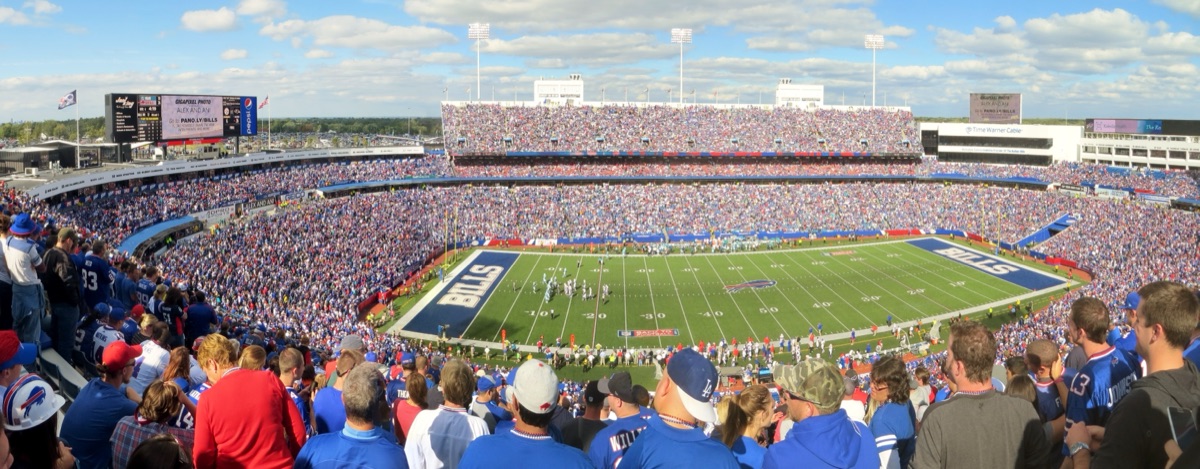
The Buffalo Bills and Minnesota Vikings have produced more than one game in which the ending changed everything. In 2014, Buffalo found the end zone with one second left. In 2002, a long touchdown pass settled an overtime shootout. In 2022, Minnesota fought back from a 17-point deficit and survived a remarkable sequence of late reversals to win in overtime. Which game is the best place to start if you want to understand why a Bills–Vikings matchup can capture attention? Our choice is the 2022 game, followed by 2002 and 2014.
This is an editorial ranking, not an official award or a statistical formula. We give greatest weight to the drama of the finish, the number and variety of consequential turns, and the enduring playmaking a viewer can revisit. We also consider the whole game rather than treating a close final score as sufficient on its own. The three selected games are regular-season meetings through the 2022 season; this is not a ranking of the franchises, their seasons or individual players. A fan who prefers a last-second regulation finish has a strong case for the 2014 game over the 2002 overtime shootout.
The 2022 meeting stands out because the late drama did not end with one play. Buffalo led 27–10 in the second half, yet Minnesota kept finding ways back. Justin Jefferson's fourth-and-18 reception sustained a crucial drive, but the game still had a goal-line stop, a fumbled snap recovered for a Minnesota touchdown, a Buffalo field goal to force overtime, and a final defensive takeaway. The official Minnesota box score lists Jefferson with ten catches for 193 yards and a touchdown. Those figures describe his production, but they do not measure the difficulty or timing of the catch; the ranking itself remains our judgment.
The 2002 game offers the clearest competing case. It finished 45–39 when Drew Bledsoe found Peerless Price for a 48-yard overtime touchdown, according to Buffalo's account of the game. Price caught 13 passes for 183 yards and two touchdowns. A sudden, decisive finish after a high-scoring game can be more satisfying than a sequence of reversals. We place it second because our criteria favor the wider range of game-changing moments in 2022, not because points or yards are inherently less valuable.
The 2014 game makes a different argument: one second remained when Kyle Orton connected with Sammy Watkins for a two-yard touchdown. Dan Carpenter's extra point gave Buffalo a 17–16 win. Minnesota's account describes an 80-yard, 15-play Buffalo drive, which helps explain why the final catch was more than a single isolated highlight. The ending was exceptionally close, even if the overall scoring and range of late reversals were narrower than in the two games above it.
There are other defensible choices. The Vikings' 35–23 victory at Buffalo in 1975 featured four Chuck Foreman touchdowns, two rushing and two receiving; Minnesota's historical preview documents that performance. We leave it outside this short list because the selected games better fit our emphasis on the final sequence, not because Foreman's achievement was insignificant. The comparison is deliberately limited to three cases, and it does not claim to include every historically important meeting.
The games also illustrate why era and context matter. Overtime formats and the way fans experience replays have changed, so a modern highlight can be easier to find than an older performance. Team accounts are valuable primary records for scores and sequences, although each is written from its own team's perspective; we use the opposing team's reports where available and treat the ordering as ours. For another Buffalo perspective, explore our greatest Bills quarterbacks. Which finish would you put first: the one-second touchdown, the overtime shootout or Minnesota's 2022 comeback?
Vikings historical series notes.
Photo: Alan Kotok · CC BY 2.0 · 2014-09-14. Resized and recompressed.
