
Who is the greatest men's tennis player of the Open Era? A fan who values Grand Slam titles may choose Novak Djokovic; another who prizes dominance on clay can make a strong case for Rafael Nadal. Roger Federer’s combination of major titles, long success and influence offers a different argument. The question becomes harder when the comparison reaches Rod Laver, Björn Borg and Pete Sampras, whose careers unfolded under different calendars, equipment and competitive conditions. This ranking makes a choice while recognizing that reasonable people will weigh those differences differently.
Our scope is men's singles careers with substantial Open Era achievements, evaluated through 31 December 2025. The Open Era began in 1968, when professionals could compete at the major championships alongside amateurs. Laver is eligible because of his extraordinary Open Era record, but his earlier achievements are clearly identified rather than counted as Open Era titles. Active players can add to their records after our cutoff; this is a dated comparison, not a live leaderboard or a forecast of their final careers. Our separate guide to women’s tennis greats considers a different field.
The main criteria are major singles achievements, sustained excellence at the top, performance on different surfaces and competitive context. We also consider influence and distinctive peaks when close candidates are difficult to separate. Titles are evidence rather than a mechanical points system. A player whose career was shorter can be valued for exceptional dominance, while longevity can favor another whose peak was less concentrated. The order reflects editorial judgment, not a claim that a match across generations could be predicted.
Djokovic ranks first on this assessment because his 24 major singles titles through 2025 combine with a career Grand Slam, sustained top-level success and strong records against the other leading players of his generation. Nadal’s 22 majors include 14 French Open titles, an extraordinary concentration of success on clay; his supporters can reasonably place that achievement first. Federer’s 20 majors, eight Wimbledon titles and years at the top create another compelling case. We place Nadal second and Federer third, while accepting that a different emphasis on playing style, peak or influence could reverse them.
Historical comparisons have limits. Major tournaments were not equally accessible throughout tennis history, travel and scheduling changed, and today’s ranking system was not in place for every stage of Laver’s career. The surfaces at the Australian Open and US Open also changed over time. A raw total therefore needs context. Laver completed the calendar-year Grand Slam in both 1962 and 1969, but 1962 preceded the Open Era. We include the earlier feat as career context and explicitly distinguish it from the period used for this list.
A cutoff also makes the treatment of younger stars clear. Carlos Alcaraz had already built a remarkable early résumé by the end of 2025, and supporters could reasonably include him instead of one of our established champions. We favor a longer completed body of work for this particular ranking; that judgment can change. Players such as Mats Wilander and Stefan Edberg also have credible cases. Exclusion is not a claim that a player could not compete with someone on the list, and our selections do not measure doubles achievements.
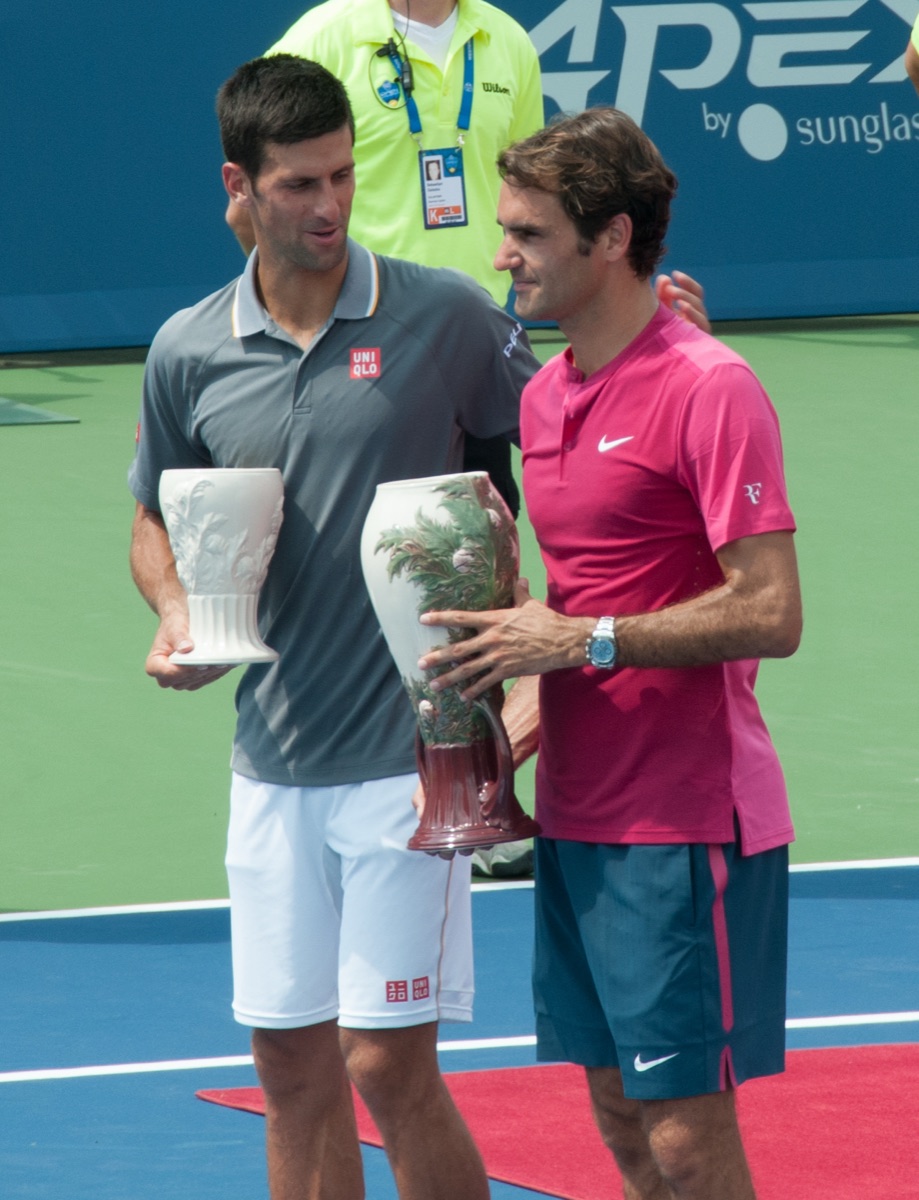
The ATP and ITF records linked below support title counts and historical milestones. We use the figures as of the cutoff, rather than presenting an active player’s later results as settled. The same contextual photograph of Djokovic and Federer at Cincinnati in 2015 appears throughout; it does not depict the other players. As with any ranking, the most interesting part is the disagreement: should longevity, an exceptional peak, or success against a particular field count most? Who would be your number one?
Photo: Eleodor; resized and recompressed. Wikimedia Commons · CC BY 2.0. Novak Djokovic and Roger Federer in Cincinnati in 2015; context photo, not the other players.
