
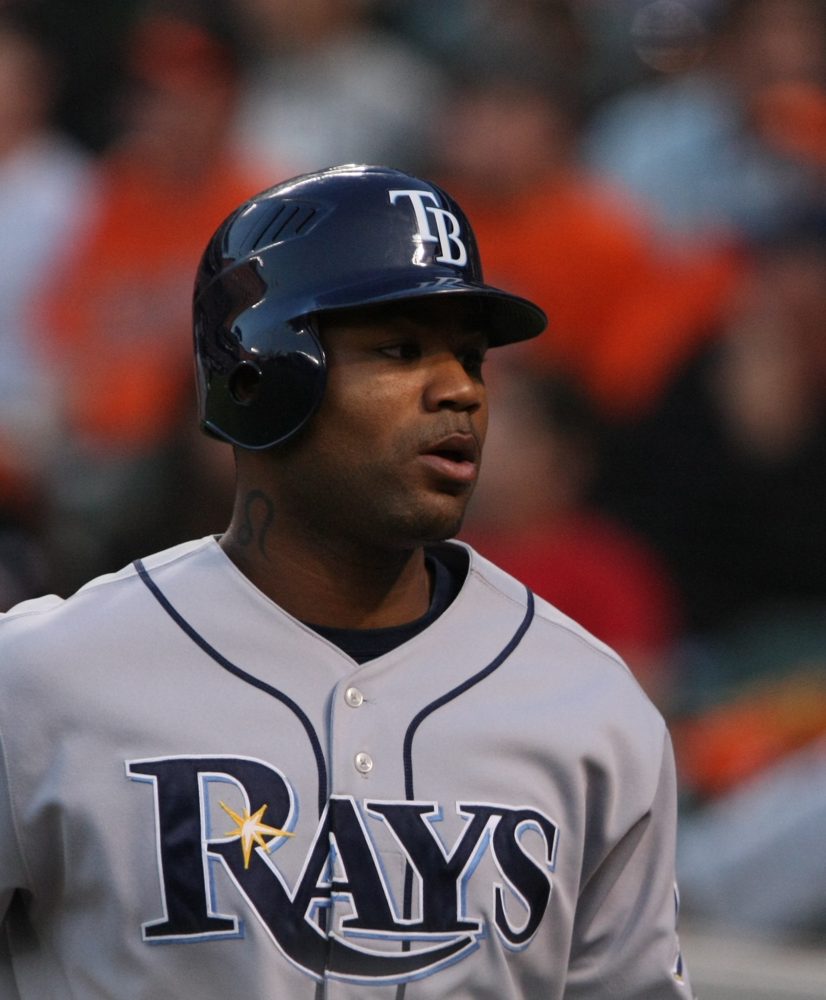
Carl Crawford ranks second because his Tampa Bay contribution combined several different ways to influence a game while spanning a formative period for the club. The Rays' historical account places his debut in 2002 and describes nine seasons with the organization; his player record lists four Tampa Bay All-Star selections. We give those years and that range of responsibility a narrow edge over Zobrist's positional flexibility. This is not a claim that one award total can settle the comparison. Crawford's case is stronger when batting, outfield work and running are considered together, rather than when any one memorable play is asked to represent an entire career.
Start with the difference between speed as a physical trait and running as a baseball contribution. A fast player still has to read a situation, choose an opportunity and understand the cost of an out. In general, pressure on the bases can change the decisions facing defenders, but it does not make every aggressive choice useful. That distinction helps avoid a ranking based only on excitement. We value the breadth of Crawford's role without treating a highlight of a stolen base as a complete statistical evaluation. The reader's task is to notice the decision and its context, not simply the apparent speed of the runner.
Outfield play adds a separate responsibility. A catch, a route, the handling of a ball that gets through and the decision about where to throw all belong to the job. Not every useful action becomes a spectacular image, and a reputation for athleticism should not replace a careful account of what happened on a play. Crawford's historical case is useful because it invites a wider view of a position player's work. Batting remains central, but the comparison should not end at the batter's box. A player can influence the shape of a game while appearing in different kinds of situations without changing his listed defensive position.
That is our main answer to Zobrist's strongest case. Zobrist changes where useful work can be placed; Crawford offers a broad contribution within a more familiar everyday identity. We prefer the latter narrowly when it is combined with his sustained Tampa Bay period. A reader who emphasizes roster construction can sensibly reverse the two, and we do not claim that Crawford would necessarily produce a better result in every possible lineup. Teams differ, opponents differ and hypothetical seasons cannot be verified. Our choice rewards a particular historical body of work rather than announcing a universal solution to how every club should organize its players.
The early-franchise context matters without needing to turn into nostalgia. Contributions before a team becomes nationally prominent deserve attention alongside those made after success attracts a larger audience. That does not automatically make an early player more valuable, and it should not lead us to discount later candidates outside our cutoff. It explains why a Rays-only historical ranking asks about continuity and identity as well as the most famous postseason moments. Crawford's work belongs to a developing team story, not merely to a collection of later highlights. Our 2009 Rays photograph illustrates that period and cannot establish anything about a current roster or event.
Second place ultimately reflects an unusually broad everyday case. We have not invented a single score to combine running, fielding and batting, nor assumed that all of those contributions are equally easy to compare across roles. Instead, we state the preference clearly enough for a reader to challenge it. Zobrist may deserve second if flexibility is the deciding factor; Crawford remains our choice because several phases of play and sustained franchise presence reinforce one another. When comparing the pair, ask which responsibility you would most regret leaving out of the discussion. That question produces a better disagreement than choosing the player with the one highlight you remember best.
Source: Official historical record 1 · Official historical record 2.
Photo: Keith Allison · CC BY-SA 2.0. Carl Crawford in Rays uniform, 12 May 2009. Historical Rays photograph; not a current game or roster claim. Resized/recompressed; source framing retained, existing Longoria source crop retained. Original image license retained; no endorsement.
