
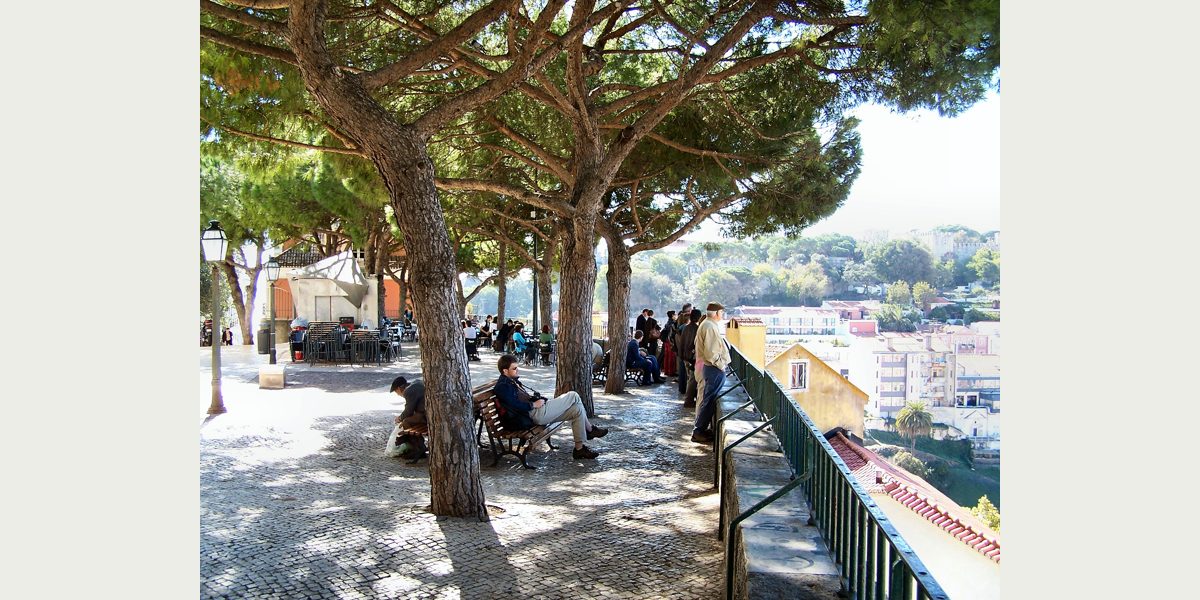
Lisbon makes more sense when you look across a valley before walking into it. A viewpoint can show how the castle hill, the regular streets of Baixa and the broad Tagus fit together, while a second terrace reveals that the apparent skyline changes completely from another side. The Portuguese word miradouro means a place for looking out. In Lisbon, that might be a neighborhood garden, a public terrace or the roof of a ticketed monument. These ten stops offer different ways to read the city rather than ten copies of the same postcard.
This ranking is an editorial selection for a first visit, with a reference date of 27 October 2026. We prioritize a useful and distinctive view, a setting that rewards lingering, and the ability to combine the stop with the surrounding neighborhood. We also consider the practical commitment involved in reaching it. We do not rank by elevation, social-media popularity or a measured photographic score. The order is not a walking itinerary: crossing repeatedly between hills would turn a pleasant outing into unnecessary climbing. Choose a small cluster and keep time for the streets between the terraces.
Graça takes first place for the balance between a broad city view and a neighborhood setting beside its church. Senhora do Monte has a persuasive competing case if a sweeping panorama is your main goal. São Pedro de Alcântara is particularly useful for looking back toward the castle from the other side of the central valley. Someone interested mainly in the river might prefer Santa Catarina; someone who wants a compact view of Alfama could put Santa Luzia first. These are differences in purpose, not disagreements that can be settled by counting stars on a review page.
Separate ordinary terraces from attractions with admission arrangements. The castle, Rua Augusta Arch and Amoreiras rooftop need their own visit planning; being able to walk around the surrounding streets does not mean access to their viewing areas is unrestricted. Check the official operator's current hours, final admission and access route before buying a ticket. An elevator mentioned in a description does not establish that the entire route has no stairs. For Amoreiras, the operator's published regulations describe a lift followed by stairs. If steps are a concern, ask about the complete route rather than simply searching for the word elevator.
Light and weather matter more than the ranking. A hazy afternoon can hide distant landmarks, while a cloudy day can still make the nearby roofs and street patterns easy to understand. Treat sunset as one possible experience, not a promise of a clear horizon or an empty terrace. Before heading uphill in autumn or winter, check the day's conditions and the time you actually have available. We do not give a universal best hour, a crowd-free guarantee or a transport timetable. The linked official pages provide the appropriate starting points for current arrangements, and historical photographs are dated rather than presented as today's conditions.
A useful viewing exercise is to identify only three things: one nearby landmark, a recognizable street or valley, and the river. Then walk a little of the neighborhood and see how the view translates into ground-level experience. At São Pedro de Alcântara, use the tiled orientation map as a starting point; at Santa Luzia, look at the decorative setting as well as the horizon. Our European-city ranking offers wider city-break comparisons, while the London parks guide explores another way to build an unhurried urban walk.
Leave space for residents and other visitors when taking photographs. Keep paths clear, use designated public areas and avoid turning a short stop into an obstacle for everyone else. You do not need all ten viewpoints to understand Lisbon. Two contrasting perspectives, taken slowly, may be more memorable than a rushed checklist. Which would lead your own ranking: the widest panorama, the most inviting place to pause, or the view that helps you understand the city below?
Official references: Visit Lisboa: Graça · São Pedro de Alcântara · Amoreiras.
Image: Graça terrace and trees; photograph dated 2007 — Filipe Rocha (Sacavem) · CC BY-SA 3.0. Downscaled and placed on a neutral canvas; JPEG recompressed without cropping or upscaling. Original rights retained; no endorsement implied. This adapted image is freely reusable under CC BY-SA 3.0, retaining attribution and that license.
