
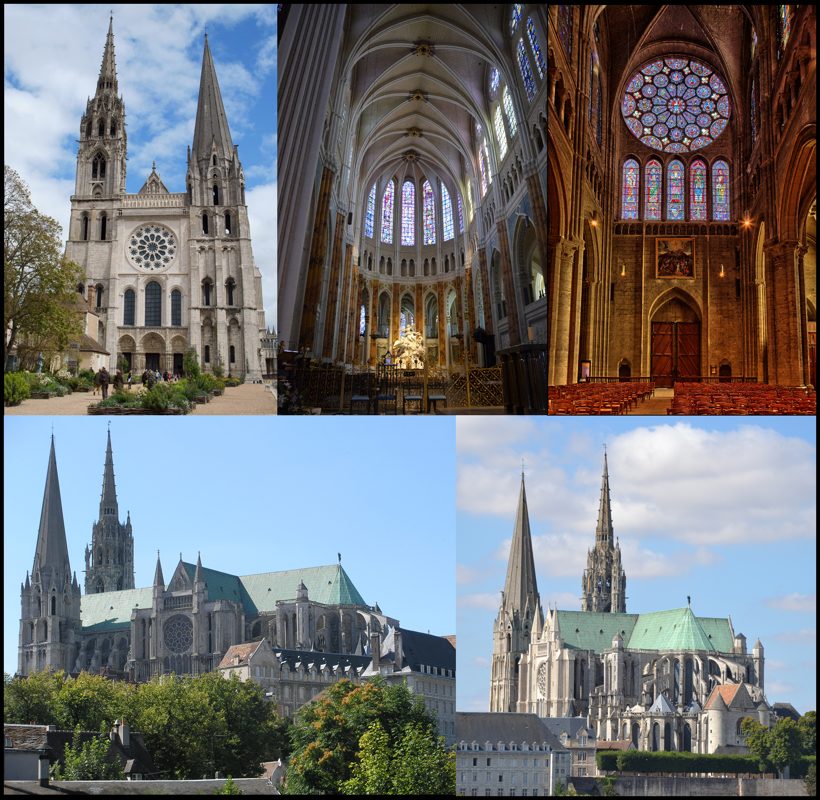
A Gothic cathedral can overwhelm you before it explains itself. Towers rise above streets, sculpted figures crowd the entrances, and windows turn daylight into color. This ranking offers ten places to learn how those effects work together. Chartres takes first place, Amiens second and Bourges third. Our priority is the clarity of the architectural lesson: how convincingly structure, space and decoration can be read as a whole. Historical significance comes next, followed by the usefulness of comparing different building traditions. The result is an editorial reading list, not a scientific beauty score, a pilgrimage hierarchy or a claim to have inspected every cathedral in Europe.
The selection concentrates on buildings with substantial medieval Gothic fabric in France, England, Germany and Spain. Some also contain earlier work, later additions or major restorations. That is part of their interest, rather than an inconvenience to hide. Canterbury makes the list precisely because its mixture invites comparison; Cologne reminds us that a medieval design can have a much later completion. We exclude Gothic Revival cathedrals conceived in the modern period and churches that were not cathedrals within our chosen field. Ten places cannot represent the entire movement. Italy, Portugal and many other important traditions deserve separate treatment, and their absence does not establish inferiority.
Start by distinguishing a building's plan from its appearance in a photograph. The plan organizes movement and the relationship between spaces. An elevation describes the vertical arrangement of a wall, while sculpture and glazing contribute further layers of meaning. A dramatic tower alone cannot tell you how the interior works. At each stop, look for the relationship between repeated bays, entrances and the larger whole before concentrating on one celebrated detail. This approach also explains why we favor a coherent spatial argument over a height record. A photograph of a portal can illustrate craftsmanship, but it cannot stand in for experiencing the entire building.
Facts and sources were checked on 3 November 2026. UNESCO property descriptions anchor most entries; Salisbury's own history and Historic England support the English comparisons. World Heritage recognition is evidence of documented significance, not a UNESCO endorsement of our order. Some listed properties include an urban area or several monuments, rather than only the cathedral. We therefore avoid calling every building an individually inscribed World Heritage site. Construction dates also need context: foundation, consecration, completion of a major campaign and finishing a tower are different events. Our short entries identify a useful distinction instead of compressing centuries of work into a misleading single birthday.
Search research helped identify an educational angle. On 3 November 2026 we inspected Google Trends Explore for the United States, past 90 days, all categories, Web Search. In one comparison, “railway stations,” “gothic cathedrals” and “roman architecture” showed relative averages of 1, 3 and 34. Related rising queries for Gothic cathedrals included a question about medieval culture marked Breakout and “romanesque cathedral” at +130%. Those are relative signals within a selected window, not monthly search volumes or proof of a seasonal cause. The useful response is to explain architectural differences, without claiming that Gothic architecture suddenly became more popular than every competing subject.
For related ways of reading buildings, compare our guide to architectural features and European castle ranking. The photographs here show different details and dates; the Chartres image is explicitly a collage. They are illustrations, not current condition surveys. This article does not promise opening hours, unrestricted access or unchanged restoration arrangements. Consult each institution before planning a visit, and respect worship and local photography rules. Read from tenth to first, treating each place as a different architectural problem. Would you give priority to Chartres's combined argument, Amiens's spatial coherence, or Bourges's distinctive alternative?
Sources: Salisbury Cathedral · Canterbury Cathedral · Cologne Cathedral · Bourges Cathedral · Amiens Cathedral · Chartres Cathedral.
Photo: MathKnight; source images credited to Honge, Robin Poitou, Marianne Casamance and MMensler · CC BY-SA 4.0. Downscaled without cropping or upscaling and recompressed. Image derivative retains the linked license. No endorsement.
