
A great museum building does more than protect objects from rain. It frames an arrival, guides people through rooms and gives a collection a public address. Some buildings make an unmistakable silhouette; others reveal their strengths in daylight, a sequence of galleries or the way an old structure accommodates a new use. Choosing the greatest is therefore an argument about what architecture should do, not a contest with a single measurable winner.
This is an editorial ranking of ten museum buildings and major architectural interventions, assessed on November 24, 2026. We weigh the clarity and originality of their spatial ideas, the experience they create for the public, their relationship with their surroundings, and their influence on later discussion of museums. These criteria are qualitative, not a formula. We do not rank the quality of collections, ticket prices, attendance or the wealth of their cities. Our guide to European art museums offers a different starting point for readers interested in collections and travel.
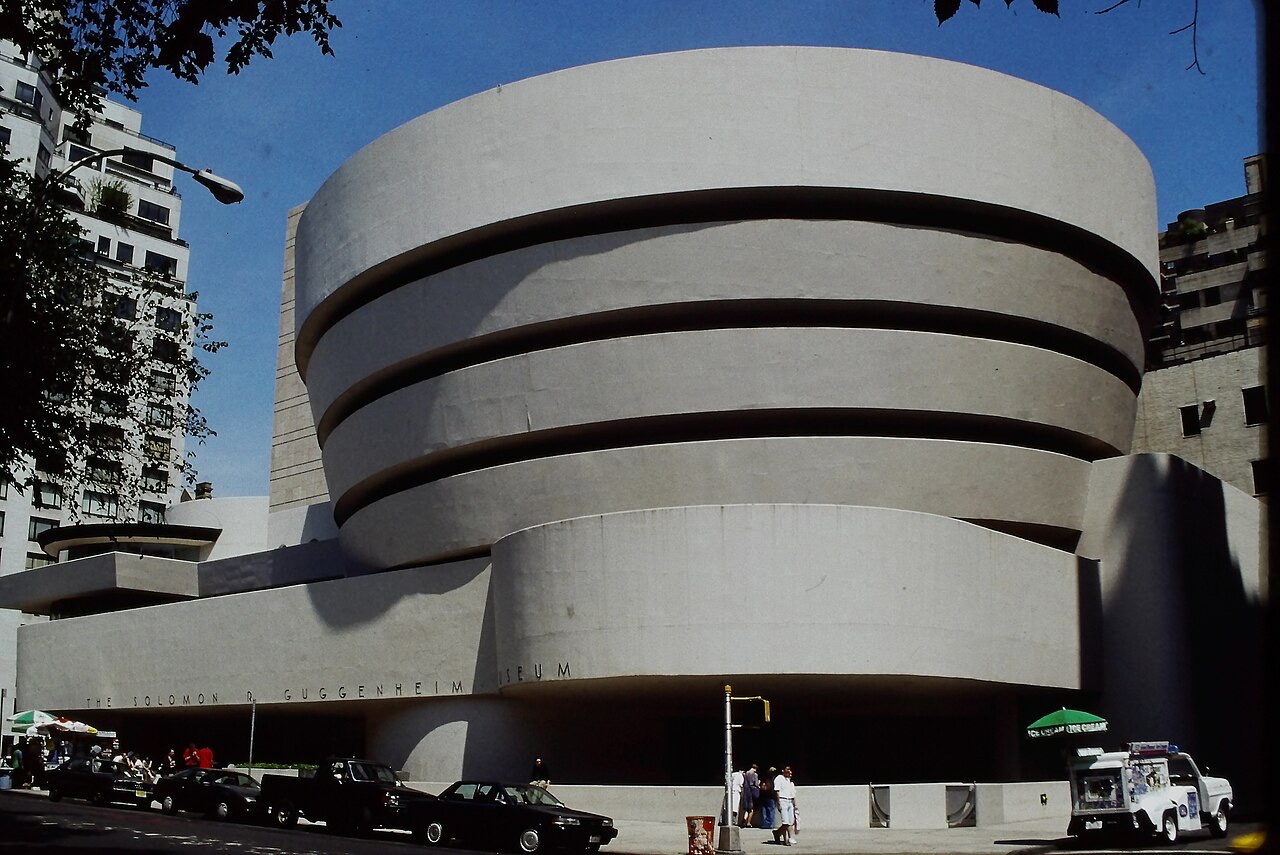
First place goes to Frank Lloyd Wright's Guggenheim in New York, whose continuous spiral makes circulation itself the central architectural idea. Gehry's Guggenheim Bilbao is a strong alternative: its sculptural exterior and riverside setting changed how many people discuss the role of a museum in a city. The British Museum's Great Court takes third for creating a covered civic space within an older institution. Readers who prize quiet galleries, social meaning or conservation could reasonably put the Kimbell, the National Museum of African American History and Culture, or the Neues Museum at the top instead.
A building and its institution are not identical. The Louvre began as a royal palace and was altered over centuries, while the British Museum's Great Court is a turn-of-the-millennium transformation within an older complex. We identify the relevant part rather than assigning every wall to one architect. The Metropolitan Museum's Fifth Avenue facade and hall are likewise only part of a much larger complex. This distinction matters because architectural credit is often shared by designers, engineers, craftspeople, clients and the teams who maintain or adapt a building long after opening day.
The choice of a museum also raises questions beyond appearance. Collections can carry histories of colonialism, unequal access and disputed ownership. A graceful courtyard does not settle those issues, and an impressive facade does not guarantee that every visitor finds a building accessible or welcoming. We consider how architecture invites movement and gathering, while acknowledging that admission rules, interpretation and institutional decisions also shape a visit. A photograph cannot demonstrate the experience of every visitor or establish that access arrangements remain unchanged.
Not every celebrated museum can fit into ten places. This selection leans toward well-documented European and North American examples and is not a complete global survey. Buildings elsewhere, including museums designed by Indigenous architects and institutions outside major capitals, could produce a very different list. We also avoid presenting the economic effects of a single building as proven by architecture alone. Bilbao's wider redevelopment involved public policy and many projects; a dramatic museum cannot explain an entire city's history by itself.
For each entry we link to the institution or its official heritage authority for factual context. Names, dates and design features are separated from our judgment about their relative merit; sources were checked on the date above. Buildings change through restoration, exhibition installation and construction, so consult the institution before making travel plans. The credited photographs show individual buildings at the time they were taken, not an inspection of present conditions. Which museum building deserves first place, and which one have we missed?
Sources: The Guggenheim · Guggenheim Bilbao.
Photo: Bmzuckerman · CC BY 4.0; resized and recompressed. The Guggenheim in New York, 1995.
