
A headline may give an earthquake's magnitude, its depth and a distance from the epicenter in the same sentence. Those numbers do not answer the same question. Magnitude describes the size of the source; shaking intensity describes effects at a particular place; depth locates the start of rupture below the surface. This guide ranks ten terms by their usefulness for understanding an initial news report, putting magnitude and local intensity first. The order is an editorial aid for readers, not a scientific ranking of hazards or an assessment of an event's consequences.
Start by identifying the source, the time of the report and the place being described. A national seismic agency's preliminary estimate can change as more observations arrive. A headline, a map and a later update may therefore carry different numbers without either writer necessarily describing a different event. Check the event time and the agency's revision before comparing them. The U.S. Geological Survey provides a glossary and explains how its network measures earthquakes. Its terminology is a reference for this article, checked on 6 November 2026; other agencies may display different preliminary estimates or use different reporting conventions.
Magnitude and intensity are easy to confuse because both use numbers and may appear next to the word strong. An earthquake has a single magnitude as a measure of source size, although methods and early estimates may differ. Shaking intensity varies from place to place. The USGS explains that the Modified Mercalli scale describes observed effects and uses Roman numerals. Distance, depth and local ground conditions can help explain why two communities experience different shaking. Neither a magnitude alone nor a map pin is a complete inventory of damage, and an early account should not be treated as a final assessment.
Location has its own pair of terms. The hypocenter, or focus, is where rupture begins inside Earth; the epicenter is the surface point directly above it. Focal depth is the depth of that starting point. A rupture can extend beyond that point, and the strongest effects need not occur exactly at the epicenter. A shallow or deep label is useful context, but cannot alone tell a reader what happened at a particular building. If a report quotes distance, find out what two places are being compared and whether the figure is an estimate.
A sequence can also be described in different ways. Aftershocks are smaller events in the same general area following a larger mainshock; they can continue for a long time, generally becoming less frequent. A swarm is a sequence without a clearly identifiable mainshock. A foreshock is recognized as such only after a larger event follows in the same area. These labels are descriptions of relationships among observed events, not proof that a later earthquake was predicted. Early warning has another meaning: a system detects an earthquake already under way and can sometimes warn a location before stronger shaking arrives. It does not predict a future start, and warning time is not assured.
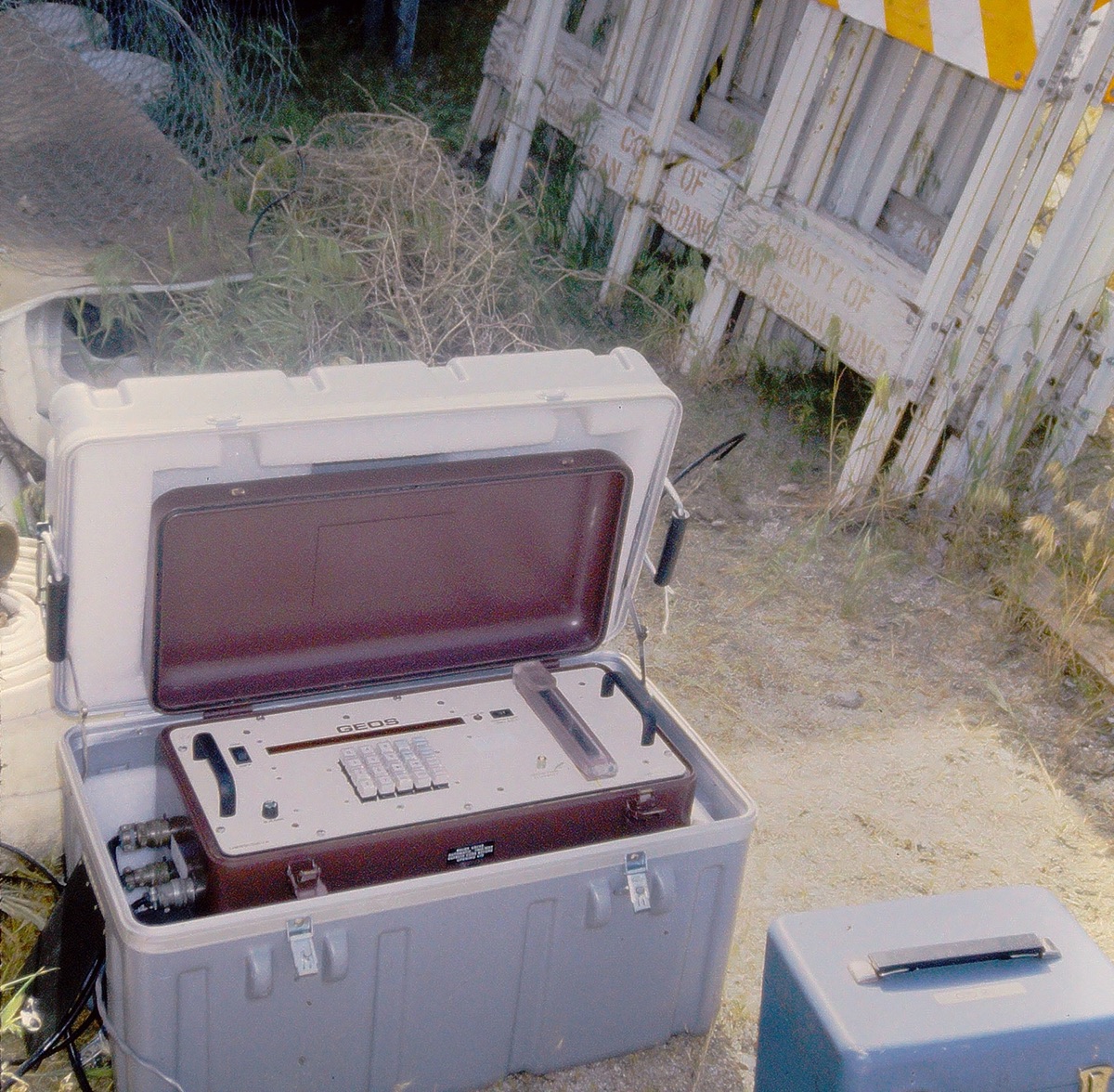
This is a reading guide, not a live alert or a substitute for local authorities' current instructions. Check the responsible agency for the latest local information, and distinguish an estimate, an observation and a forecast when a report uses them. The photograph shows a USGS portable seismometer deployed after California's 1992 Joshua Tree earthquake; it is historical context, not evidence of a current earthquake. For another example of reading fast-moving information, see our breaking-news photo checks. Which term would you want explained first in a breaking-news update?
Sources: USGS glossary · USGS earthquake science.
Photo: Susan E. Hough / USGS · Public domain. Susan E. Hough / USGS, approximately 1992; resized and recompressed.