
The history of voting rights in the United States is not a single moment when everyone gained access to the ballot. It is a succession of campaigns, constitutional amendments, laws and court decisions, each operating in a particular historical setting. Some established protections on paper; others addressed the obstacles that remained when officials refused to respect those protections. Understanding the difference is essential to understanding how American democracy developed.
This list ranks ten turning points by their breadth of legal or political effect, their influence on later changes and their value for understanding the struggle over access to the ballot. It is an editorial judgment through 13 November 2026, not a claim that the importance of one community's rights can be measured against another's. The Voting Rights Act of 1965 leads the list because it supplied federal enforcement tools against racial discrimination in voting. The Nineteenth and Fifteenth Amendments offer strong competing cases for first place because they established enduring constitutional protections.
The order is not a timeline. Seneca Falls appears alongside later legal developments because political organizing can change the questions a country is willing to debate. The 1924 Indian Citizenship Act belongs here because citizenship and the vote were connected, even though the act did not immediately remove every state barrier to Native American voting. The 2013 Shelby County decision is included because it changed how a major enforcement mechanism operated; a turning point can narrow an existing tool as well as extend one.
Legal language matters. The Fifteenth Amendment prohibited denying citizens the vote on account of race, color or previous condition of servitude. The Nineteenth prohibited denial on account of sex. Neither statement meant that all practical obstacles disappeared when the amendment was ratified. Discriminatory registration practices and violence continued to prevent many Black citizens, including women, from voting. Some Native Americans also faced state restrictions after 1924. A legal change and the ability to exercise a right are related but distinct.
The 1965 Voting Rights Act responded to a long record of exclusion. Its nationwide protections and its former coverage formula served different purposes. Under Section 5, covered jurisdictions had to obtain federal approval before certain voting changes; in Shelby County v. Holder, the Supreme Court held the Section 4(b) coverage formula unconstitutional. The Court did not strike down Section 5 itself. Some jurisdictions can still be subject to preclearance through a separate court order, and other protections remain enforceable.
The Twenty-fourth Amendment and the later National Voter Registration Act illustrate another distinction: a rule can address a specific barrier without settling every question about access. The former prohibited poll taxes in federal elections; the latter created certain registration opportunities for federal elections, including applications associated with driver's licenses in covered states. These descriptions are historical explanations, not instructions about a particular person's eligibility or current registration requirements.
The people behind these changes did not share a single experience. Organizers petitioned, marched, litigated and built coalitions; they also disagreed over strategy and priorities. The public record includes both progress and exclusions within reform movements. Recognizing those differences makes the history more accurate than a simple story in which one law solved every problem at once.
The selections below move from number ten to number one. For more context on constitutional provisions, see our guide to US constitutional amendments. A reader who values grassroots organizing most might rank Seneca Falls or Selma higher; someone focused on the constitutional text might put the Fifteenth or Nineteenth Amendment first. Which turning point would you choose, and why?
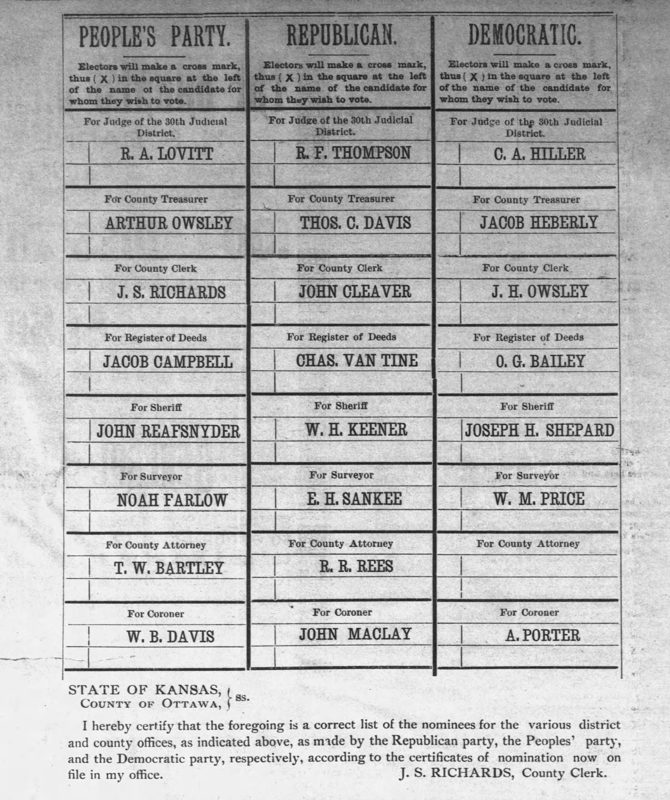
Photo: J.S. Richards (County Clerk of Ottawa County, Kansas) and state of Kansas · Public domain · 1893. Resized and recompressed. An 1893 Ottawa County, Kansas sample ballot; historical context, not a ballot from this event.
