
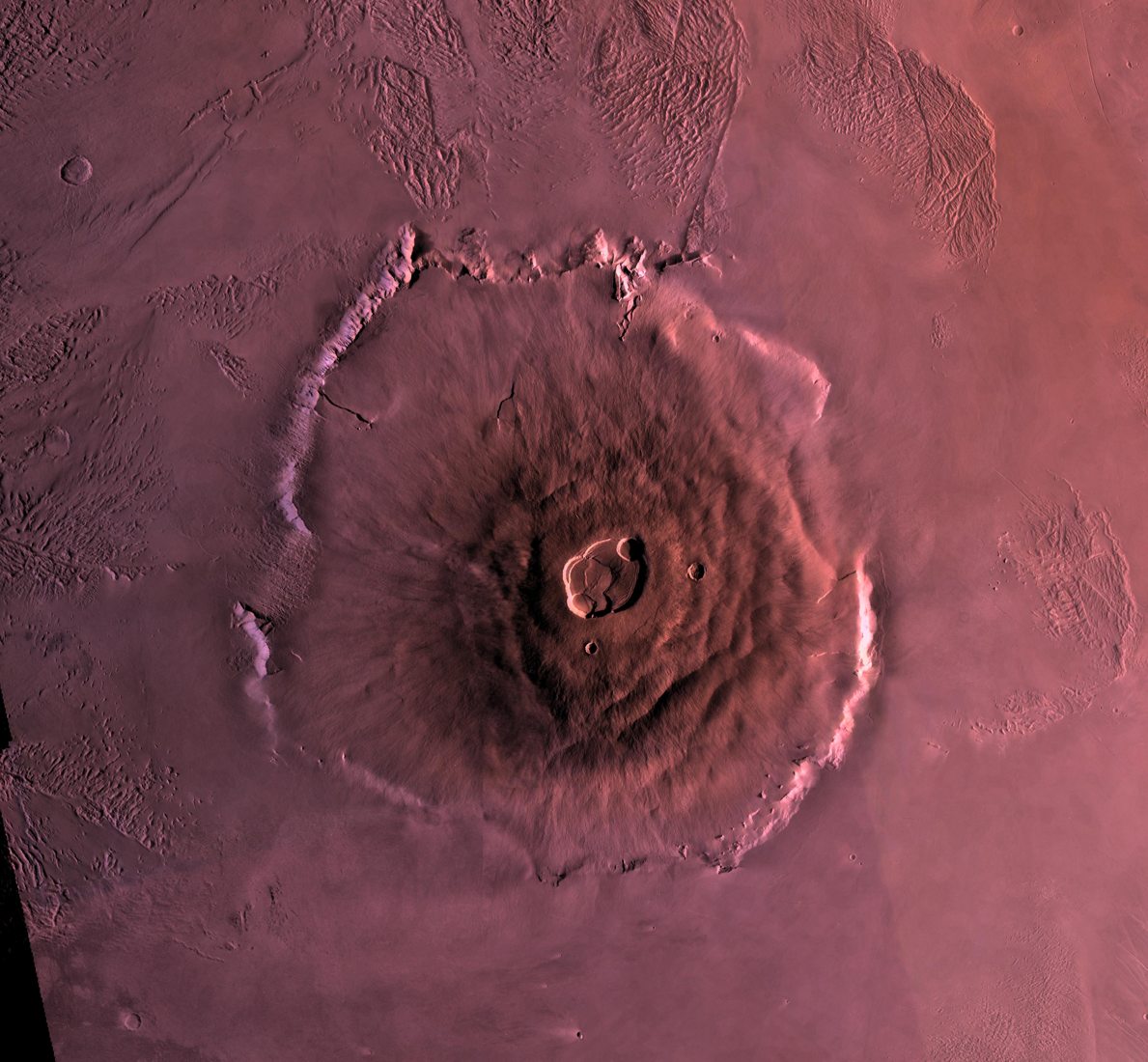
Olympus Mons finishes first because its broad volcanic form gives a beginner an accessible starting point that quickly opens into deeper questions. NASA identifies it as the largest known volcano in the solar system, and the selected Viking mosaic shows more than a summit: an extensive shield, a pronounced outer scarp, neighboring terrain and a complex summit depression. The entry wins on teaching value rather than on a spectacular height figure alone. A large landform becomes useful when the viewer can connect its parts with construction, collapse and later modification. Olympus Mons offers those relationships in a form that remains recognizable even before every detail is understood.
The shield shape directs attention toward repeated volcanic construction rather than the steep cone many people first imagine when hearing the word volcano. A broad form can accumulate through many episodes rather than one sudden event. That does not mean the selected image dates each episode or proves the status of the volcano today. Morphology describes the shape and its relationships; determining the timing of eruptions requires other evidence. This guide therefore avoids calling a dark flow fresh merely because it looks distinct, or declaring an imminent eruption because the volcano is enormous. The historical photograph is a record of terrain, not a live monitoring alert.
Reading the evidence
The summit depression supplies a second process. NASA's image description relates the caldera to collapse following drainage of magma during eruptions from the flanks. This is a different kind of change from building the broad shield. A volcano can grow and also lose support or material in particular locations. Thinking in those separate verbs prevents a misleading picture of a mountain that only gets taller. Trace the summit boundary and then return to the larger outline: the depression is part of the volcanic system, but it does not define the full extent of the edifice. A close-up of the top would answer different questions from the mosaic used here.
The outer scarp and surrounding grooved terrain add further complexity. The source describes an aureole around parts of the volcano and notes uncertainty about its origin, including possible gravitational movement from an earlier edifice. We preserve that uncertainty instead of selecting one tidy explanation as settled fact. A particularly useful reading question is where the volcano ends and the surrounding modified terrain begins. Different boundaries may serve different geological purposes. The edge of a slope, the reach of a flow and the extent of material moved from the flank need not coincide. Learning to specify the boundary makes a size comparison much more meaningful.
Comparisons and the ranking
Height comparisons require similar care. A summit's elevation above a planetary reference surface and its relief above nearby ground are different quantities, and published summaries can use different baselines or rounding. Rather than repeating an impressive number without its reference, this page emphasizes the observable architecture and links the original record. The same caution applies to comparisons with Earth's mountains. A slogan about being taller than Everest can conceal more than it explains if the measurements are not defined consistently. Olympus Mons remains extraordinary without that shortcut. Understanding why a comparison is difficult is itself part of understanding the landform, not an attempt to diminish its scale.
Valles Marineris would be a defensible first choice for a lesson about interacting processes across a region, while Jezero might lead a lesson about sediment and ancient water. Olympus Mons wins this particular ranking because its overall form gives a clear entrance to several connected ideas: accumulation, summit collapse, flank boundaries and the limits of visual interpretation. It also provides a strong ending to the countdown. The smallest wind-carved ridges and the largest volcanic structure both require readers to distinguish material from process, observation from explanation and shape from timing. Which would you use to introduce Mars to a new reader: the volcano's recognizable outline, the canyon's complexity or the delta's record of transport and deposition?
Source: NASA mission image and geological context 1.
Photo: NASA/JPL/USGS · NASA/JPL reuse policy. Olympus Mons Viking mosaic, PIA00300; processed orbital view, component dates unspecified. Source framing and processing retained; resized/recompressed without added crop, colorization or AI. No endorsement.