
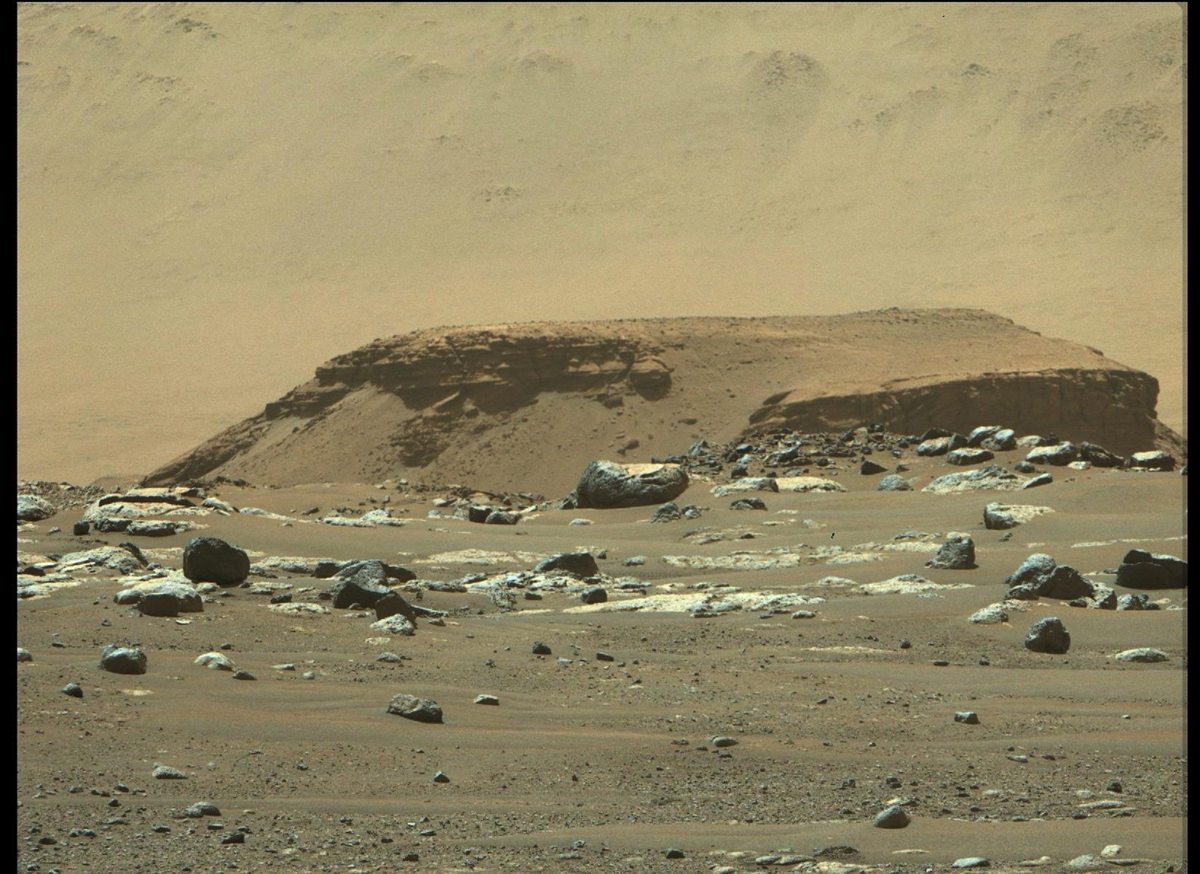
Jezero's delta takes third because it connects a recognizable landform with the physical behavior of sediment carried by water. NASA describes the surviving fan-shaped deposits as the remains of an ancient river entering a lake within Jezero Crater. The basic mechanism is a change in transport conditions: as flowing water loses the ability to carry its load, particles settle and accumulate. That makes the delta a strong teaching example. It is not merely a place given importance because a rover went there. Its geometry and deposits provide a reason to ask how material moved, where it came from and what happened when the flow entered a different environment.
The selected Perseverance image shows a remnant of the deposit from the rover's landing area in February 2021. It is a ground-level view of part of a surviving structure, not an orbital map of the complete original delta. That distinction explains why an isolated raised outcrop can belong to a broader fan-shaped system. Later erosion may leave fragments of a deposit that was once more continuous. A reader should therefore avoid expecting every delta photograph to resemble a textbook plan view from above. Perspective and preservation change the appearance, while the scientific interpretation joins the local observation to the larger crater context.
Reading the evidence
A delta is especially useful for thinking about the relationship between form and process. A fan-like outline suggests a particular arrangement of transported sediment, but not every fan on a planetary surface has an identical origin. Context matters: channels, the enclosing basin, layering and the mission's geological evidence strengthen the interpretation. This is a more careful argument than announcing that an outline by itself proves a lake. The point is not to make every conclusion uncertain. It is to show what makes a conclusion persuasive: multiple relationships fitting one physical explanation, rather than a resemblance selected because it makes an appealing headline.
Layered outcrops can also preserve changes within the depositional system. One should not assume that the entire body accumulated at a constant speed, under one unchanging flow or during a single brief event. Those are separate questions for geological analysis. For an introductory exercise, distinguish the broad interpretation of a river-fed deposit from the finer questions about individual beds and episodes. A general process may be well supported while its detailed timing remains under investigation. This habit is useful beyond Mars: being able to explain the formation of a landform does not mean that every part of its environmental history has already been reconstructed.
Comparisons and the ranking
Jezero's importance to the search for ancient environments is not evidence that life has been found. A deposit that may preserve information about a past lake can be scientifically valuable whether or not that information includes biology. Habitable conditions, preserved chemistry and confirmed organisms are different propositions. This page makes no discovery claim based on a trend, a color or the attractive shape of an outcrop. It asks readers to appreciate why sedimentary deposits can be useful archives and why determining what an archive contains requires careful testing. That is a stronger educational story than treating every interesting Martian rock as a near-confirmation of an answer scientists are still investigating.
The delta could outrank both higher entries for someone interested mainly in ancient water. We place it third because its strongest interpretation depends on combining the rover view with wider evidence, whereas the broad architecture of the volcano and canyon offers an easier initial foothold. Its particular strength is causal clarity: moving material slows, particles settle, deposits accumulate, and later erosion changes what survives. After reading this page, compare the delta with Bagnold Dunes. Both involve transported grains, yet the transporting medium, setting and preserved structures differ. That comparison turns two visually distinct places into a lesson about how a similar ingredient can record very different histories.
Source: NASA mission image and geological context 1.
Photo: NASA/JPL-Caltech/ASU/MSSS · NASA/JPL reuse policy. Jezero delta remnant viewed by Perseverance, 22 February 2021; estimated natural-color rendering. Source framing and processing retained; resized/recompressed without added crop, colorization or AI. No endorsement.