
Cleveland's 119–95 NBA Cup win over Philadelphia on 6 November 2026 brought LeBron James back to Northeast Ohio as a 76er and gave Cavaliers fans a reason to revisit an earlier chapter. From 2015 through 2018, Cleveland reached four straight NBA Finals. Which of those teams had the strongest season? Our choice is the 2015–16 championship team, followed by the 2016–17 finalist and the 2014–15 finalist. This is a ranking of completed seasons in that four-year Finals run, not a ranking of individual players or a prediction about the current team.
The order is editorial. We put the championship result first, then weigh the strength of the route through the Eastern Conference and the character of the Finals opposition. A title carries the greatest weight because winning the last series is the objective each team shares. Among the finalists who lost, however, the judgment is closer: should the team that won more Finals games rank higher, or the team that reached the Finals with fewer playoff defeats? We favour 2017's 12–1 conference run over 2015's 12–2 run, while acknowledging that the 2015 Cavaliers took two games from Golden State and the 2017 team took one. Neither comparison proves that the teams could be placed on a single objective scale.
The 2016 Cavaliers are first because they completed the task. Cleveland overcame a 3–1 deficit against Golden State and won Game 7 by 93–89, claiming the franchise's first NBA title. The result also ended Cleveland's long wait for a major professional sports championship. LeBron James's late block and Kyrie Irving's go-ahead three are enduring moments, but the series depended on many possessions and teammates across seven games. The opponent's 73 regular-season wins make the comeback memorable context; they do not mean every game in the series followed the same pattern.
The 2017 team presents a different argument. James, Irving and Kevin Love returned to the Finals after a remarkably strong Eastern playoff run, losing only once before the championship series. Golden State won the Finals 4–1, with Kevin Durant joining the Warriors since the previous year's matchup. A reader who puts Finals competitiveness above the road to the Finals may reasonably prefer the 2015 team. Our second-place selection gives extra weight to Cleveland's complete route through the East, while the Finals outcome remains an essential part of the record.
In 2015, Cleveland reached the Finals in James's first season back with the franchise. Kevin Love had been injured earlier in the playoffs, and Irving's knee injury in Game 1 ended his postseason. Cleveland led the series 2–1 before Golden State won the next three games to take the title 4–2. The injuries are context for assessing the team that played, not a claim that a healthy roster would necessarily have won. A six-game loss and a strong Eastern run make this team a credible alternative to 2017 at number two.
The omitted 2018 team is also worthy of consideration: Cleveland again reached the Finals, where Golden State swept the series 4–0. Readers who value the difficulty of reaching a fourth consecutive Finals or James's individual performances may rank 2018 above a team we chose. That argument changes the emphasis rather than changing the actual results. This list stops with the four completed Finals seasons from 2014–15 through 2017–18; the 2007 Finals team and later Cleveland teams lie outside that defined window. Past playoff outcomes do not tell us how the present roster will finish.
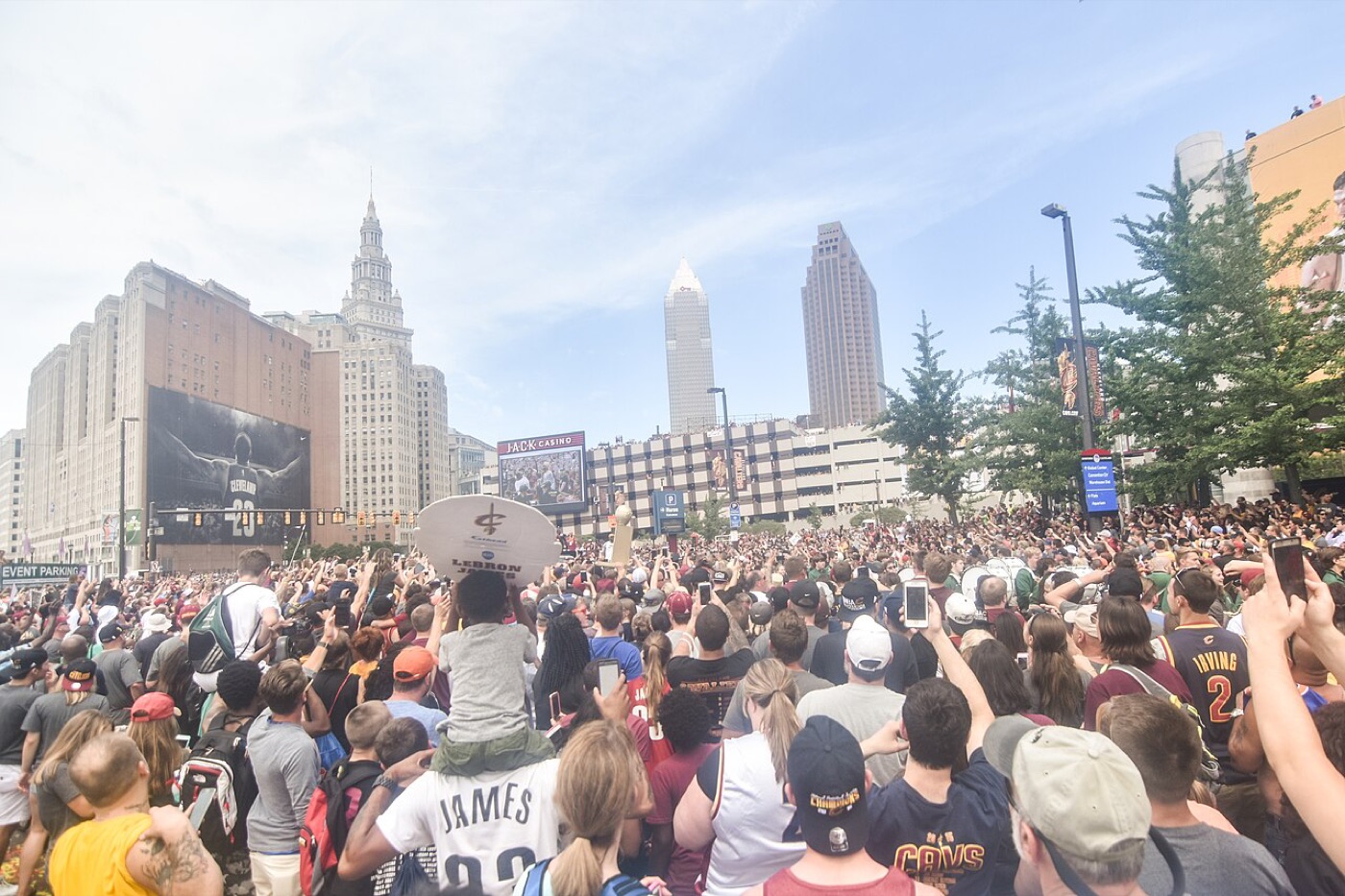
Sources include NBA game records, the Cavaliers' playoff guide and league histories, checked on 7 November 2026. The opening photo shows Cleveland’s championship parade on 22 June 2016. Entry captions identify each later image; an image from one date should not be mistaken for a different game. For another perspective, see our greatest Cavaliers players and greatest Finals Game 7s. Would you place the 2015 team's six-game Finals above the 2017 team's dominant Eastern run, or is there a stronger case for 2018?
Photo: Erik Drost · CC BY 2.0 · 2016-06-22. Image resized and recompressed; no endorsement implied.
