
The Rays beat Boston 3–1 on 19 October 2008 in Game 7 of the American League Championship Series at Tropicana Field. The result sent Tampa Bay to its first World Series. That first is the foundation of our number-one choice: a franchise can win another deciding game, but it cannot repeat the moment when reaching that stage becomes part of its history for the first time. Historical consequence alone is not enough to make a great viewing recommendation, however. This game also supplies a changing score and a late defensive finish that give the breakthrough an immediate sporting shape rather than leaving it as an abstract milestone.
Boston scored first through Dustin Pedroia's first-inning home run. For a viewer who already knows the eventual result, that opening is still useful: it prevents the retrospective from feeling like an uninterrupted march toward celebration. Matt Garza then held Boston to that one run across seven innings. The interesting relationship is between the initial setback and the work that kept the score within reach. A single early event did not determine the game. Watching the innings between the opening run and Tampa Bay's response makes the eventual lead something built and protected, rather than a conclusion that the audience should assume was waiting all along.
Building the lead in stages
Tampa Bay's scoring came in stages. Evan Longoria's fourth-inning double tied the game, Rocco Baldelli's fifth-inning single put the Rays ahead, and Willy Aybar's seventh-inning home run extended the lead. That progression gives the rewatch three different questions: can the team erase the deficit, can it move in front, and can it create room before the finish? Those are not interchangeable achievements. Each changes what the next innings demand. The additional run matters because a two-run lead and a one-run lead allow different routes back for an opponent; neither removes the need to finish the defensive work.
The eighth inning provides the defining late test. David Price entered with the bases loaded and struck out J.D. Drew, then completed the ninth to secure the last four outs. For a newcomer, bases loaded means runners occupy all three bases; the next outcome can therefore affect more than the batter alone. The situation explains why an out can rival a home run as the most important memory of a game. It also shows why a starter's strong performance does not complete the story. Garza's innings created the position, but the final defensive sequence still needed someone to turn a fragile opportunity into a finished result.
A first that cannot happen twice
The final play, handled by second baseman Akinori Iwamura, gives the achievement a visible endpoint. A historical first is easy to describe in a sentence; a completed play shows exactly when possibility became reality. We do not need to claim that every fan experienced it identically or that the result settled any argument about future seasons. Its permanence is narrower and more defensible: this was the club's first pennant. Later success can deepen a history without replacing its beginning. That distinction is why the selection stays first even for viewers who find Brosseau's late home run the more electrifying individual highlight.
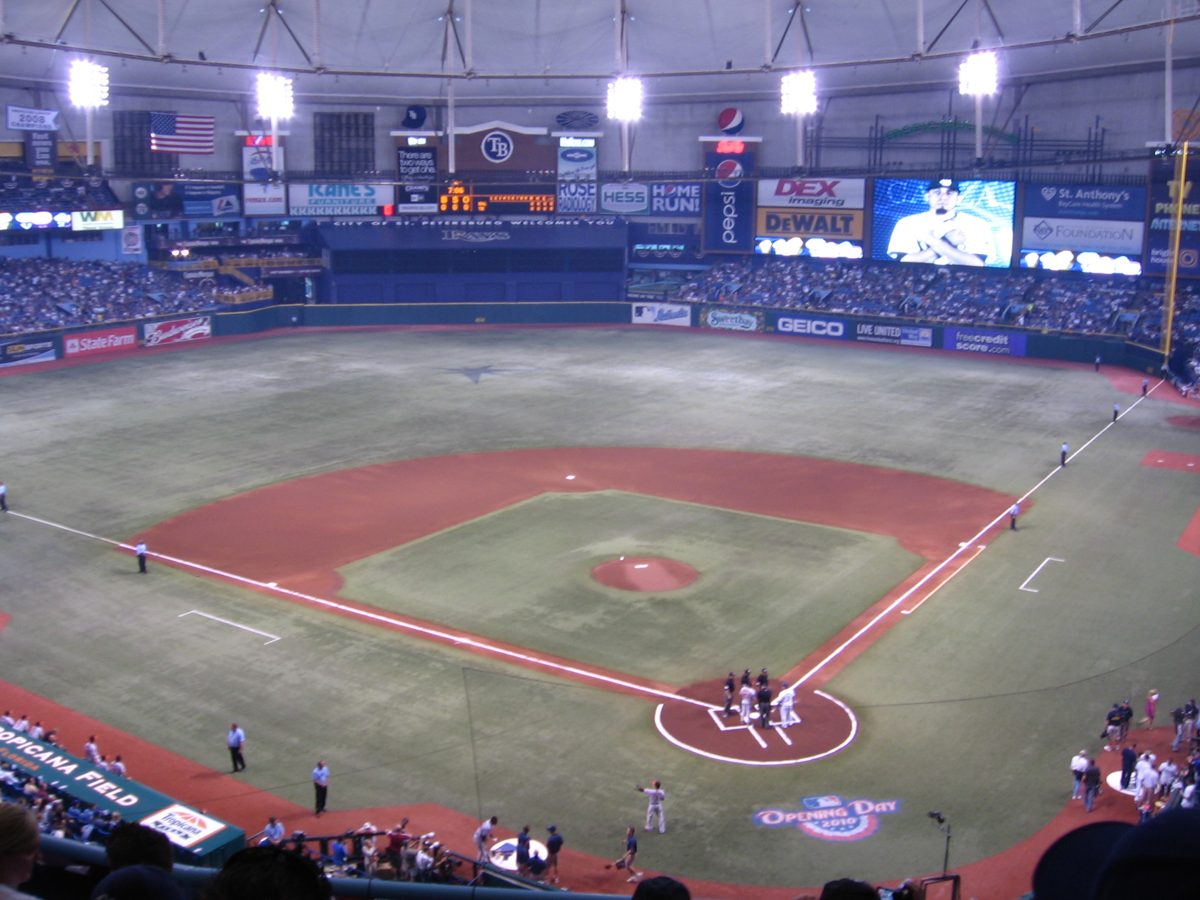
A reader who prefers a more concentrated duel can reasonably choose the 2020 ALDS game instead. Someone who values overcoming a vanishing series lead may favor the 2020 ALCS finale. Our winner balances both kinds of immediate drama with the biggest historical threshold among these three selections. Rewatch the whole route: early deficit, gradual scoring, late loaded bases, final outs. The accompanying Tropicana photograph was taken on opening day in 2010 and is not a photograph of this 2008 finish. With that distinction clear, which moment deserves the final image of the ranking: the decisive swing, the pennant saved from a comeback, or the first celebration that made all later comparisons possible?
Photo: EaglesFanInTampa · CC BY-SA 3.0. Tropicana Field on opening day, 6 April 2010; archival venue context, not the ranked 2008 game. Resized and recompressed; no new crop; adapted image remains CC BY-SA 3.0.
