
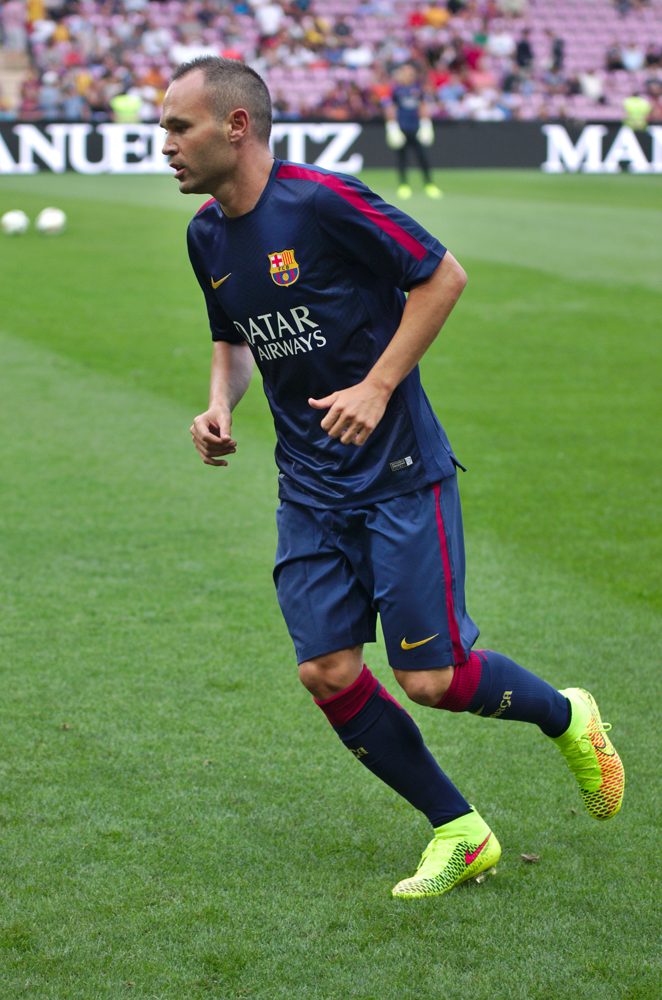
Andrés Iniesta is second because he offers the most persuasive challenge to our preference for control. Some midfielders make a team secure; others make a difficult situation suddenly different. Iniesta's case rests on the latter ability without reducing him to an occasional dribbler. A change of direction, a controlled first touch or a short carry can alter which defender must respond and which teammate becomes free. Those actions matter when tidy circulation has stopped producing progress. Under a ranking that values escaping a blocked attack above organising the next sequence, he could comfortably finish first rather than second.
For the club record, Barcelona's 2023 retrospective credits him with 674 appearances, 57 goals and 32 trophies in its account of his first-team career. We follow that retrospective's stated scope rather than mixing totals from other databases with different inclusions. The numbers support a long and substantial contribution, but the argument here does not depend on treating goals as the main currency of midfield. A player can improve an attack without making its final pass or taking its final shot. Iniesta's importance is therefore better explored through the situations he changed than through a simple comparison of scoring columns.
A decisive example, a wider contribution
The clearest famous example is his stoppage-time equaliser at Chelsea on 6 May 2009. Barcelona's official account places the goal in the 93rd minute and identifies it as the strike that took the club into the Champions League final. It was an equaliser in that match, not a winning goal in the final itself. Keeping those distinctions straight makes the achievement more credible rather than less dramatic. The event demonstrates that his career included a decisive scoring intervention, but our ranking does not turn one celebrated strike into evidence for every claim about his technique or tactical contribution.
For the broader viewing exercise, watch how a receiver deals with an opponent approaching from one side. A pass can move the ball away; a carry can instead draw that opponent into a different relationship with the next defender. Iniesta is an especially useful player for thinking about that distinction. Ask whether the movement merely looks elegant or actually changes an available route. Also look at the next action: escaping one challenge is more valuable when the ball remains usable for the team. These are questions to take to footage, not a claim that every dribble succeeded or that opponents could never contain him.
Why second can still challenge first
His strongest claim to first is that control is not the same as penetration. A team can retain possession yet struggle to move an organised defence, and the ability to introduce a new angle can be more valuable than another safe connection. That argument gives Iniesta a route past Xavi without denying Xavi's command. Our reason for placing him second is the greater weight we give to sustained orchestration across the whole pattern of play. The ranking prefers the player who most clearly shaped the ongoing sequence over the one who could most memorably change its direction. That is a choice of criterion, not an objective separation of talent.
Watch Iniesta alongside, rather than detached from, the other two names. The base supplied by Busquets and the circulation associated with Xavi could create the receiving situation from which Iniesta worked; his movement could then make their next pass more valuable. Giving him second should not obscure that reciprocal benefit. It should make the debate sharper: how much should a midfielder be rewarded for preserving a team's rhythm, and how much for escaping it at the right moment? Iniesta is the strongest reason this list cannot be settled by appearances, medals or affection alone. His case asks what kind of difficulty you consider most important to solve.
Source: FC Barcelona · FC Barcelona.
Photo: Barça - Napoli - 20140806 - Andres Iniesta.jpg · Clément Bucco-Lechat · CC BY-SA 3.0. Archive photograph, not the cited match; resized and recompressed without cropping. Original image license retained.
