
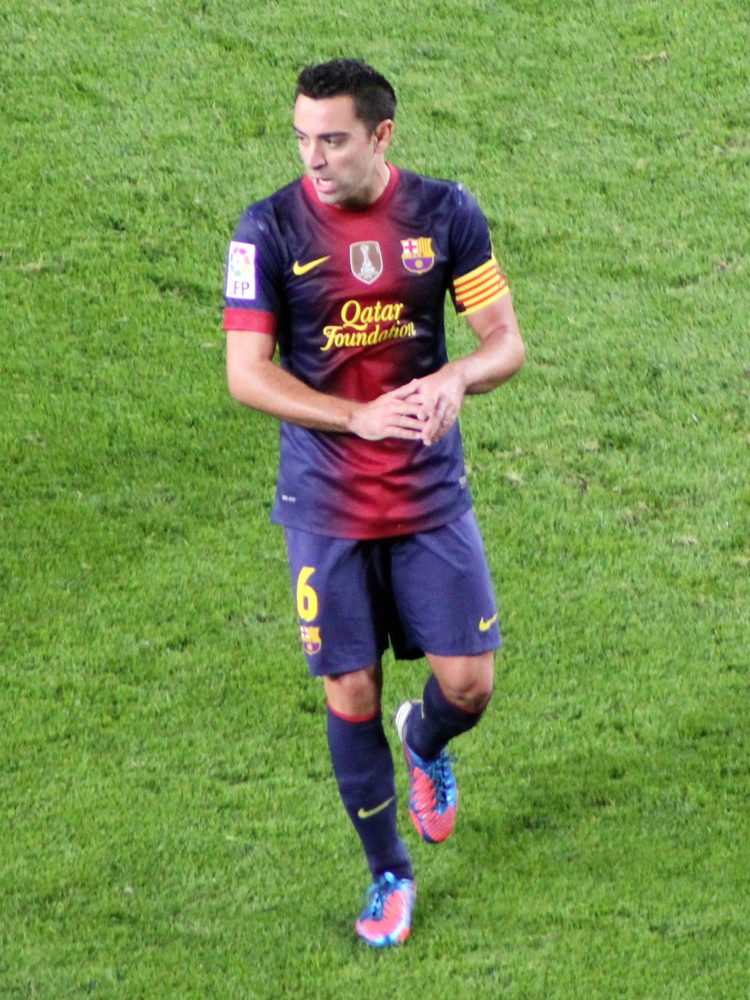
Xavi Hernández finishes first because this ranking gives the highest weight to the organisation of a team's repeated decisions. The case is not that he always attempted the most spectacular pass or that possession was automatically useful because he had the ball. It is that his Barcelona playing career provides a compelling model of midfield as direction: making the next connection available, deciding when a move should continue and recognising when the point of attack needs to change. Our winner represents control with purpose, rather than a demand that every situation be solved by keeping the ball for its own sake.
Barcelona's official legend profile records 767 appearances and identifies the 2015 league, Copa del Rey and Champions League treble as his final season's conclusion at the club. Those facts establish the scale and endpoint of his playing contribution. They do not mean he had the same role in every season or started every decisive match. This is a playing-career ranking, so later coaching judgments are deliberately outside it. Keeping that boundary prevents a reader's opinion of a manager from quietly rewriting the evidence used to compare a midfielder with former teammates whose careers followed different routes.
A shared reference at Wembley
The 2011 Champions League final gives a shared reference point for all three entries. UEFA records Barcelona's 3–1 victory over Manchester United and describes Xavi's pass for Pedro's opening goal. That is a specific example of circulation producing a decisive forward connection, rather than an invitation to praise possession in the abstract. A match contains many contributing actions, including work by players outside this shortlist, so the final should be used as a window into a team rather than a personal trophy belonging to Xavi. Its value here is that the individual decision can be located inside an observable collective performance.
A useful way to watch him is to begin one pass earlier than the obvious action. Before he receives, which opponents are looking at the ball, and which teammate could benefit if it changes side? After the pass, does he remain available or move to support a different route? These questions make a short exchange more informative than counting touches. A backward pass may reset an attack productively, while a forward pass may hand a teammate an impossible situation. Direction on the pitch is not automatically the same as progress in the game. The quality of the next receiving situation is part of the judgment.
The argument against our winner
The objection is substantial. Iniesta could transform a moment when a passing rhythm was no longer enough, while Busquets provided the underlying connection that helped any rhythm exist. A ranking built around either of those priorities could reverse our order without becoming irrational. There is also a danger of crediting one organiser for a collective system: coaching, positioning, teammates and opponents shaped the conditions in which Xavi operated. We therefore call him the strongest answer to our stated question, not the sole author of Barcelona's football. First place acknowledges a leading influence while leaving the collaborative nature of that influence intact.
Xavi ultimately wins because our method values the ability to give an entire pattern of possession a coherent next step. Iniesta is the closer rival for invention under pressure; Busquets is the strongest alternative if balance and connection receive the greatest weight. None needs to be diminished to explain the winner. Revisit a full stretch of the team's play, decide which problem you think is hardest, and then order the three accordingly. Would you build the midfield around Xavi's orchestration, Iniesta's ability to open a gap or Busquets' platform? The facts anchor the comparison, but the answer to that final choice remains a legitimate football argument.
Source: FC Barcelona · UEFA.
Photo: 2012 2013 - 06 Xavi Hernández.jpg · Javier Segura (Castroquini) · CC BY-SA 3.0. Archive photograph, not the cited match; resized and recompressed without cropping. Original image license retained.
