
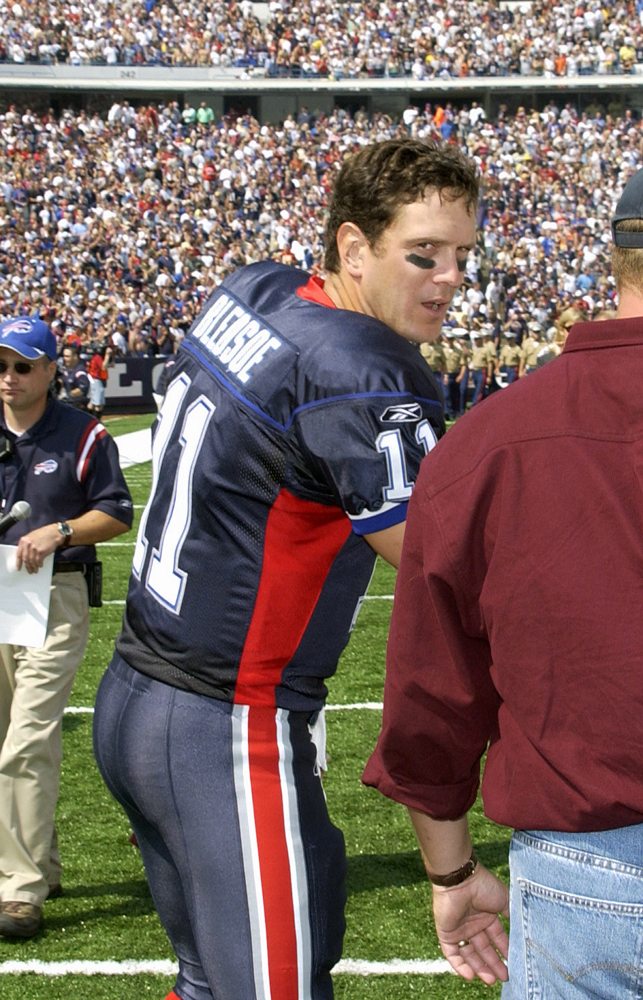
Drew Bledsoe ranks second because the strongest part of his Patriots case combines a demanding passing role with a recognizable change in competitive expectations. He arrived as the first overall selection in the 1993 draft and remained with New England through 2001. The Patriots Hall of Fame records his 2011 induction and identifies him as a central figure in the franchise’s development during that period. Our ranking does not treat a high draft position as an accomplishment equivalent to playing well. It matters as context for the responsibility he inherited. The argument for second place depends on what followed, not on the promise represented by a draft-day announcement.
His New England passing totals provide one concrete anchor: 29,657 yards, alongside 2,544 completions on 4,518 attempts in the Hall’s account. These were franchise career records when his Patriots career was evaluated, rather than records that should be declared untouched forever. The volume demonstrates how much of the offense passed through his hands. It does not establish that every attempt was efficient, or that an offense asking for more passes necessarily makes its quarterback better than one with a different assignment. A fair interpretation recognizes both the burden and the limits of using accumulated production as a shortcut for quality.
The evidence and its limits
The 1994 season offers a sharper way into his case. The Hall highlights the Minnesota game in which he attempted seventy passes and completed forty-five, connecting it with a late-season run to the playoffs. The unusual workload is historically significant without needing a present-day claim that nobody has ever matched or surpassed it. When a quarterback must keep an offense functioning across repeated passing situations, the task includes decisions and routine completions as well as striking highlights. For a viewer, that makes a long sequence of ordinary plays potentially more revealing than one deep throw selected to summarize the entire afternoon.
Bledsoe also led the Patriots to the AFC championship for the 1996 season and an appearance in Super Bowl XXXI. The distinction between reaching that game and winning it must stay clear. The team did not win that Super Bowl, and a ranking should not quietly convert participation into a title. Nevertheless, returning a franchise to that stage is a substantial part of a quarterback’s historical résumé. It gives the passing volume a competitive setting: the discussion is not only about totals accumulated in isolation. Defense, coaching and teammates remain part of the explanation, just as they do for Brady and Grogan.
The strongest competing case
Grogan’s best challenge is that nine seasons cannot simply erase sixteen years of service and a distinctive running contribution. We accept that challenge and still put Bledsoe second because this list emphasizes the strongest sustained stretch of responsibility and contention over the longest association alone. That choice is an editorial weighting, not a proof that one man’s style was universally superior. Bledsoe should also be judged on his own New England work, rather than treated merely as the player whose starting position preceded Brady’s. A successor’s extraordinary career can change a predecessor’s place in the record book without making the earlier contribution disappear.
To examine this argument yourself, compare the questions you ask of Bledsoe with those you ask of Grogan. If you praise a running option, consider what it adds to a possession; if you praise repeated passing, consider whether it sustains the offense rather than merely enlarging the box score. Do not award either player an imaginary supporting cast and then call the result evidence. Bledsoe’s second place rests on a real combination of responsibility, production and postseason reach. That leaves space for disagreement about priorities while explaining why this countdown values his concentrated Patriots case above Grogan’s longer one, and below Brady’s much broader record of sustained achievement.
Source: Patriots Hall of Fame historical record 1.
Photo: SMSGT Ray Lloyd, USAF; existing crop by WuTang94 · Public domain. Drew Bledsoe on 7 September 2003 while with Buffalo; context portrait, not a Patriots game. Existing source crop retained; resized/recompressed, no further crop or AI enhancement. No endorsement.

