
Which Detroit Pistons championship deserves first place: the breakthrough, the repeat, or the team-first statement? This countdown compares the titles of 1989, 1990 and 2004 as three different basketball stories. It puts the most memorable expression of a team’s identity first, then considers historical importance and the strength of the alternative case. That makes it an editorial ranking of championship meaning, rather than a formula for deciding which roster would win a hypothetical series. The reference date is 26 October 2026; the years identify completed championship seasons, so today’s fixtures do not change the comparison.
A good starting point is to separate the result from the interpretation. A championship and a Finals MVP award are documented achievements. Calling one title the greatest requires a choice about what matters. You might value becoming a champion for the first time, returning to defend the trophy, or presenting the clearest example of a particular basketball philosophy. Those priorities can produce different winners without changing any historical result. Our short list keeps that disagreement visible: third place means third under this stated approach, rather than a judgment that winning a second consecutive title was somehow unimportant.
The first criterion is how clearly a championship offers a distinct team story that a new viewer can understand. Can you explain its appeal without treating the trophy as the achievement of one player alone? The second is the milestone it represents within the selected history. The third is how persuasive its strongest rival claim remains. These are qualitative criteria, with no invented point totals or statistical weights. They favor a memorable collective identity over a comparison of regular-season records. If your own question is which team was strongest on paper, you should choose different evidence before choosing a different order.
The Finals MVPs provide useful signposts: Joe Dumars for 1989, Isiah Thomas for 1990, and Chauncey Billups for 2004. The Basketball Hall of Fame’s player biographies help anchor those identities. They should not become a shortcut that erases teammates, or a claim that an individual award measures every contribution to a title. When revisiting a championship, ask what the award identifies, what the team accomplished together, and which part of the story attracts you personally. Keeping those questions separate makes the discussion more useful than simply counting famous names on either side.
Our choice of 2004 at number one reflects the appeal of a championship told through shared roles and defensive purpose. That is a reading of its significance, not proof that other champions lacked teamwork. The best challenge comes from 1989: a first title can reasonably be treated as the defining achievement because it establishes the very tradition later teams inherit. Meanwhile, 1990 has the strongest conceptual argument for placing repeat success above a single breakthrough. A reader who puts confirmation before novelty could move it directly to first. Each alternative has a coherent principle, rather than needing an invented flaw in the winner.
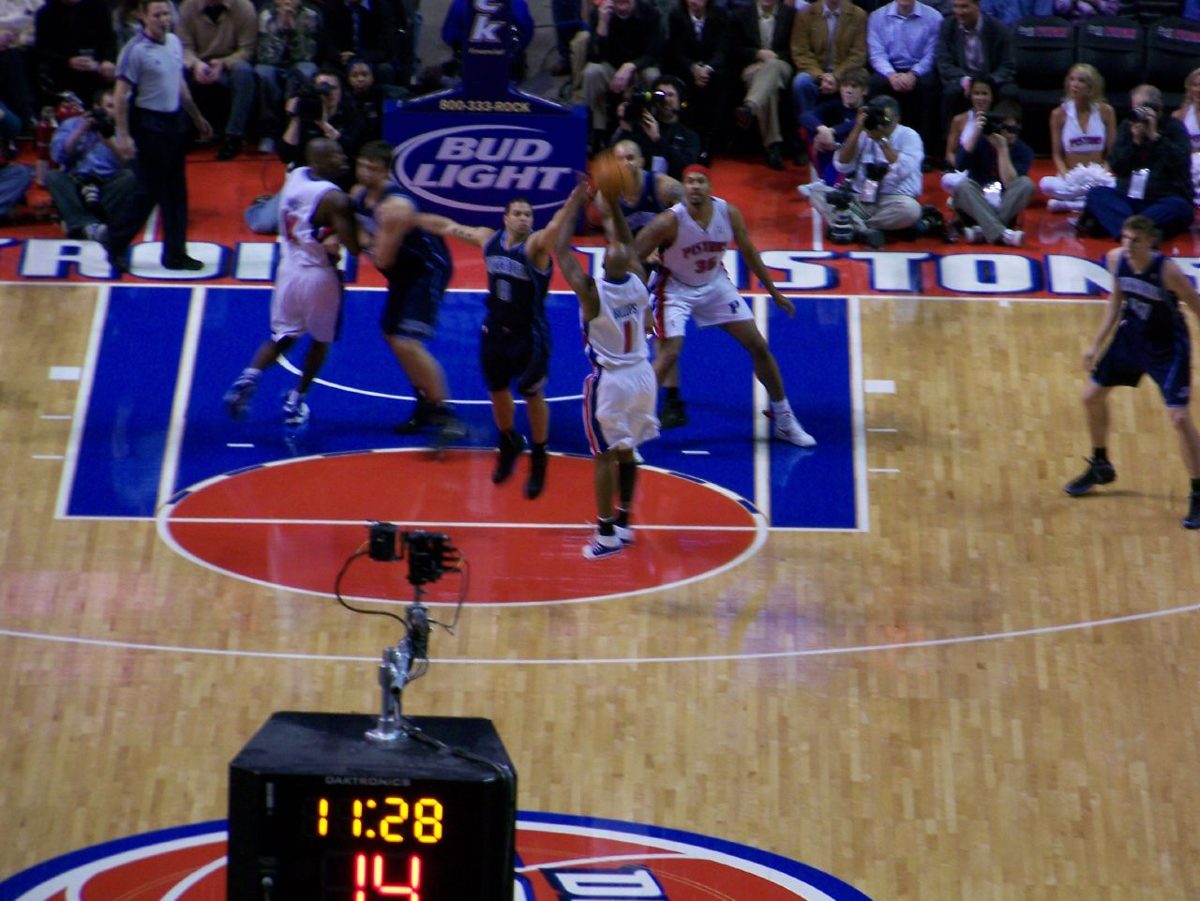
Read the three entries as a compact guide to choosing what to revisit, with the year, opponent, series result and award holder clearly distinguished from our judgment. The photographs are contextual images from other dates, not pictures of the listed Finals. For a broader argument about individuals, see our greatest NBA players ranking; for help distinguishing the numbers in a game report, use the NBA box-score guide. Neither replaces this team-focused comparison. After the countdown, choose your own deciding criterion: does Detroit’s greatest championship mean its first breakthrough, its successful repeat, or its strongest statement of collective identity?
Sources: Basketball Hall of Fame biographies — Isiah Thomas · Joe Dumars · Chauncey Billups.
Image: Chauncey Billups shooting 2006.jpg — Kevin Ward · CC BY-SA 2.0. Resized and recompressed as JPEG without further cropping or upscaling. Original license/status retained. No endorsement implied. This adapted image is shared under CC BY-SA 2.0.
