
A basketball box score can look like a spreadsheet written in another language. PTS, FGM, FGA, REB and TOV describe different pieces of the same game, but reading just the biggest number invites mistakes. A reserve can produce an exciting scoring burst in a short appearance; a starting guard can organise an effective attack without leading the scoring. This guide ranks ten familiar NBA statistical categories by their usefulness to a beginner trying to understand a completed game. It is a reading guide, not a formula for choosing the best player.
The countdown moves from specialised defensive events toward the scoring and playing-time information that anchors an initial reading. Points take first place because they connect most directly to the result; minutes come second because opportunity changes the meaning of almost every other total. Someone interested primarily in defence could reasonably reverse much of this order. Fouls and plus-minus also deserve attention, but limiting the guide to ten categories leaves room to explain makes alongside attempts rather than treating every abbreviation as an isolated number. The ranking is editorial judgment, with definitions checked on 25 October 2026.
Start by checking the table's scope. One game's totals, season totals and per-game averages answer different questions. A column showing twenty points in a single game cannot be compared directly with a column showing twenty points per game across a season without explaining that difference. Regular-season and playoff filters matter too. Keep the competition, date range and unit visible before sorting. Provider layouts vary: one table may show a combined shooting fraction, another separate makes and attempts, and another percentages. The underlying arithmetic is more useful than memorising where a website places each column.
All numerical examples in these pages are invented teaching examples, not reports about an actual player, matchup or season. For instance, eight field goals including two threes, plus four made free throws, produce twenty-two points. The two threes already belong inside those eight field goals. Adding their full six points again to sixteen points from eight baskets would double-count part of the scoring. Learning to reconcile these columns is a practical way to catch misunderstandings before turning a stat line into a claim about performance. A box score should make the game clearer, not merely supply impressive-looking totals.
The NBA's official glossary provides the league's notation, while its rulebook establishes scoring values and game duration. The FIBA statisticians' manual is a useful separate reference for understanding why recording assists, rebounds and defensive events involves judgment. It is not a substitute for NBA-specific interpretations. These pages explain common concepts without claiming that every borderline play is recorded identically across competitions. Photographs illustrate basketball settings or actions; they are not evidence for the hypothetical numbers. Search interest informed the choice of this beginner topic, but no search-volume estimate or popularity score determines the order.
Use the guide alongside our essential NBA rules article when a whistle or clock decision is unfamiliar, and our greatest NBA players ranking when you want to see how statistical production fits a broader argument about careers. Neither replaces watching possessions. After reading a line, ask what happened, how much opportunity the player had, and what the table leaves out. A screen, defensive rotation or useful extra pass may matter without receiving a conspicuous entry. Which column do you look at first after a game, and which one has most often changed your first impression?
Sources: Jr. NBA: reading a box score · NBA statistical glossary · NBA scoring and timing rules · FIBA statisticians’ manual 2024, separate competition reference.
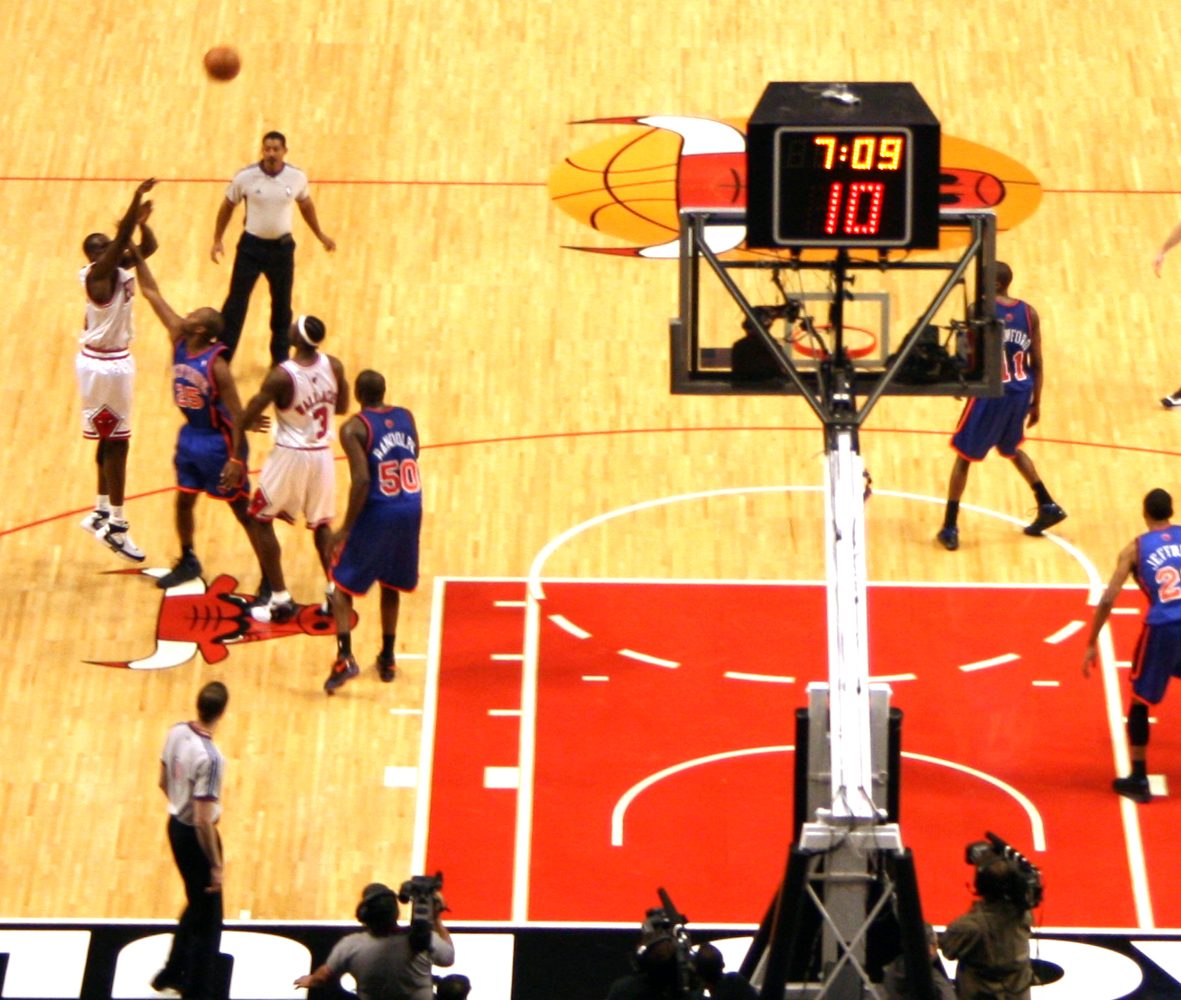
Photo: Gavin J. Dow (Gavindow); source crop/color correction by HITNOM and Adeletron 3030 · CC BY 3.0. NBA court and shot clock, 14 December 2007; context photograph, not evidence of a specific statistical event. Existing optimized local JPEG reused unchanged. Earlier resizing/recompression retained, with source crop/color adjustments where applicable. The stated license applies to this image; no endorsement or evidence of the invented examples is implied.
