
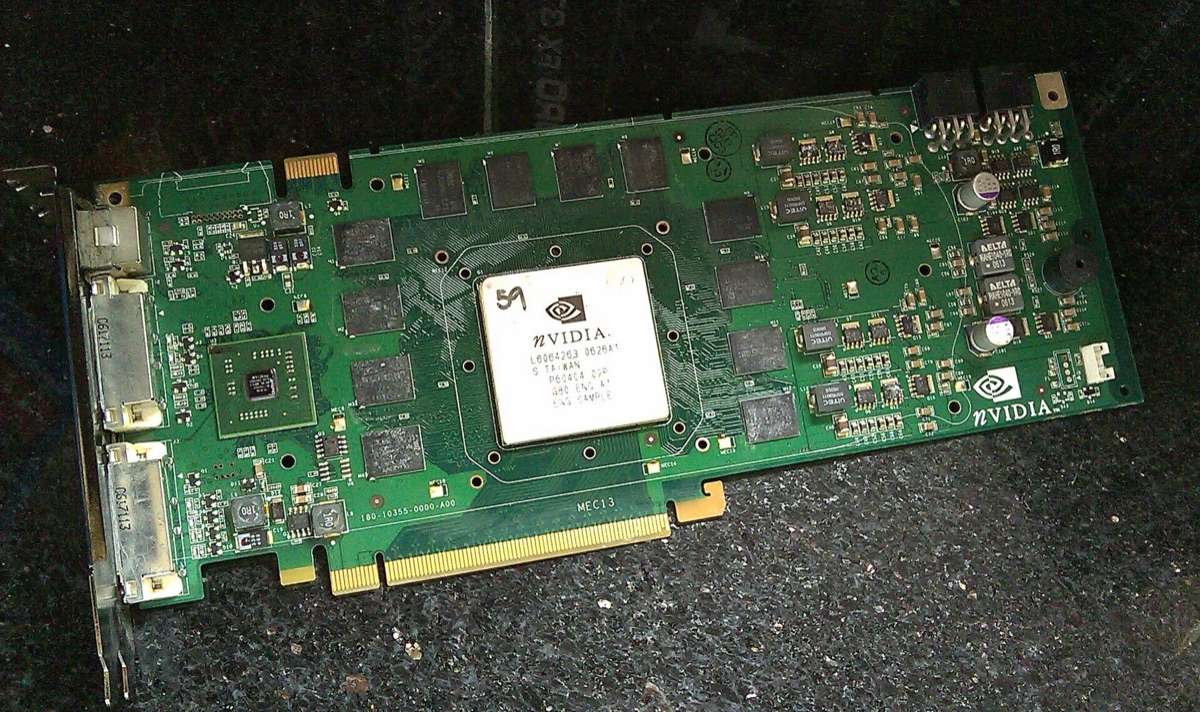
Why does a graphics-chip company attract attention far beyond PC gaming? One answer is that the graphics processing unit, or GPU, has become useful for many kinds of parallel computation. NVIDIA's history contains several distinct steps in that development, from a consumer graphics card at the end of the 1990s to programmable GPUs and data-centre accelerators. Understanding the differences makes it easier to read technology headlines without treating every GPU as the same product.
This ranking compares three NVIDIA milestones: GeForce 256, the GeForce 8800 GTX and H100. Google Trends showed unusually strong US search interest in “nvidia” on November 23, 2026. That interest provides a reason to revisit the company's technology; it does not establish why any individual searched or prove a claim about its share price. This article is about computing history, not an investment recommendation, a buying guide or a forecast of future performance.
Our editorial criteria are the importance of each milestone to GPU capabilities, the breadth of work it helped make possible and its explanatory value for understanding the next stage. We rank the 8800 GTX first because its G80 architecture brought together a unified design and the foundations of NVIDIA's CUDA programming model. H100 comes second for its place in the data-centre era and its Transformer Engine. GeForce 256 is third for its role in establishing a recognizable consumer GPU category. These are judgments, not benchmark results or a comprehensive ranking of every NVIDIA product.
The GeForce 256 was introduced in 1999. NVIDIA marketed it as a graphics processing unit with dedicated graphics functions, including hardware transformation and lighting. Graphics accelerators existed before it, and crediting one product with inventing all computer graphics would be misleading. Its importance in our selection is the way it illustrates a transition toward more capable dedicated graphics hardware for consumer PCs. Its fixed-function design was different from the more programmable systems that followed.
The GeForce 8800 GTX arrived in 2006 with the G80 architecture. NVIDIA's technical brief describes a unified design in which processing resources could be allocated to different graphics tasks. Its later architecture history identifies G80 as an important starting point for GPU computing with a C-based development environment. CUDA is a software and programming ecosystem, not a claim that every application automatically runs faster on any GPU. The 8800's place here reflects that combination of graphics flexibility and general-purpose programming, rather than a guarantee about performance today.
NVIDIA announced its Hopper architecture and H100 accelerator in 2022. Unlike the consumer GeForce products in this list, H100 was designed for data centres and workloads including artificial intelligence and high-performance computing. Its Transformer Engine is designed to accelerate transformer-based models by managing numerical formats. Results depend on models, software and system configuration, so we do not repeat marketing speed multipliers as universal facts. H100's importance is easier to grasp when the hardware, the software and the surrounding server are considered together.
Other choices are defensible. Someone who gives priority to gaming might rank GeForce 256 first, while a reader focused on recent AI infrastructure might prefer H100. Other NVIDIA generations and competing companies also contributed substantially; three examples cannot tell the whole history of graphics or computing. For wider context, see our ranking of influential personal computers. Sources were checked on November 23, 2026. The credited photographs show specific hardware examples, not tests performed by Topnilo. Which milestone would you put first?
Sources: NVIDIA.
Photo: Hyins · Public domain; resized and recompressed. A GeForce 8800 GTX board photographed in 2011.
