
A programming language can change more than the way a developer writes a line of code. It can make computers accessible to students, give researchers a way to express new ideas, or become a shared interface between applications and data. This list compares ten influential languages by their historical contribution, breadth of application, ideas adopted by later systems and educational value. It is an editorial ranking, not a current popularity chart, job-market forecast or claim that one language is best for every project.
C takes first place for its role in systems programming and its connection to the development of Unix. JavaScript follows because it became a language of interactive web pages and later found uses outside the browser. Python ranks third for a readable style and a broad range of applications. SQL takes fourth: although it is a domain-specific language for working with relational data rather than a general-purpose language in the same sense as the others, excluding it would overlook an important way people communicate with databases.
Reasonable readers will disagree. Someone who values the web above operating systems may put JavaScript first. A teacher could put BASIC ahead of several later languages because it helped open computing to beginners. A researcher interested in symbolic computation might prefer Lisp; an advocate of object-oriented ideas could favor Smalltalk. Our comparison weighs several kinds of influence rather than pretending there is one common numerical score. Being ranked lower does not mean a language was less innovative in its original setting.
The selection spans different eras. Fortran emerged in the 1950s for scientific computation. Lisp explored symbolic computation and recursion; BASIC made interactive programming more approachable. Smalltalk helped develop an object-oriented way of organizing software. C and C++ were shaped by systems programming, while Java pursued portability across different environments. Python and JavaScript reached developers through different communities and problems. SQL brings a separate question: how to describe the data a user wants without spelling out every retrieval step.
A language is not the same thing as an implementation, a library, a framework or an operating system. A standard may have several implementations, and a language can change considerably over time. Java and JavaScript have different origins despite their similar names. SQL has dialects, while Lisp refers to a family of related languages. These distinctions matter when reading history and when following a tutorial: the version and environment determine which instructions are relevant.
Dates and historical descriptions were checked on 15 November 2026 against the Computer History Museum, Dartmouth, the Python documentation, Mozilla, IBM, Oracle and accounts by language creators. We do not use a current popularity score as a substitute for historical influence. Some sources describe early versions rather than every feature available today. The people named in this guide worked with colleagues and communities; no major language's history can be reduced to a single individual or release date.
This guide is for understanding ideas, not selecting a universally superior first language. The right learning path depends on the kind of work, the resources available and personal curiosity. Modern versions, tools and documentation change, and rankings cannot guarantee a job or a particular result. For more context, explore our personal computer history and free coding websites. Which language would you put first for its historical influence, and what would you count as evidence?
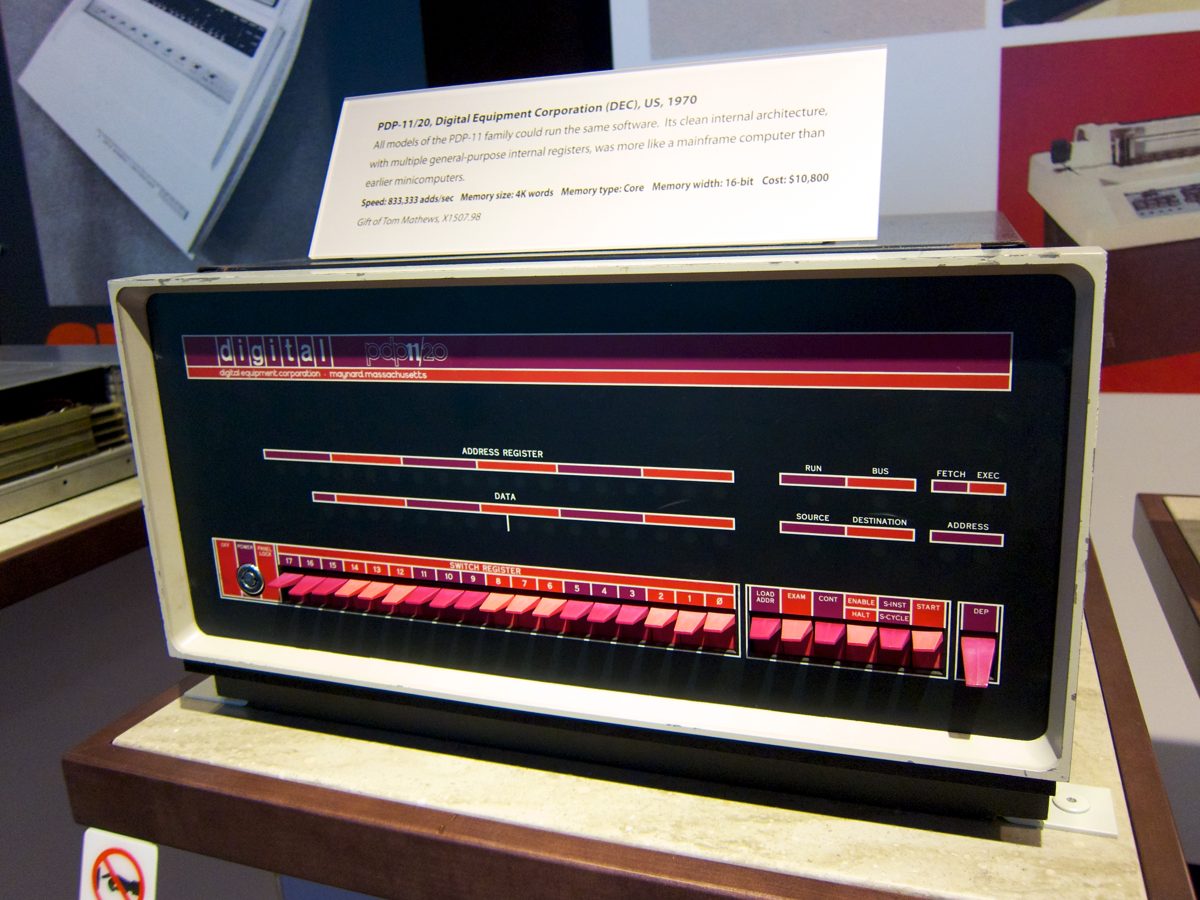
Photo: Don DeBold; resized and recompressed. Wikimedia Commons · CC BY 2.0. A PDP-11/20 at the Computer History Museum, photographed in 2011; contextual hardware image, not evidence of a particular software installation.
