
Ancient Roman architecture survives in places as different as a busy Italian capital, a French river valley and a Croatian city centre. The most memorable structures do more than look old: they show how people moved water, gathered for performance, worshipped, defended a city or expressed imperial power. This ranking selects ten surviving Roman structures and complexes for the architectural ideas they make understandable today. It is an editorial comparison, not a measurement of beauty or a definitive list of the empire's greatest achievements. The #1 choice combines scale, legibility and influence, but a reader interested in water engineering may reasonably prefer our highest-ranked aqueduct.
Our scope is deliberately broad enough to compare buildings with structures such as aqueduct bridges. It is also narrow enough to give each place a clear identity: we focus on a named structure or a single related complex, rather than ranking entire cities against individual buildings. The selections range from the early imperial period to late antiquity and extend beyond Rome itself. Their present-day countries did not exist in the same form when the monuments were built; geographic labels are provided to help readers locate them, not to suggest that modern borders explain the ancient world. Research was checked against UNESCO World Heritage descriptions and the institutions responsible for the monuments in November 2026.
The order weighs architectural ingenuity, historical significance, how clearly a visitor or reader can understand the original function, and the surviving fabric. It does not pretend these qualities can be added into an objective score. A great structure that survives only in fragments may be historically essential yet offer a less complete picture of its construction. A well-preserved monument can also owe its appearance to centuries of repair and adaptation. We do not treat a restoration as a defect, but distinguish surviving ancient material from later work where the sources allow. The relative order is a judgment call: those who value an intact temple, an engineering network or a lived-in palace most highly could produce a persuasive different ranking.
An aqueduct illustrates why a single postcard image rarely tells the whole story. Its prominent arches form only one part of a water system; channels, gradients and the route across the landscape mattered too. At Pont du Gard, the surviving bridge carried the channel across a river valley as part of a longer system serving ancient Nemausus, now Nîmes. Segovia's towering arches also bring an infrastructure project into the centre of a modern city. Neither should be mistaken for a bridge built mainly for pedestrian traffic. Comparing them helps explain the practical problem behind the monument rather than just the visual effect.
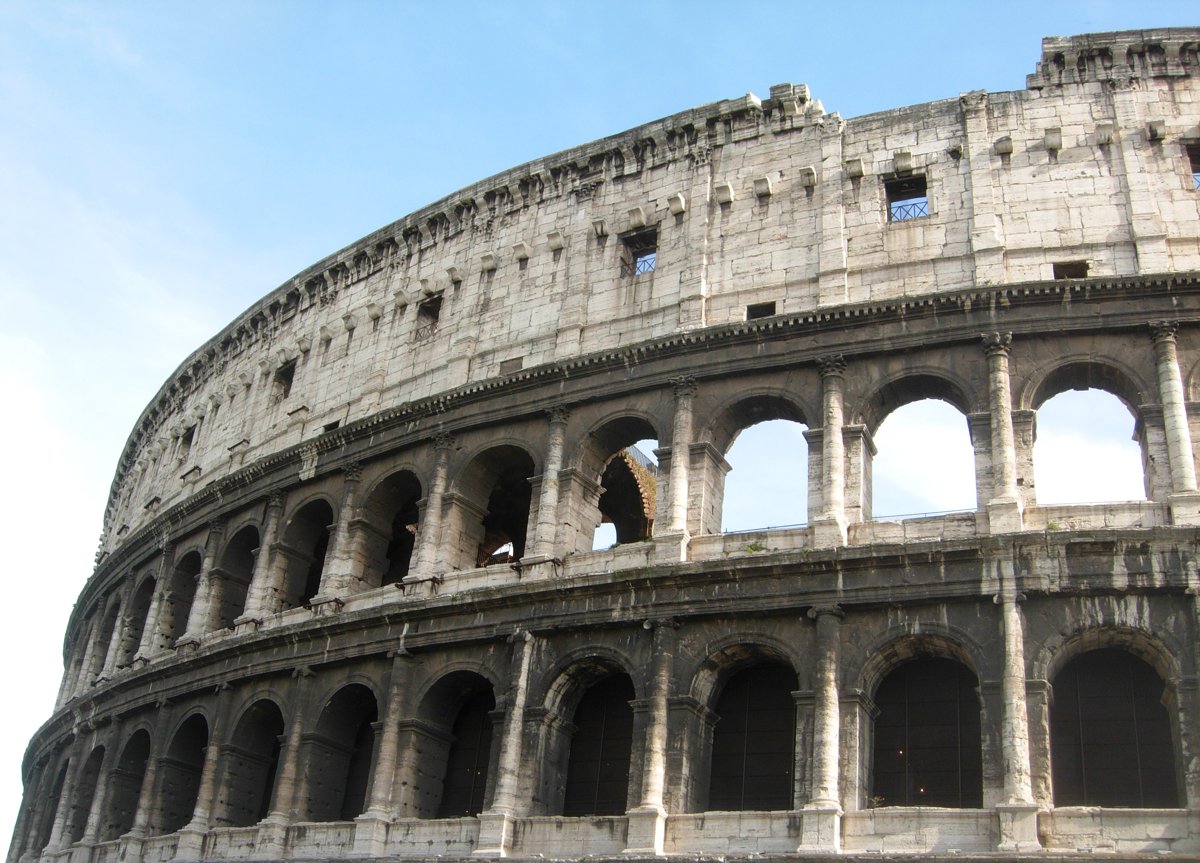
Public performance buildings make another useful comparison. A theatre's seating and stage wall served a different kind of event from an amphitheatre surrounding an arena. In the Colosseum, underground rooms and machinery formed part of the staging of spectacles, while the massive rings of circulation and seating organised movement above. The surviving building is not a complete reconstruction of its ancient state: sections of the outer perimeter have disappeared and the underground changed over time. Our separate guide to Roman amphitheatres explores that building type in greater depth. Here, two arenas appear alongside temples, waterworks and a palace so that different architectural purposes can be compared.
Temples invite a different question: what did architecture communicate as well as shelter? At the Maison Carrée in Nîmes, the formal front and Corinthian decoration belonged to a provincial setting tied to imperial worship. Rome's Pantheon combines a columned entrance with a great circular interior and an opening in the dome. The Palace of Diocletian in Split demonstrates another kind of afterlife, as ancient spaces became part of a continuously inhabited city. These places are not frozen moments. Their meanings and uses changed, and the people who built and maintained them are as important to the story as the rulers whose names are most familiar.
Conditions, opening hours and access can change, so consult the official site before planning a visit. This list does not suggest that the structures are untouched, equally complete or equally accessible, and historical architecture should be approached with respect for local communities and conservation rules. For more ways to read the built environment, see our guide to architectural features. Which surviving Roman structure best explains what its builders could accomplish?
Sources: UNESCO — Rome · UNESCO — Pont du Gard · UNESCO — Maison Carrée · Colosseum Archaeological Park.
Image: Acediscovery · CC BY 4.0 · 2009-05-09. Resized for the web; source license retained.
