
Nonfarm payroll employment ranks third because it provides a recurring measure of jobs in the establishment survey rather than a count of distinct employed people. The Bureau of Labor Statistics gathers information from businesses and government agencies within the programme's coverage. A person holding two covered jobs can appear twice in payroll employment, while the household survey treats the person differently. This distinction is not a technical nuisance; it explains why payroll jobs and household employment can move differently. Before interpreting a jobs headline, decide whether the claim concerns positions on payrolls or the number of people with work.
The monthly change is a net change, not a count of every new hiring event. Imagine covered employers adding 300 jobs while other covered employers lose 200 over a simplified comparison. The net increase is 100, not evidence that only 100 jobs were created or that nobody lost work. These are illustrative counts, not actual survey results. The point is to separate an aggregate balance from the many movements beneath it. A positive net figure can coexist with difficult experiences in particular industries or places, just as a negative total can coexist with businesses that are expanding and recruiting.
Net changes and coverage
Coverage also matters. Nonfarm payroll employment does not represent every form of work, and it should not be casually expanded to include all self-employment or every agricultural worker. The release's definitions explain who belongs in the establishment measure and why the household survey has a different scope. A comparison between the two is useful only after those boundaries are understood. If the series disagree in one month, the proper question is what concepts, samples and reference periods differ. Treating disagreement as proof that one must be fraudulent replaces statistical reading with a conclusion that the figures alone do not establish.
Look beyond the headline to industry detail and, where relevant, hours and earnings series. More payroll jobs do not necessarily mean more total hours in exactly the same proportion. Average earnings can also be influenced by changes in the mix of workers and industries, so an average increase need not describe the pay rise of a typical individual. These companion measures answer related questions rather than repair a defective headline. The employment report is most useful when read as a collection of defined estimates, not a single number that must somehow summarise every dimension of work, pay and household security.
Hours, revisions and a balanced summary
Revisions are central to responsible reading. An early payroll estimate uses the information available at the time and can be updated as more reports arrive; broader benchmarking also affects the series. A new release can therefore change the interpretation of previous months as well as add the latest one. Record both the release date and the reference month, and compare trends using a consistent version of the data. This does not justify dismissing all early estimates. It simply means that the first headline is an informed estimate rather than a permanent final count against which every later figure should be treated as suspicious.
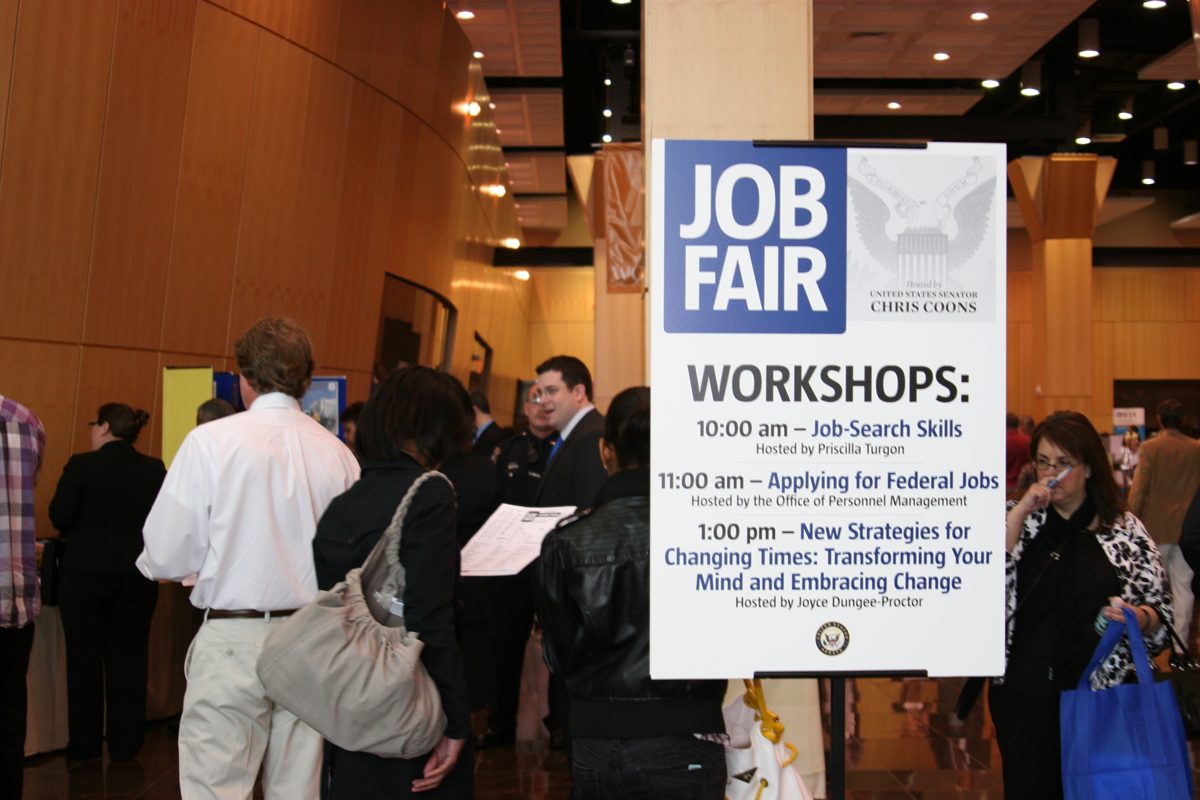
Payrolls earn a high place because employment is a broad and important dimension of economic life, but they do not outrank GDP's production scope or CPI's foundational price lesson in this editorial sequence. A reader focused on work could reasonably choose them first. Pair payrolls with the unemployment rate and claims while preserving their different definitions. The job-fair photograph is archive context, not evidence of current hiring. A good summary names the net change, the main industry pattern and relevant revisions without turning jobs into people or implying that a national average describes every household's experience.
Photo: Sen. Coons Job Fair.jpg · Senator Chris Coons · Public domain. Archive illustration only, not a survey observation or current economic evidence; resized and recompressed without cropping. Original image rights retained.

