
Space telescopes have changed astronomy by making very different kinds of evidence available. Some produce pictures that become part of popular culture; others measure positions, tiny changes in brightness or the faint afterglow of the early universe. Comparing them is therefore a more interesting argument than asking which has the biggest mirror. A powerful new instrument can reach places an older one cannot, while a relatively modest specialist can transform an entire field. This countdown asks which ten space observatories have the strongest claim to greatness through their demonstrated scientific contribution, considered as a selected historical shortlist on 26 October 2026.
Our editorial order gives the greatest weight to the breadth and lasting influence of established results. Opening a genuinely useful observing window comes next, followed by the value of a mission's legacy for later researchers. Public fascination matters as an invitation to learn, but it does not substitute for scientific evidence. We have not counted papers, divided discoveries by budget or built a numerical league table. Those would require a different, carefully standardized study. The positions here are reasoned judgments, supported by the linked NASA and ESA mission accounts, rather than a claim that scientists have voted for this exact order.
That choice of criteria explains our central disagreement: Hubble takes first place ahead of Webb because an accumulated legacy across many subjects outweighs newer capability in this particular comparison. A reader who values infrared access to early galaxies and detailed atmospheric studies more heavily could reasonably choose Webb instead. Someone interested above all in how common planets are might champion Kepler, while a specialist in cosmic history could put COBE or Planck much higher. These alternatives are part of the ranking's point. We want the criteria to make disagreement more informed, not to hide it behind a supposedly objective score.
The selection covers astronomical observatories working beyond Earth's atmosphere, including specialist survey missions and microwave measurements. It is not a list of planetary flybys, ground observatories, solar missions or every spacecraft carrying a camera. Nor does inclusion mean that a mission is still collecting observations: an archive can remain scientifically valuable after operations end. Recent projects with less accumulated evidence are outside this particular legacy shortlist. Their omission is not a prediction of failure. A future ranking may change substantially as new observations are checked, interpreted and used by other teams. No launch date or promised instrument alone guarantees a lasting discovery.
A useful way to read each short entry is to ask what was measured before admiring what was pictured. Infrared, visible light, ultraviolet, X-rays and microwaves answer different questions; they are not interchangeable settings on one universal camera. A map of star positions does different work from a map of temperature variations. Where illustrations, engineering photographs, exhibition models or processed astronomical images accompany the text, the captions identify that context. They are not photographs of every spacecraft in flight, and processed colors should not be mistaken for a person's unaided view. The images illustrate the missions, rather than prove their relative rank.
For a closer look at interpreting observational pictures, explore our guide to Hubble images; for exploration by visiting spacecraft, compare our NASA Solar System missions countdown. Those are complementary subjects, not competing versions of this list. Start at number ten and watch the emphasis shift from precise mapping and specialized windows toward wider scientific influence. Keep your preferred definition of greatness in mind as you go. Would you give first place to the telescope that has already changed the most fields, the one that opens the most exciting new view, or the one that most directly changed your understanding of our place in the universe?
Sources and comparison: NASA · ESA.
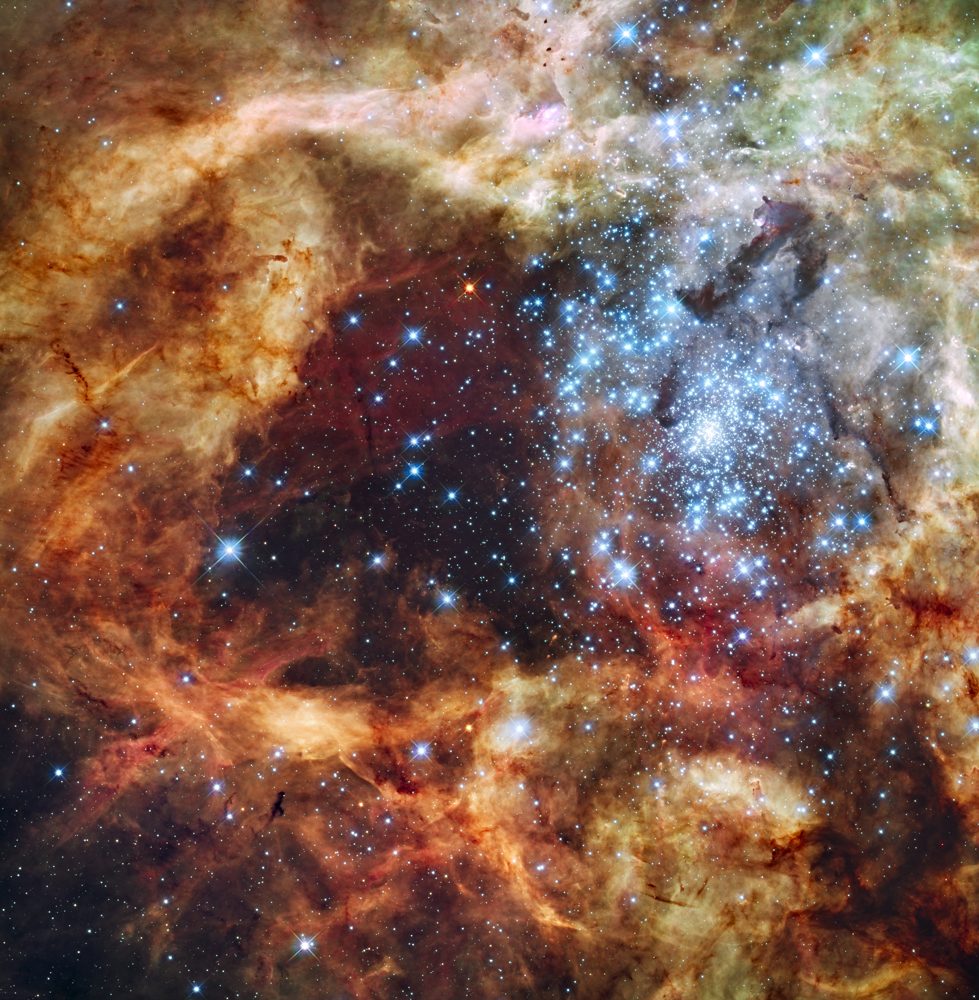
Image: Hubble processed image of R136 in the Tarantula Nebula, October 2009; not a spacecraft photograph — NASA, ESA, F. Paresce (INAF-IASF, Bologna, Italy), R. O'Connell (University of Virginia, Charlottesville), and the Wide Field Camera 3 Science Oversight Committee · Public domain. Resized and recompressed as JPEG without cropping or upscaling; original license/status retained. No endorsement implied.

