
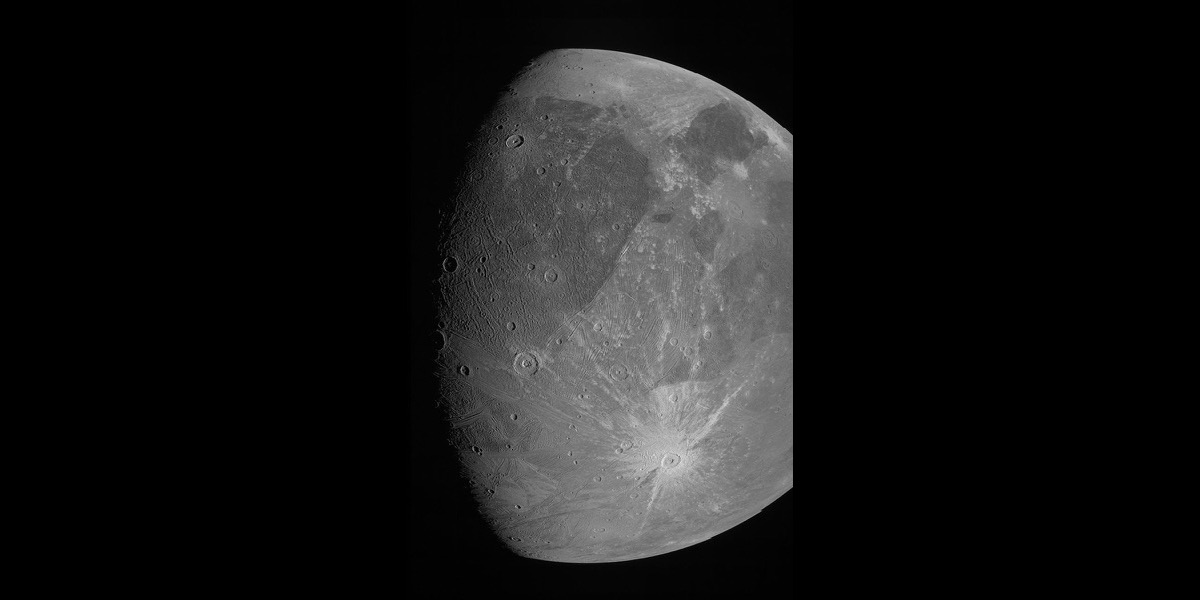
Ganymede is the largest moon in the Solar System, with a mean diameter of approximately 5,262 kilometres. Titan comes second and Callisto third. Earth's Moon is fifth, between Io and Europa. The table below puts all ten in descending size order and names the planet each one orbits, so you can compare their sizes without opening every entry. The individual pages then explain a distinctive feature of each world, with spacecraft imagery and links to NASA sources.
Here, largest means mean diameter, not mass, surface brightness or apparent size in the sky. We calculate diameters as twice the mean radii in JPL's physical-parameters table, reviewed on 3 November 2026, and round to the nearest kilometre. JPL defines mean radius using a sphere with the same volume as the satellite. This provides a consistent comparison even when a body's shape is not a perfect sphere; it does not measure the atmosphere above its surface.
| Rank / moon | Mean diameter (km) | Planet |
|---|---|---|
| 1. Ganymede | 5,262 | Jupiter |
| 2. Titan | 5,150 | Saturn |
| 3. Callisto | 4,821 | Jupiter |
| 4. Io | 3,643 | Jupiter |
| 5. Earth’s Moon | 3,475 | Earth |
| 6. Europa | 3,122 | Jupiter |
| 7. Triton | 2,705 | Neptune |
| 8. Titania | 1,578 | Uranus |
| 9. Rhea | 1,527 | Saturn |
| 10. Oberon | 1,523 | Uranus |
To interpret the table, first compare neighbouring rows, then compare everything with our own Moon. Ganymede and Titan are each roughly one and a half times the Moon's diameter. Callisto is also larger than the Moon, while Io is only slightly wider. Europa is smaller. These comparisons describe distance across the worlds, not how much material they contain: density matters when comparing masses. A larger diameter alone therefore does not tell you which moon is heavier or what its interior contains.
The closest pair in this top ten is Rhea and Oberon. Their central diameter estimates differ by only about four kilometres, and the quoted radius uncertainties overlap. We preserve their order by the central values rather than suggesting the measurements establish an absolute separation. Rounded numbers can look more definite than the underlying science. For schoolwork or a graphic, keep the word approximately and explain the measurement used instead of mixing diameters from one source with equatorial sizes from another.
Which planets have the biggest moons? Jupiter contributes four members of this list: Ganymede, Callisto, Io and Europa. Saturn contributes Titan and Rhea; Uranus contributes Titania and Oberon. Neptune contributes Triton, and Earth contributes the Moon. That distribution describes this size threshold, not the total number of moons around each planet. A planet with many small satellites does not necessarily contribute many entries here. Familiar smaller moons such as Enceladus and Pluto's Charon fall outside this top ten.
Why are Ganymede and Titan still moons if they are wider than Mercury? Their size does not determine that label: both are natural satellites orbiting planets. The comparison is useful because it challenges the idea that every moon must be a tiny rock. It does not mean that they have Mercury's mass, composition or surface conditions. NASA's overview of moons provides the broader context, while the linked entries keep each world's physical characteristics separate from its place in a size ranking.
Spacecraft photographs answer a different question from the table. They show terrain, colour and lighting, but the pictures here are not displayed at one common scale. A large-looking disc on your screen may represent a smaller world. Some images use enhanced colour or a single camera filter; captions identify those treatments. Possible subsurface oceans are also different from visible surface seas. Read the scientific description alongside each photograph rather than treating an attractive image as proof of liquid water or life.
Use the table links to go straight to a moon, or follow the countdown from Oberon to Ganymede. For the exploration behind these images, continue with our NASA Solar System missions guide. To compare geological processes rather than diameters, try our volcanic landforms guide. The most useful next question is not simply which world is biggest, but which visible features help explain its history and which conclusions still depend on further observations.
Image: Ganymede, preliminary JunoCam green-filter view. NASA/JPL-Caltech/SwRI/MSSS. Image reuse terms.