
Super Bowl XXIII wins because it joins a narrow championship contest with a finish that remains a powerful way to understand the 49ers' classic era. On 22 January 1989, San Francisco defeated Cincinnati 20–16 at Joe Robbie Stadium in the Miami area. The game decided the 1988 season. Montana's final touchdown pass went ten yards to John Taylor, leaving thirty-four seconds on the clock. Those facts identify the ending without requiring an invented quotation or a claim about what every player was thinking. Our first-place choice values the pressure of that resolution, while keeping the rest of the game inside the account.
San Francisco's winning possession began at its own eight-yard line with the team trailing 16–13. The eleven-play, ninety-two-yard drive is the center of the argument for first place. The field position explains the task: the offense had to cover almost the entire field while the championship remained undecided. A viewer should follow each gain and the changing situation, rather than jump straight to the final completion. The famous throw is the endpoint of an organized sequence. Treating it as an isolated miracle makes the story smaller, because it removes the accumulated work that turned an unfavorable starting position into a scoring opportunity.
Rice and Taylor in the same story
Rice's full-game performance prevents the final receiver from becoming the only receiver in the story. He finished with eleven catches for 215 yards and a touchdown, earning the game's MVP award. Taylor's winning catch was his only reception of the game. That contrast is particularly useful for understanding why the decisive moment and the strongest sustained individual performance need not belong to the same person. Both can matter at once. A careful account credits the last score while preserving the work that kept the offense functioning long enough to have that chance. A title game is richer than one photograph of the ball arriving in the end zone.
The result also marked Bill Walsh's final game as San Francisco's head coach and his third Super Bowl win. That historical ending adds resonance, but it should not be used to pretend the participants' private thoughts are known from a modern highlight. The visible sequence and the documented record are enough. For someone learning the game, separate three questions: what happened, why the situation was difficult and why the event became significant afterward. The first needs accurate facts, the second careful interpretation and the third historical context. Blending them too quickly is how an engaging story becomes a collection of claims that its evidence cannot support.
A later image, a lasting debate
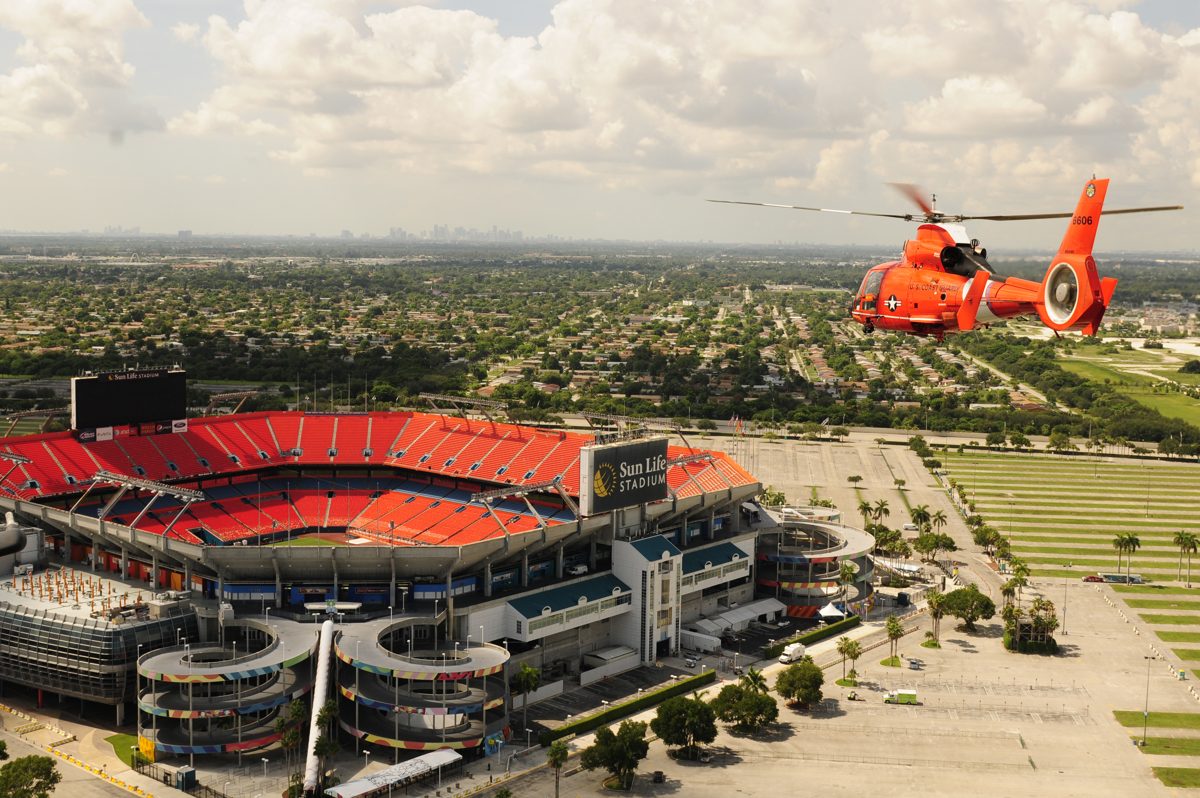
The venue image is deliberately later than the championship. It shows the stadium in its Sun Life Stadium period during a Coast Guard flyover practice in August 2011, not the January 1989 game. Names and physical details change over a venue's life. Keeping the image date attached lets it provide geographical context without becoming a false scene of the winning drive. The official team histories and NFL material linked below establish the sporting events. Our Packers-quarterback guide supplies a related discussion of titles and individual contributions, but this ranking continues to compare complete games rather than turn the victory into one player's entire career assessment.
First place reflects our preference for a championship whose meaning stayed open until a late, sustained response changed it. XXIV can win on domination and XIX on the blend of offense, defense and opponent. XXIII wins here because its ending combines distance, pressure and a clearly documented sequence with Rice's outstanding wider performance. Would you keep the comeback above the blowouts, or choose the certainty of 55–10? A useful answer explains its standard and respects the competing case. The final drive deserves its fame most when it remains part of a team game, with the complete record supporting the emotion rather than being replaced by it.
Source: San Francisco 49ers · San Francisco 49ers · Pro Football Hall of Fame · NFL: Super Bowl XXIII · Miami Hurricanes: venue history.
Photo: Petty Officer 3rd Class Tara Molle · Public domain. Sun Life Stadium during a Coast Guard flyover practice, 3 August 2011; not the 1989 game. Later venue illustration, not championship action. Resized and recompressed without cropping; original license retained.
