
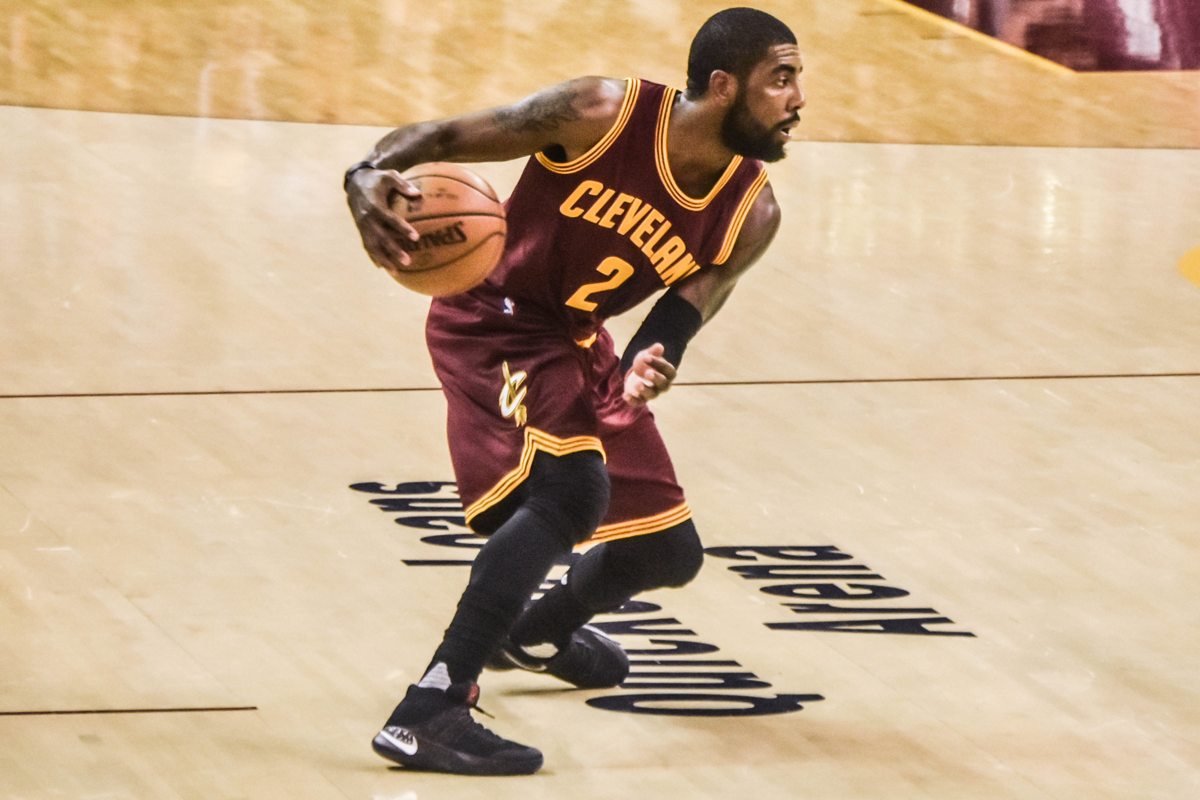
Kyrie Irving takes third, which should not be mistaken for a small place in Cleveland's story. His strongest argument is unusually direct: at the decisive moment of the Cavaliers' first championship, he created the basket that separated the teams. In the 2016 Finals' seventh game, his late three over Stephen Curry supplied the go-ahead score. That is a major piece of franchise history, not a decorative highlight attached to an otherwise unrelated career. Yet our ranking gives sustained responsibility across Cleveland seasons more weight than a single possession, which is why Mark Price receives the narrow edge for second.
The basketball value of that shot is richer than the shorthand “clutch”. A possession late in a close game can force an offense to find a workable attempt after the opponent has reduced its preferred options. An individual creator matters because he can still generate a shot when the first action does not supply an easy opening. Irving's famous moment is a clear way to discuss that responsibility. It does not establish that he was always the best possible choice in every late-game situation, nor does one successful attempt prove a universal rule about how close games should be played. Its importance comes from what actually happened in that championship setting.
The evidence and the basketball question
His Cleveland career was also larger than that ending. The Cavaliers selected Irving first in the 2011 draft, and his six seasons with the team provided a substantial period to evaluate rather than a cameo. We regard his ability to carry a difficult scoring task as the strongest basketball reason for inclusion. A scoring guard's contribution should not be reduced to a points total: consider who has to handle the ball, how a defense reacts to that threat and whether an offense has another route when its initial plan fails. Those are questions for evaluating a role, not claims that a photograph or highlight clip measures every part of his performance.
The best case for second is that championship-level scoring under pressure should count more than a longer regular-season foundation. It is credible because Cleveland's 2016 achievement is central to the comparison, and Irving's contribution cannot be credited entirely to James simply because James was the leading figure. A team can have a clear best player and still depend on another creator doing something that the best player did not do on that possession. Giving Irving his own case protects the ranking from treating teammates as interchangeable accessories. It also prevents a general LeBron argument from swallowing every meaningful part of the Cavaliers' title story.
The competing case and our verdict
Why does that case not prevail here? Price's longer Cleveland tenure and sustained organizing role fit our first criterion more strongly. We do not argue that Irving lacked the ability to lead, or attempt a hypothetical championship swap between players from different eras. Such a comparison would require assumptions about teammates, rules and opponents that the historical record cannot settle. The narrower claim is that, when a franchise ranking begins with a sustained Cleveland body of work, Price has a defensible advantage. Put title-defining individual scoring first, and the order can reverse without anyone needing to dispute the underlying events or invent an objective numerical gap.
To judge Irving fairly, examine the decision as well as the finish. In any replay, ask what the defense is trying to remove, what time remains to create an alternative and which teammates affect the space around the ball. Do not assume that more dribbles always mean better creation, or that a made shot makes every preceding choice optimal. The reason to study a famous play is to understand its particular problem, not convert it into a formula. Irving earns third because his Cleveland impact combines a sustained scoring role with a singular championship contribution. For readers who value that final contribution most, he is the strongest challenger to our second-place choice.
Source: Official NBA / Cavaliers historical record 1 · Official NBA / Cavaliers historical record 2 · Official NBA / Cavaliers historical record 3.
Photo: Erik Drost · CC BY 2.0. Kyrie Irving with Cleveland, 1 November 2016; historical game photograph, not the Finals decider. Resized/recompressed; source framing retained, no added crop, recoloring or AI. Image retains its original linked license; no endorsement.
