
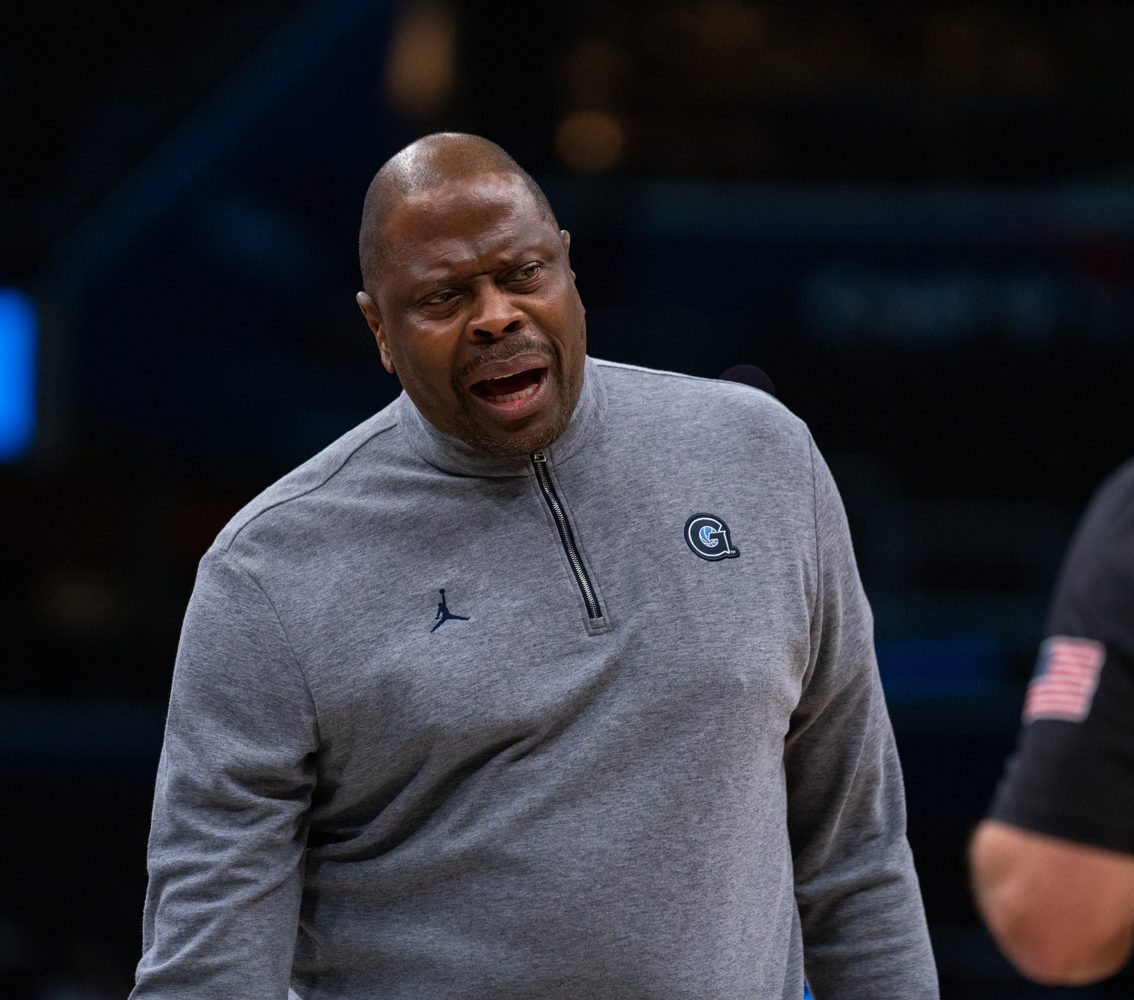
Patrick Ewing ranks third in this classic Knicks shortlist, but he supplies its strongest argument against making championships the dominant measure. The Hall of Fame describes fifteen seasons in New York and a center whose contribution combined scoring, rebounding, shot blocking and defense. That range matters because a franchise cornerstone is asked to provide more than memorable baskets. Sustained responsibility can shape the identity of a team even when it does not end in the championship result used to separate our top two. Our position gives that distinction considerable weight without treating the absence of a Knicks title as a complete explanation of Ewing's career.
Start with the problem of judging a center's work. Scoring draws attention because each successful possession produces a visible outcome. Defensive positioning, contesting space and finishing a possession with a rebound can be less easily reduced to a single celebrated moment. A serious comparison should ask which tasks a player repeatedly carried and how those tasks fit together. This is a framework for evaluating the role, not a claim that we have measured every possession of Ewing's career. The source record establishes his broad skill set; the conclusion that sustained two-way responsibility strengthens his candidacy is our editorial interpretation.
The value of sustained responsibility
His case also challenges the way fans compare players whose best seasons belong to different teams and eras. Team outcomes depend on more than the leading player's ability, and a loss does not isolate which individual responsibility was insufficient. Conversely, pointing to difficult circumstances cannot automatically turn every near-success into the equivalent of a championship. Both cautions are necessary. Ewing's argument becomes stronger when we ask what repeated franchise service is worth rather than awarding imaginary victories. That keeps the debate grounded: a supporter can reasonably prioritize sustained value without claiming that a counterfactual title actually happened or that teammates and opponents should disappear from the evaluation.
The duration of his New York contribution is therefore central rather than decorative. Fifteen seasons mean that an assessment concerned with franchise identity must think beyond one dramatic night. What does it mean for supporters to associate a team's competitive ambitions with the same central player over a long period? The answer cannot be reduced to affection alone, but affection is not the only thing longevity represents. Repeated responsibility supplies a different kind of historical weight from a short peak. Someone who gives that weight first priority can put Ewing above both Frazier and Reed without denying the championship evidence that favors them here.
Why longevity can change the winner
We nevertheless place him third because our initial question gives the most weight to championship-level peak before sustained franchise value. That choice favors the accomplishments anchoring Reed's and Frazier's cases. It does not mean Ewing is third in every possible comparison of skill, career value or personal significance to New York supporters. Nor does it turn his scoring into an isolated strength and his defense into an afterthought. The useful disagreement is about the order of the criteria. If duration and the breadth of a center's repeated burden come first, the ranking needs to change rather than pretend those priorities were already measured and rejected.
His strongest challenge to our verdict is straightforward: why should a sustained franchise cornerstone lose to a shorter championship peak when basketball results are collective? Our answer is that the peak receives priority in this particular list. If that trade-off seems wrong to you, Ewing has a serious route from third place to first.
Source: Naismith Hall of Fame.
Photo: AlexanderJonesi · CC BY-SA 2.0. Patrick Ewing as a coach, 18 December 2021; not a Knicks playing-era photograph. Resized and recompressed without additional cropping; source license/status retained.
