
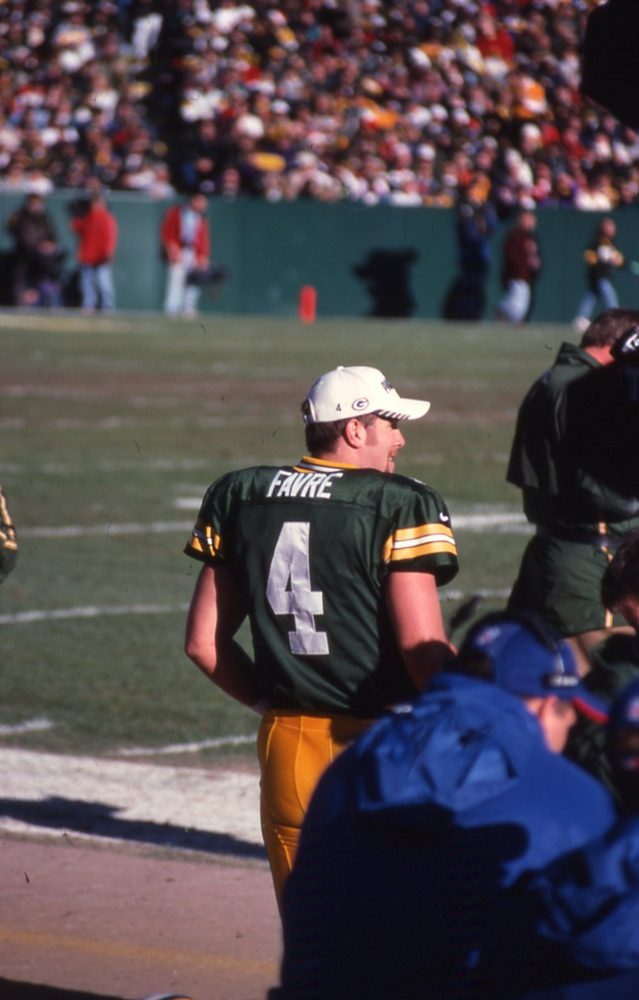
Brett Favre ranks third, but his case is stronger than the position might initially suggest. His Green Bay playing years ran from 1992 through 2007, and his Associated Press MVP awards came in three consecutive seasons: 1995, 1996 and 1997. That is a sustained peak rather than one spectacular autumn. A ranking that emphasizes how often a quarterback was recognized as the league's leading player can reasonably move him above the other two. Our order gives more weight to Starr's championship period and Rodgers's modern passing case, while treating Favre as an essential contender rather than an easy bronze medal.
Continuity is central to understanding his contribution. The Packers' history records 253 consecutive regular-season starts for Green Bay after he first took the starting job. Keep that franchise sequence distinct from the longer consecutive-start record accumulated across his whole NFL career. Availability matters because the position does more than supply isolated highlight throws. A team builds its preparation, expectations and weekly offensive plan around the player taking those snaps. The number establishes repeated participation; it does not, by itself, prove that every performance was equally good or that playing through every difficulty should be recommended as a general health principle.
Continuity and championship contention
His peak also translated into championship contention. The Pro Football Hall of Fame describes a run of three straight NFC championship games beginning with the 1995 season and two Super Bowl appearances, including the victory in Super Bowl XXXI. Those stages should be separated. Reaching a conference final, winning a conference and winning a Super Bowl are different achievements, even when part of the same successful stretch. Reading the sequence helps explain why Favre's case is about more than accumulating seasons. He combined a durable presence with a period in which Green Bay repeatedly advanced deep into the championship competition.
The comparison with Rodgers is the closest argument on this page. Rodgers's Green Bay passing record gives our second-ranked player a strong case for sustained precision and scoring production. Favre's answer is his consecutive MVP run and the value of a long, dependable center to the team's identity. Neither argument requires claiming that every apparent difference can be assigned to the quarterback alone. An offense contains teammates and coaching decisions. If you favor Favre, explain why repeated peak recognition and continuity outweigh the alternative evidence; that is a more persuasive position than simply treating the style you grew up watching as the universal standard.
The case for moving Favre higher
A useful way to revisit Favre is to compare a full game from his championship-contending period with a highlight compilation. The short collection preserves memorable outcomes but hides the decisions and ordinary plays between them. In a complete sequence, watch the relationship between situation, intended opportunity and result. You need not pretend to know an unseen play call or a receiver's assignment. Describe what the footage actually shows and keep inferred intention separate. That approach gives a fan a richer language for discussing a famous quarterback than a label such as fearless, especially when another viewer values caution or consistency differently.
Third place is therefore a choice among extraordinary Green Bay careers, not a dismissal. Favre can win if your greatest-player definition puts repeated contemporary recognition, long service and the return of championship contention at its center. He finishes behind Rodgers here because we prefer the latter's passing record in the modern comparison, and behind Starr because the championship-era case comes first in our criteria. The disagreement remains legitimate because the criteria are visible. Which would persuade you more: the three consecutive MVP seasons, the sustained sequence of starts, or the evidence of what Green Bay achieved during that peak? Decide what those facts mean before moving a name up or down.
Source: Green Bay Packers · Pro Football Hall of Fame.
Photo: David Wilson · CC BY 2.0. Historical illustration, not a current-game image or ability test. Resized and recompressed without cropping; source image license retained.
