
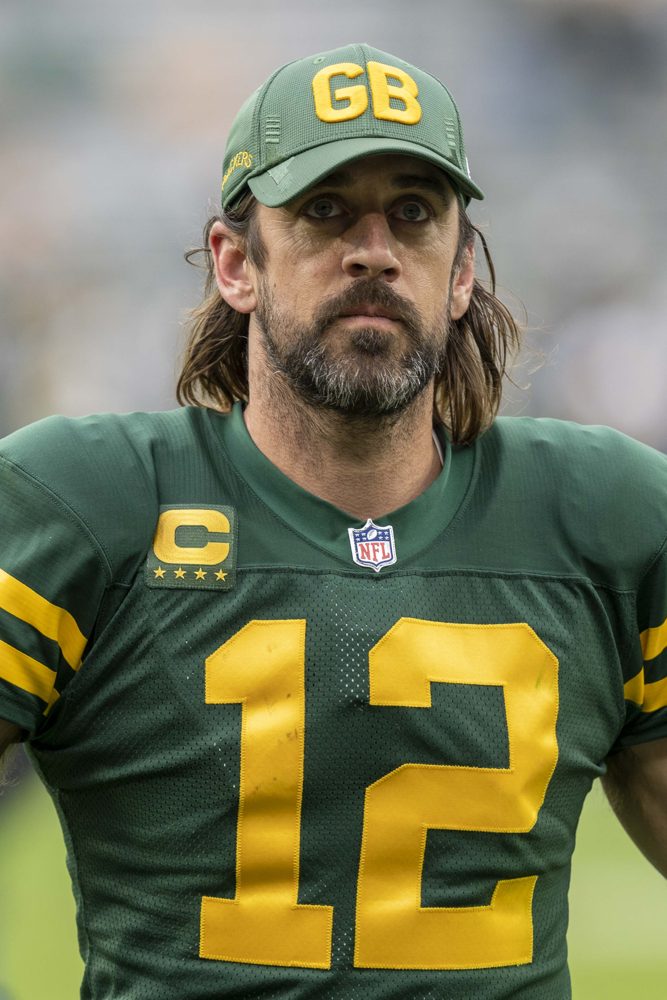
Aaron Rodgers takes second place and offers the most direct challenge to our winner. We evaluate his Green Bay seasons, 2005 through 2022, with his role as the regular starter beginning in 2008. His later work for another franchise does not add to this Packers ranking. The team's April 2023 trade announcement supplies a clear endpoint for the statistical comparison. Keeping that boundary matters: an all-career number can look convincing while quietly answering a different question. Here, the subject is the contribution made in Green Bay, including a long period of individual excellence and a championship performance that deserves attention in its own right.
The Green Bay regular-season ledger is formidable: 475 touchdown passes and 105 interceptions. Those are Packers figures, not his eventual NFL totals and not a mixture of regular season and playoffs. They establish a powerful combination of scoring production and limited interceptions over a large body of work. That does not mean each touchdown measures the same difficulty or every interception belongs to the passer alone. It means the documented record gives a concrete foundation for his case. Fans who want to put him first can begin there rather than relying only on the visual impression of a spectacular throw.
A Green Bay statistical boundary
His four AP MVP seasons, 2011, 2014, 2020 and 2021, extend the argument beyond a raw career total. Recognition across that span indicates repeated standing near the top of his contemporary competition. The season labels also prevent a common dating mistake: an award presented in the following February belongs to the football season being recognized. Rodgers's 2021 honor was announced in February 2022. The distinction is small but useful when comparing award timelines. Four awards should not be confused with four championships, nor should a regular-season award be treated as a direct measure of one postseason performance.
Super Bowl XLV supplies the championship anchor. Rodgers was the game's MVP after throwing for 304 yards and three touchdowns in Green Bay's victory. That performance prevents the argument from becoming merely theoretical admiration for an efficient regular-season passer. It demonstrates a high-level contribution on the final stage. Yet one championship remains a different historical case from Starr's five NFL title seasons. Whether that difference should decide first place is precisely the debate. We give the championship-era contribution priority while acknowledging that a reader emphasizing passing excellence can choose Rodgers without denying the importance of the older achievements.
The strongest challenge to Starr
When revisiting his play, watch how an impressive completion fits the down, distance and available alternatives shown on the screen. A throw away from the pocket can be memorable, but the ordinary sequence that set it up may explain more about the offense. Do not invent a defender's assignment or treat a television angle as if it reveals every receiver. Pair viewing with the official statistical scope. This helps separate what you observed from what a total establishes, and it gives the discussion more precision than declaring that one player simply had the best arm anyone has ever seen.
Second place reflects our preference among criteria, not an assertion that Rodgers lacked a credible first-place argument. He leads this trio when modern passing production and repeated elite recognition dominate the question. Starr stays above him because this particular franchise ranking begins with an exceptional championship period interpreted in its own era. Favre remains close through his consecutive MVP peak and continuity. Change those priorities and the order can change honestly. Would you trade some weight on championship seasons for the combination of 475 Green Bay touchdown passes, 105 interceptions and four MVP awards? That is the strongest argument against our winner, and it deserves a substantive answer.
Source: Green Bay Packers · Green Bay Packers · Green Bay Packers.
Photo: All-Pro Reels · CC BY-SA 2.0. Historical illustration, not a current-game image or ability test. Resized and recompressed without cropping; source image license retained.
