
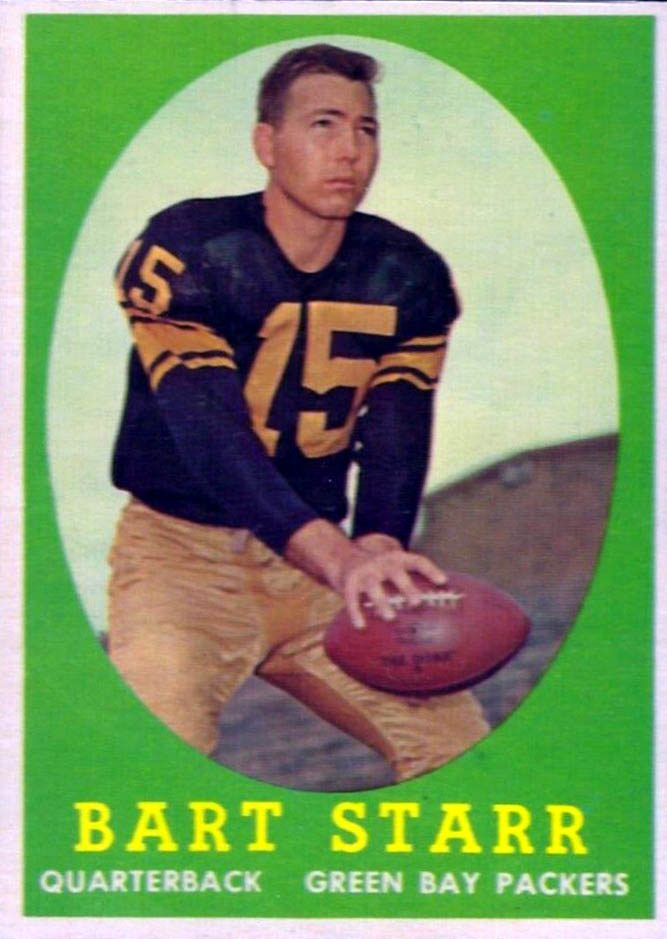
Bart Starr wins our Packers quarterback comparison because championship-era contribution comes first, and his Green Bay record supplies an unusually strong version of that case. He played for the team from 1956 through 1971 and helped lead the championship seasons of 1961, 1962, 1965, 1966 and 1967. Those dates describe five NFL titles, with the final two seasons also producing victories in Super Bowls I and II. The distinction matters: they are not seven separate championship seasons. Our choice concerns what Starr contributed to that dynasty, not a claim that a quarterback alone created every result on an exceptionally accomplished team.
Individual recognition gives the title argument additional substance. Starr was the AP NFL MVP for the 1966 season and the MVP of the first two Super Bowls. The awards cannot isolate his influence perfectly, but they challenge the suggestion that he was merely a passenger benefiting from everyone around him. Contemporary recognition and championship performance reinforce each other. His passing totals belong to a different football environment from Rodgers's or Favre's, so we do not use a modern yardage threshold as the admission test for greatness. The question is how well he fulfilled the quarterback's responsibilities within the competition he actually faced.
Individual responsibility in a dynasty
The Ice Bowl offers a concrete episode to examine. In the 1967 NFL Championship Game against Dallas, Starr finished the decisive drive with a quarterback sneak. The Packers' historical account describes him proposing the sneak to Vince Lombardi during the preceding timeout. That is a specific example of decision and execution, not simply an iconic photograph of a pile of players. It helps make leadership discussable through an identifiable action. At the same time, the score required teammates to do their work. Recognizing Starr's role should sharpen an account of the play rather than erase blocking, preparation or the wider drive.
The team's history also describes Starr calling his own plays, a responsibility common to quarterbacks of his era. This matters when translating the position across time. A reader should not assume that the same job title always meant an identical distribution of decisions between coach and player. Nor does that fact establish that an older quarterback would automatically outperform a modern one in a different system. It tells us to take the actual historical role seriously. Starr's contribution can be evaluated as preparation, decisions and execution within Lombardi's team, instead of being judged only by how closely his footage resembles today's passing game.
Why the championship-era case wins
There is a credible objection to first place: team championships depend heavily on the surrounding roster and coaching. We accept that limit. The case for Starr is not simply five being larger than one; it is the combination of a remarkable winning period, documented responsibility and individual recognition at that period's center. Rodgers offers the stronger modern passing record, while Favre supplies a compelling repeated MVP peak and continuity. None of those contributions disappears because Starr wins. Our greatest Bills quarterbacks guide illustrates why a franchise comparison becomes more useful when it explains the historical question rather than pretending that every era can be reduced to one clean table.
Starr finishes first because our hierarchy favors the quarterback's role in an exceptional championship era, supported by evidence of individual excellence. This is an editorial conclusion, not a fan poll, a physical talent test or a verdict on anyone's entire life. A different starting question can yield Rodgers or Favre without making the historical facts optional. The productive disagreement begins by naming what you value and showing how the evidence supports it. Would you choose Starr's title-era leadership, Rodgers's passing production and four MVP seasons, or Favre's consecutive MVP run and long Green Bay service? Which criterion would you change first, and why?
Source: Green Bay Packers · Pro Football Hall of Fame.
Photo: Topps; photograph uncredited; scan via Vintage Football Card Gallery · Public domain. Historical illustration, not a current-game image or ability test. Resized and recompressed without cropping; source image license retained.

