
Tom Harmon is third in our comparison, but his strongest argument reaches directly at the way the comparison is built. The Heisman Trust identifies him as Michigan's 1940 winner and describes a single-wing tailback whose contribution involved running, passing and other responsibilities. That compact factual base matters more here than a later professional résumé. We are evaluating a winning college season, not turning everything subsequently associated with a famous name into evidence for it. If your priority is the breadth of an older all-purpose role within its own game, Harmon can reasonably move higher than our order.
The first task is to avoid translating a historical position too literally. A label can look familiar while describing a different set of decisions and demands. Read the role before deciding what kind of modern player it resembles. Running and passing responsibility, for example, can place different questions on the same person than a highly specialised role does. That is an interpretive framework for the verified profile, not a claim that we have assigned every play a comparable modern value. It keeps the older season in the discussion without pretending that the surrounding sport was simply today's game in a different uniform.
The strongest Harmon-first case asks for a ranking of importance within context. Under that standard, the question becomes how much a player was asked to do and how central that range was to his team's identity. Modern familiarity should not count as an achievement in itself. A season should not rise merely because more viewers know the images, nor fall because its surviving story is less immediately accessible. This is especially useful for readers who instinctively begin with the most recent name. Try stating the standard without using a player's name, then see whether the older role fits it better than expected.
Our counterargument is that breadth alone does not settle the order. Responsibilities are valuable because of their quality and effect, not just because they can be listed. We give Howard's clearer receiving-and-returning case second, and Woodson's primarily defensive foundation with contributions elsewhere first. Someone who gives greater weight to the demands of an earlier all-purpose season can disagree without disputing the award or the year. The disagreement should remain about which kind of season we value. It should not become an invented head-to-head contest in which every participant is dropped into identical modern conditions without evidence.
A useful reading exercise is to separate three things in an account of Harmon: an achievement documented by the source, an explanation of his role and an opinion about how that role compares with another period. They belong together, but they are not interchangeable. The trophy establishes recognition; the role tells us what kind of contribution is being discussed; the final comparison remains editorial. We avoid adding unrelated wartime, broadcasting or professional accomplishments to improve his college-season score. Those histories may be important in a biography, but this article has a narrower question and should respect it consistently for all three players.
Third place therefore marks a demanding competing case rather than a token historical inclusion. Harmon makes the list more interesting by exposing the assumptions that favour later forms of excellence. Choose him first if contextual all-purpose responsibility is the decisive standard, and explain why that should outweigh the particular strengths of Howard and Woodson. We keep him third because our priorities favour the next two cases more strongly, not because the earlier game deserves less attention. A fair debate should leave the reader understanding why a different order could be coherent. Which part of his role would you regard as hardest for a comparison across eras to capture?
Sources: Heisman Trust 1.
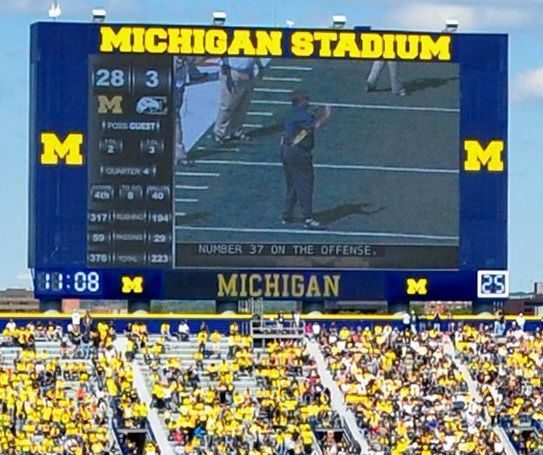
Photo: Andrew Horne from Ann Arbor · CC BY 2.0. Michigan Stadium scoreboard, contextual image only: file title says 17 September 2012, metadata says 17 September 2011; not Harmon or a 1940 game. Resized and recompressed, no additional cropping or upscaling; pre-existing source crop retained where present. CC BY 2.0 retained, no endorsement implied.
