
John Havlicek takes third because our ranking rewards a long contribution that remains valuable as responsibilities change. The Hall of Fame records sixteen Boston seasons, eight championships, thirteen All-Star selections and the 1974 Finals MVP. That is the factual platform, not an automatic calculation of rank. Our interpretation emphasizes adaptability: a great franchise player can contribute without demanding that every possession look the same. Havlicek's case challenges the habit of equating greatness only with the most visually distinctive offensive star. He sits below Russell and Bird here, but a reader who gives sustained two-way usefulness greater weight has a coherent reason to move him upward.
Consider what adaptability means in a team argument. A player can be useful when the ball is elsewhere, when the lineup changes or when another teammate is the central creator. Movement, attention and the willingness to take a different responsibility can make a strong group easier to sustain. The Hall's profile describes Havlicek's enduring movement at both ends; we read that as a reminder to judge the work connecting possessions, not only the moment a shot falls. This is an editorial lens, not a claim that we measured every cut, assignment or decision. The absence of a single spectacular statistic does not make such work irrelevant.
His championship record creates an important debate rather than an easy shortcut. If rings alone determined this list, the reasoning would collapse into a count and ignore who did what within a team. If rings were dismissed altogether, the ranking would lose part of the actual competitive objective. We take a middle position: success matters alongside role, peak and duration. Havlicek's place is strengthened by the idea of meaningful contribution across a substantial career, while his third position reflects our preference for Russell's foundational team influence and Bird's offensive centerpiece case. That preference should be stated plainly instead of hidden behind an apparently objective numerical table.
The strongest argument for moving Havlicek higher is that flexibility can be harder to replace than a recognizable specialty. A hypothetical roster may already contain a demanding primary scorer but still need someone who improves the possessions around that scorer. That thought experiment helps explain a criterion; it is not evidence that Havlicek would outperform another player on an imagined modern team. We cannot rerun careers with identical teammates or rules. What we can do is identify the kind of contribution a ranking values and ask whether the chosen order is consistent with it. A fan who prizes sustained integration over peak authorship may reach a different answer.
There is also a fair challenge from outside the selected three. A Cousy-first advocate might emphasize the importance of offensive organization, while a Sam Jones supporter could argue for a different reading of championship contribution. Naming those alternatives does not require pretending that one award or one remembered play settles the comparison. It asks the reader to define the priority. Our shortlist places Havlicek above the cutoff because the combination of duration, adaptability and a substantial championship role is persuasive under our standard. It does not imply that every other classic Celtic lacks a serious case, nor that a fourth name would be an unreasonable addition to a longer discussion.
Third place should therefore be read as a substantive endorsement, not a consolation position. Havlicek keeps the debate honest by asking whether a franchise's greatest player must always be the person who most obviously controls the story. Our answer still favors the two names ahead, but his case demonstrates why supporting a contender and defining one are related rather than identical accomplishments. If you would move him above Bird, explain whether longevity, defensive contribution or adaptability is doing the work in your judgment. A clear reason makes the disagreement more interesting than simply declaring one era tougher. The next entry tests how much weight we should give an offensive peak.
Sources: Basketball Hall of Fame profile 1.
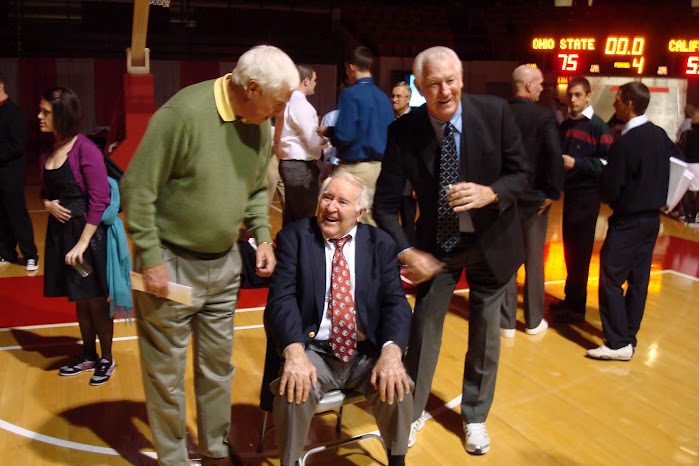
Photo: Jekelfoster23 · CC BY-SA 3.0. John Havlicek at right, Bob Knight at left and Frank Truitt seated; source describes 30 January 2010 reunion, metadata separately lists 17 August 2012. Image resized/recompressed, source framing retained. Original license or public-domain status retained; no endorsement.
