
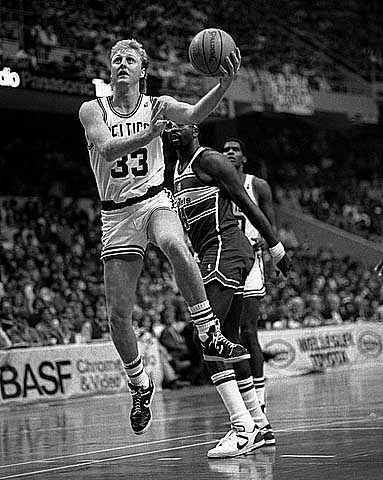
Larry Bird is second, with the most persuasive case to overturn our winner. The Hall of Fame records three championships, three league MVP awards and two Finals MVP awards; it dates his Boston arrival to 1979 and retirement to 1992. We value the offensive possibilities associated with his all-around game, especially how a creator can make a team's options less predictable. That assessment is editorial, not an attempt to turn a highlight reel into a universal efficiency score. If peak offensive command is your main standard, placing Bird first is a defensible conclusion. Our order differs because sustained championship foundation receives the greatest weight.
Offensive greatness is more interesting than the ability to finish a possession. A creator can influence where defenders stand, which teammate becomes available and what happens after the initial plan is interrupted. Watching a passing decision can therefore be as revealing as watching a made shot. The Hall profile supports Bird's broad offensive identity; our argument is that such breadth gives a strong centerpiece case without needing invented tracking numbers. A defense must account for more than one possible ending. This is a basketball interpretation of the recorded career, not a claim that we measured his decision-making against players from another period under identical conditions.
The strongest Bird-first position begins by asking what a team needs when its ordinary offense stops working. A player who can offer several credible solutions may be especially valuable in that moment. The attraction is not merely variety for its own sake. It is the ability to keep the next decision alive: a difficult possession can become a pass, another angle or a different shot opportunity. We use this as an explanatory framework rather than narrating a particular game we have not documented here. It helps distinguish offensive authorship from simply adding up points, and explains why Bird can challenge a player whose primary case begins at the other end.
The counterargument is that a ranking of a franchise's greatest players cannot be confined to the moments when the ball needs a solution. Preventing a favorable chance can shape the next possession before any offensive improvisation is necessary. That is where our Russell-first judgment begins. It does not deny Bird's broad contribution or imply that offense is superficial. It says that our highest priority is the capacity to anchor a championship structure over time. Readers who reverse that priority can reverse the first two names without ignoring the facts. The disagreement is about how to interpret value, not whether one of the careers belongs in the conversation at all.
Bird also sits ahead of Havlicek because we place substantial weight on the claim of being a team's central offensive author. A longevity-focused reader may disagree, particularly when considering the value of adapting to different roles. Neither position should rely on pretending that the careers happened in the same competitive setting. Teammates, tactical assumptions and the evidence available to viewers differ across periods. We therefore avoid an imagined one-on-one contest as the deciding device. The question is how each career shaped Boston's ability to contend, under a standard we can explain. A hypothetical matchup might be entertaining, but it would not supply the historical proof our ordering needs.
Second place leaves Bird very close to the top in editorial terms, even though we assign no artificial margin or score. His case is strongest when the reader values creative control, versatility within an offense and the ability to provide answers when a possession becomes difficult. Our winner's case is strongest when the reader begins with defensive identity and sustained team influence. That is a meaningful debate because both routes address winning, rather than opposing winning to entertainment. If Bird is your number one, identify the priority that earns him the position. Would you build the comparison around the best offensive centerpiece, or around the player who most fundamentally organized a championship team?
Sources: Basketball Hall of Fame profile 1.
Photo: Steven Carter from Northern New England, USA · CC BY-SA 2.0. Larry Bird playing; capture date unspecified, Flickr metadata 31 March 2006 is not the game date. Image resized/recompressed, source framing retained. Original license or public-domain status retained; no endorsement.
