
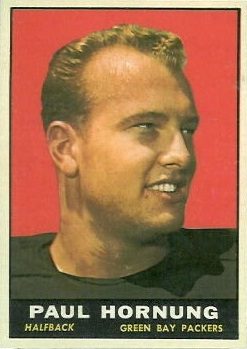
Paul Hornung takes third because he supplies the hardest test of a team-success criterion. He won the 1956 Heisman while Notre Dame finished 2–8. That pairing should start a discussion, not end one. An individual award and a team's record measure different things, and a player does not control every possession, teammate or opponent. Yet a ranking that gives some weight to the relationship between individual excellence and successful teams cannot simply ignore the defeats. Hornung belongs on this shortlist because his range forces us to explain exactly how much that context should matter, rather than using a trophy as a substitute for evaluating his college contribution.
The official record shows why the individual case is substantial. In his award season he passed for 917 yards and rushed for 420. Notre Dame's account also describes kickoff returns, extra-point kicking and interceptions from safety. Those are different kinds of responsibility, not multiple names for the same job. Passing asks a player to read and distribute; carrying the ball asks him to create or preserve space; defense requires him to respond to the opponent's choices. It is reasonable to value the ability to contribute across these phases even when the team's overall results remain poor. Versatility is the affirmative argument for Hornung, not an excuse invented to erase a losing season.
Several jobs, different statistics
Be careful with total offense. In football statistics, that label combines rushing and passing; it is not a simple measure of every useful action a player performs. Return yardage, kicking and defensive work need their own descriptions. A reader who adds every available number without checking categories can create an impressive but meaningless comparison. Hornung is especially useful for learning that distinction because his range extends beyond a quarterback's passing line. The point is not to produce a giant synthetic total. It is to recognise several separate ways of helping a team, then decide how much each should count in a historical evaluation.
There is also an important limit to the archive. The Heisman player page says complete game-by-game statistics for his 1956 season are unavailable there. We therefore do not invent a possession-by-possession account or claim that each defeat resulted from everyone except Hornung. Nor do we select one flattering statistic and declare the debate settled. The verified season figures and documented roles support a strong case for breadth. They do not let us measure every missed opportunity or reconstruct every coaching decision. Respecting that limit makes the praise more credible: the reader can see which parts are established and which parts remain our interpretation of the available evidence.
Why team context changes the order
The counterargument for putting Hornung first is straightforward. If greatness means carrying the widest variety of football responsibilities, a championship may say less about the individual than the scope of his work. Under that method he could pass both Brown and Lujack. Our ranking leaves him third because it rewards distinction within an era while also considering how an exceptional contribution connects to a successful team. Brown's receiving-and-return case and Lujack's two-way championship case provide stronger combinations under that balance. This is not a retrospective challenge to the 1956 voters or an assertion that a different player should receive his award. It is a separate comparison among Notre Dame winners.
To understand his place, imagine removing the team record from the discussion and describing only the jobs he performed. Hornung immediately looks like a contender for the top. Put the record back, and the ranking becomes more difficult without making those skills disappear. That tension is why third place is meaningful rather than dismissive. His later professional reputation adds no points here, and the 1961 card image illustrates a later stage of his career rather than the 1956 college season. Hornung leaves the next entry with a useful challenge: can a more specialised player create enough impact through receiving and returns to outweigh this unusually broad football portfolio?
Source: Heisman Trust · Notre Dame.
Photo: 1961 Topps 40 Paul Hornung.jpg · Topps. Public domain: 1961 Topps card, US copyright not renewed. Archive illustration; resized and recompressed without further cropping. Existing source crop retained. No endorsement implied.
