
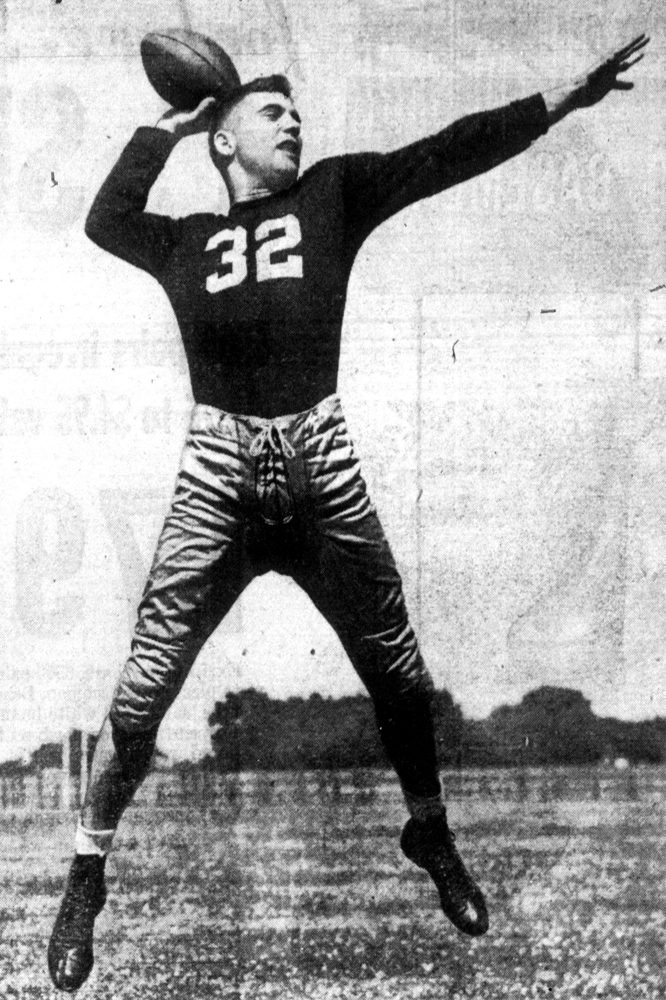
Notre Dame's Heisman history offers three different answers to the same question: what makes a great college football player? A quarterback can organise a championship team, a receiver can change a game before the offense even takes the field, and an all-purpose player can remain exceptional on a struggling side. This editorial Top 3 puts Johnny Lujack first, Tim Brown second and Paul Hornung third. It judges their Notre Dame work, not their subsequent professional careers. The order rewards breadth of contribution, distinction within an era and a meaningful connection between individual performance and the team's success, with the last consideration breaking the closest comparison.
The topic begins with current interest but looks backward for reliable substance. On 18 October 2026 at approximately 05:05–05:06 UTC, Google Trends Trending Now showed notre dame vs byu in the 1M+ search-volume bucket, with displayed growth of 1,000%. The filters were United States, past 24 hours and all categories, sorted by search volume. Auburn versus Georgia also appeared at 1M+, while several other college games appeared at 500K+. Those rounded trend-group buckets are not monthly keyword volumes, exact search counts or votes for these players. Search interest establishes a reason to explore the program; it does not establish a game result.
A college-only comparison
A Heisman winner is an eligible candidate here, not automatically the winner of every historical argument. The award recognises a particular season, while this list considers the player's college contribution around it. Three places necessarily omit important winners, including Angelo Bertelli, Leon Hart, John Lattner and John Huarte. Their absence is a selection decision, not a claim that their awards mattered less. We choose these three contrasting cases because they make the criteria visible: championship leadership and two-way work, receiving and returns, and unusually wide responsibility despite team defeats. Another shortlist can be reasonable without changing a single recorded result.
Comparisons across decades need restraint. Offensive systems, substitution practices, schedules and the use of the forward pass changed. A 1940s passing total should not be treated as if it came from a modern high-volume offense. Equally, an old player's versatility does not prove he would dominate a later era. We compare what the player did in his own setting, then ask why that contribution mattered. We do not manufacture an adjusted score or use professional statistics to fill gaps in college evidence. The explanations below separate verified dates and achievements from our judgment about their relative historical weight.
How to read the evidence
The Heisman Trust's player archives and Notre Dame's official histories provide the factual foundation. Brown's regular-season receiving line is kept separate from a later bowl-inclusive total, and Lujack's famous tackle against Army is dated to 1946 rather than moved into his 1947 award season. Hornung's losing team record remains part of the case rather than an inconvenient detail to hide. These distinctions help the comparison remain useful beyond a single football weekend. Our existing Bills-quarterbacks ranking explores a different, professional-team debate; this one stays within Notre Dame college history and does not borrow NFL greatness to decide its winner.
Read the countdown as a set of competing arguments rather than a formula. Hornung asks whether a player's range should outweigh the team's record. Brown asks how receiving and returns should be valued beside a quarterback's influence. Lujack asks how much a championship setting strengthens a two-way contribution without giving one player all the team's credit. The archive images identify the players and their eras; later portraits are not images of the college action described. By the finish, the useful question is not simply which name feels most familiar. Which contribution would you reward most: carrying many responsibilities, creating field-changing plays or helping sustain championship football?
Source: Google Trends · Heisman Trust.
Photo: Johnny Lujack passing̠ 1947.jpg · Unknown photographer / Los Angeles Daily News. Public domain: US publication without copyright notice; Los Angeles Daily News, 2 December 1947, page 40. Archive illustration; resized and recompressed without further cropping. Existing source crop retained. No endorsement implied.
