
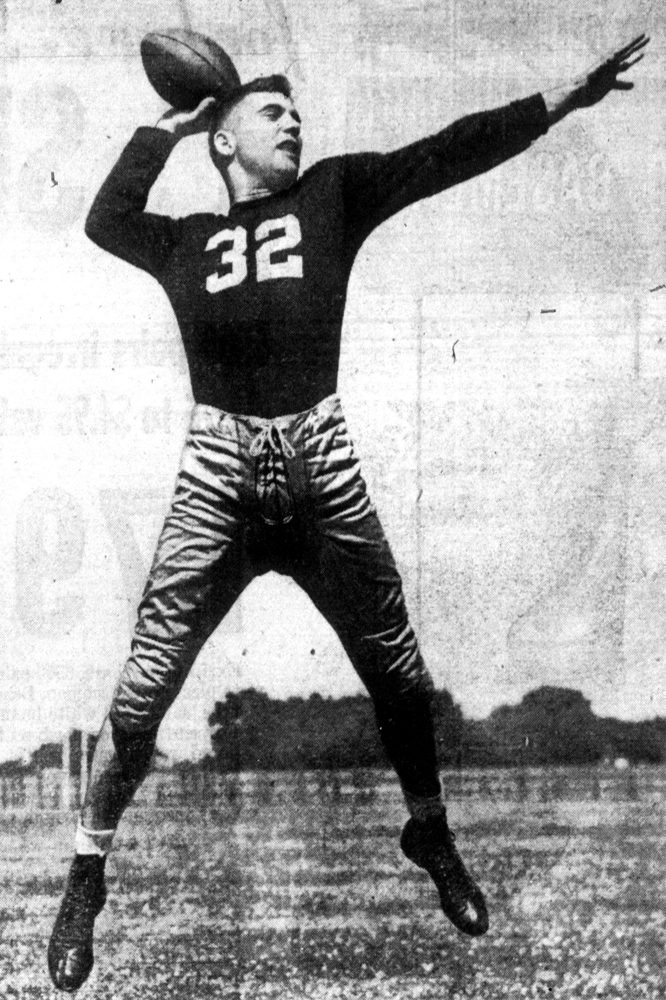
Johnny Lujack wins because this ranking gives a narrow advantage to an individual who contributed on both sides of the ball within Notre Dame's championship history. His Heisman season was 1947, when the Irish went 9–0 and won the national title recognised in the official archive. That is not a claim that one quarterback created nine victories alone. It places his contribution within an unusually successful team and asks how his offensive and defensive responsibilities strengthen the individual case. He finishes ahead of Brown and Hornung under that balance, while either challenger could lead a ranking that valued a different kind of impact more heavily.
Lujack's story also prevents a simple one-season reading. Notre Dame credits him with helping its title teams of 1943, 1946 and 1947, with his college career interrupted by wartime Navy service. The 1943 contribution included taking over after Angelo Bertelli left for military service; it should not be described as an uninterrupted, identical role across three full seasons. That distinction gives the achievement a more precise shape. He contributed to a championship team, returned after an interruption and remained important in later championship football. We reward that pattern without turning the list of team honours into a personal ownership claim or erasing the contributions of his teammates.
A career interrupted, not a simple title count
His best-known defensive moment belongs to 1946. Against Army, Lujack's open-field tackle on Doc Blanchard helped preserve a scoreless tie. It was not a scoring play, and it was not part of the following year's Heisman season. Its importance to this ranking is that it makes the two-way argument concrete. A quarterback's influence did not stop when his offense left the field. The play illustrates a different sort of pressure from throwing a touchdown: preventing a decisive score can be central to the result. Calling it a famous tackle is justified by the official histories; inventing dialogue, a precise internal thought or an unverified cinematic sequence would not be.
Read his passing figures within their era. The Heisman archive lists 61 completions from 109 attempts for 777 yards in 1947. Those totals should not be placed beside a later passing offense and treated as a direct measure of relative talent. Frequency, system and responsibilities matter. The same caution protects Brown from being reduced to a comparison with a quarterback and Hornung from having his defensive or kicking work vanish inside a passing table. Statistics make a claim checkable, but they do not automatically supply the judgment. Lujack's advantage comes from the combination of role and context, rather than from winning a numerical contest that the different eras never actually played.
The strongest case and its limitation
The strongest objection is that championship context can overreward a player surrounded by an outstanding team. That is a real concern, not a footnote. Brown's receiving and return achievements and Hornung's wide workload offer alternatives that do not depend on the same title story. We therefore give championships a supporting role rather than treating them as sufficient proof. Lujack leads because the winning context sits beside a documented two-way contribution and an important place across several Notre Dame teams. A title without that individual evidence would not settle this list. The method asks what he contributed to success, not merely whether he was present when success occurred.
The 1947 archive image belongs to his college era, but it is not presented as a photograph of the Army tackle. Keeping that distinction closes the comparison on the same terms as the other entries: evidence first, interpretation clearly labelled. Lujack is our winner for the strongest combination of era-relative distinction, breadth and championship contribution. Brown remains the best alternative for readers who prioritise receiving and field-changing returns, while Hornung challenges anyone who places too much individual responsibility on a team's record. Which would you put first if you had to choose only one: the championship two-way quarterback, the receiver-returner or the player whose versatility outshone a losing season?
Source: Heisman Trust · Notre Dame.
Photo: Johnny Lujack passing̠ 1947.jpg · Unknown photographer / Los Angeles Daily News. Public domain: US publication without copyright notice; Los Angeles Daily News, 2 December 1947, page 40. Archive illustration; resized and recompressed without further cropping. Existing source crop retained. No endorsement implied.
