
Tim Brown places second because his Notre Dame case combines receiving with the ability to alter a game through returns. He won the Heisman in 1987, and the award archive describes him as a flanker rather than a quarterback. That positional distinction matters. A receiver depends on routes, coverage, timing and a passer to receive opportunities, while a returner has a different route to influencing the contest. Brown brought both roles into one college résumé. We rank him above Hornung because this combination provides a particularly compelling example of concentrated, game-changing skill, while leaving Lujack ahead for the broader connection between two-way contribution and championship success.
His regular-season receiving figures in the official archive are 39 catches for 846 yards and three touchdowns. The same page separately records the later Cotton Bowl and a higher bowl-inclusive total. This article keeps the regular-season line intact instead of mixing the two sets of numbers. That is more than a bookkeeping preference: the award was decided before the bowl, so later production should not quietly become evidence available to the original voters. Historical comparisons improve when the reader knows the period being counted. A season total without that boundary can be technically real and still misleading in the argument where it is used.
Keep the statistical window clear
The most vivid illustration came against Michigan State in September 1987, when Brown returned consecutive punts for touchdowns. The official histories identify this sequence as an important part of his Heisman case. A punt return begins after the opponent has chosen to surrender possession and gain field position. Turning it into a touchdown reverses that bargain immediately. Brown's achievement therefore belongs to special teams, not his receiving total, and it should be appreciated on its own terms. The sequence is valuable evidence of what made him distinctive without pretending that two plays alone explain an entire college career or establish an objective ranking of all return specialists.
For a viewer, separate the skills involved. A receiver must create or find a usable window and complete a catch in the team's passing structure. A returner must judge the ball, space and pressure before deciding how to move through a developing field. Blocking and teammates still matter in both cases; an exceptional individual does not perform in an empty stadium. Brown's place rests on doing important work in two different phases, not on claiming every yard as a solo achievement. This also explains why comparing him with an old two-way quarterback is more interesting than simply placing their passing and receiving numbers beside each other.
The receiver-returner case for first
Brown has a credible argument for first. Someone who prizes explosive changes in field position and the challenges facing a non-quarterback can reasonably choose him over Lujack. A modern viewer may also find his particular mix of responsibilities easier to observe than the older championship era. Familiarity, however, is not itself a criterion. We keep him second because our final balance rewards contribution on both sides of the ball within a sustained championship story. That preference does not reduce Brown to a highlight reel or make a title a prerequisite for greatness. It explains the narrow difference between two strong cases that answer different versions of the same question.
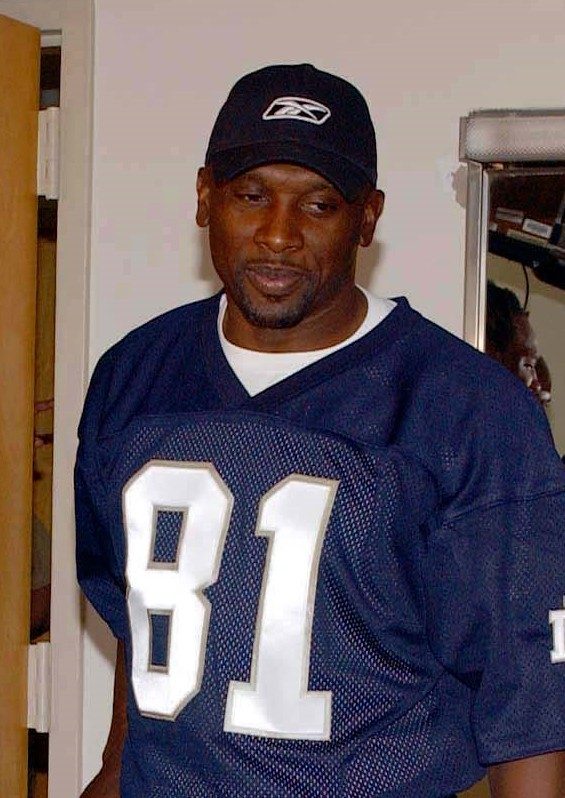
His later professional career is deliberately outside this ranking, even though many readers first recognise his name from it. The photograph from 2005 is a later archive portrait, not evidence of a 1987 Notre Dame game. Keep those boundaries in view and Brown's college case remains powerful without borrowed achievements. He shows how a player can change the reader's idea of who should control a football game: influence need not belong only to the person taking the snap. Second place rewards that contribution while passing one question to the winner. Should spectacular receiving and returns outweigh an older player's combination of quarterbacking, defense and championship-era leadership?
Source: Heisman Trust · Heisman Trust · Notre Dame.
Photo: Tim Brown.jpg · Photographer's Mate 1st Class Aviation Warfare Systems Operator Toiete Jackson. Public domain: official-duty U.S. Navy work; Toiete Jackson. Archive illustration; resized and recompressed without further cropping. Existing source crop retained. No endorsement implied.
