
LSU 2019 ranks third, but it presents a first-place argument that is easy to understand. Ed Orgeron's team finished 15–0 and defeated Clemson 42–25 for the national championship on 13 January 2020. The season label remains 2019 even though the last game took place after New Year. Those facts make LSU a useful starting point for the comparison: its unbeaten season was longer than the twelve-game campaigns of the two teams above it. If you value the accumulation of successful tests, rather than treating all perfect records as equivalent, this is the candidate most likely to challenge our order.
The offensive identity was especially clear. Joe Burrow finished the season with 60 touchdown passes and 5,671 passing yards in LSU's official final statistics. Those are season totals, not the figures from the moment he won the Heisman Trophy, and passing touchdowns must not be confused with all touchdowns he was responsible for. For this ranking, the numbers help establish how consistently the passing attack produced over the campaign. They do not require a claim that a quarterback from another era would post the same totals with the same opportunities. The meaningful achievement is how effectively LSU used the opportunities its actual season supplied.
Two closing games, two kinds of proof
The semifinal adds important substance to the case. LSU beat Oklahoma 63–28 before meeting Clemson, so the championship was not simply a famous closing performance attached to an otherwise unexamined record. The two postseason scores illustrate different kinds of separation: a semifinal that established a large final margin and a title game in which LSU had to respond to an early deficit. That combination is useful when assessing greatness. A team can demonstrate both the ability to overwhelm an opponent and the ability to keep executing when the opening phase does not follow its preferred script.
Against Clemson, LSU trailed 17–7 in the second quarter before taking a 28–17 halftime lead, according to the official championship account. That is the passage I would revisit when considering its strongest claim. Watch the logic of the comeback rather than assuming the final score describes the whole evening. The same game that ended with a convincing margin began with a real problem to solve. This does not diminish the title; it gives it texture. A memorable champion is not always one that never faces resistance, but one whose response demonstrates why the resistance ultimately could not define the outcome.
The strongest reason to change our order
Why only third? Our criteria give extra weight to how little uncertainty Nebraska allowed across its season, while Miami supplies a particularly strong collective-team counterargument. That weighting is debatable, and LSU's fifteen wins are the clearest reason to overturn it. We are not reducing the team to Burrow alone or claiming its defense was irrelevant; the title game required work on both sides of the ball. Rather, the passing production is the most immediately documented way into an argument that also includes the length of the campaign and a convincing finish against a defending champion.
Choose LSU as your winner if you want the ranking to reward sustained offensive execution across a longer title route. You do not need to invent a score against Nebraska or Miami to make that case. Start with the completed 15–0 record, the official season statistics and the two closing wins, then explain why those accomplishments outweigh the other contenders' strengths. Third place here means a place in a highly selective debate, not a suggestion that LSU was an ordinary champion. If your first reaction is that fifteen victories deserve more credit than twelve, you have already identified the most useful question to bring to the rest of the countdown.
Source: LSU · LSU · LSU · LSU.
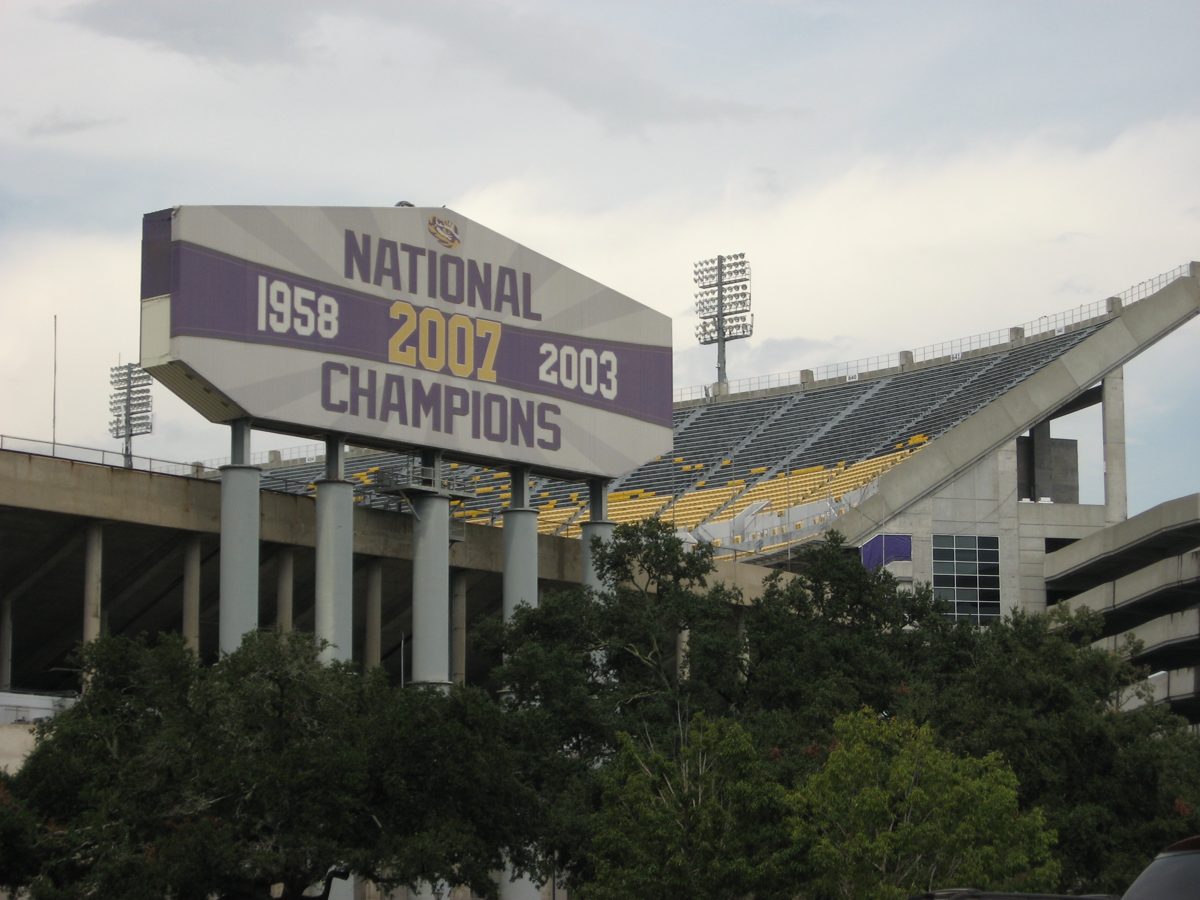
Photo: Tiger Stadium, aka Death Valley, Louisiana State University (LSU), Baton Rouge, Louisiana (3).jpg · Ken Lund · CC BY-SA 2.0. Dated archive illustration of a home setting, not an image of the ranked team or its championship game. Resized and recompressed without cropping; source rights retained.
