
When college football rankings dominate the conversation, the argument rarely ends with the current table. It quickly becomes a question about history: which undefeated champion would you trust against the very best? This Top 3 compares national-title seasons from 1990 through 2019, covering the major-college Division I-A/FBS level in the United States. It ranks individual teams in particular seasons, not the greatest programs across generations. That distinction makes the discussion manageable. A university with a long trophy collection does not automatically supply the strongest single team, and a famous professional alumnus cannot win a college game retrospectively.
The immediate inspiration is actual search interest. On 18 October 2026, around 17:05 UTC, we inspected Google Trends Trending Now for the United States, the past 24 hours, all categories, with the table explicitly sorted by search volume. The leading group, college football rankings, showed a rounded 1M+ search bucket and 100% growth. AP top 25 showed 500K+ and 200%. Those are short-window trend-group figures, not monthly keyword volumes, difficulty scores or the relative zero-to-one-hundred indices used in Explore. They support a timely ranking discussion; they do not establish which historical team deserves first place or prove anything about an unfinished season.
An explained thirty-season comparison
Our order gives most weight to sustained dominance within the team's own season, followed by the quality of the championship finish and the breadth of a persuasive team case. We use documented results and lineups to explain the choice, rather than invent a cross-era simulation or an objective greatness score. Nebraska 1995 wins because its undefeated record contained no narrow escape and culminated in a decisive title performance. Miami 2001 is the closest challenger for readers who value the collective roster and forceful peak. LSU 2019 offers the strongest alternative for those who prioritize a longer championship campaign and elite passing execution.
Keeping the period closed at 2019 is deliberate. It gives this article a defined thirty-season comparison rather than pretending to settle all college football history or treating 2026 form as a completed record. The scope also includes worthy competing cases beyond the three selected. Readers may prefer Texas 2005 or Clemson 2018, for example. A three-entry list has to leave strong champions outside it; exclusion is not a statement that they lack a case. The useful response is to identify the criterion that would move another team ahead, then examine whether you are applying that same criterion consistently to every candidate.
What a fair cross-era debate can ask
Cross-era comparisons require restraint. These teams did not play the same schedule, the same number of games or under identical postseason systems. More wins mean more opportunities to fail, but they also reflect the competition format. A large final score is powerful evidence about one matchup without measuring every possible matchup. NFL careers can help a modern reader recognize a name, yet they are not the achievement being ranked here. The central question is what the team accomplished as a college unit during that season. Bowl games played in January belong to the preceding season labels, which is why LSU's January 2020 championship appears under 2019.
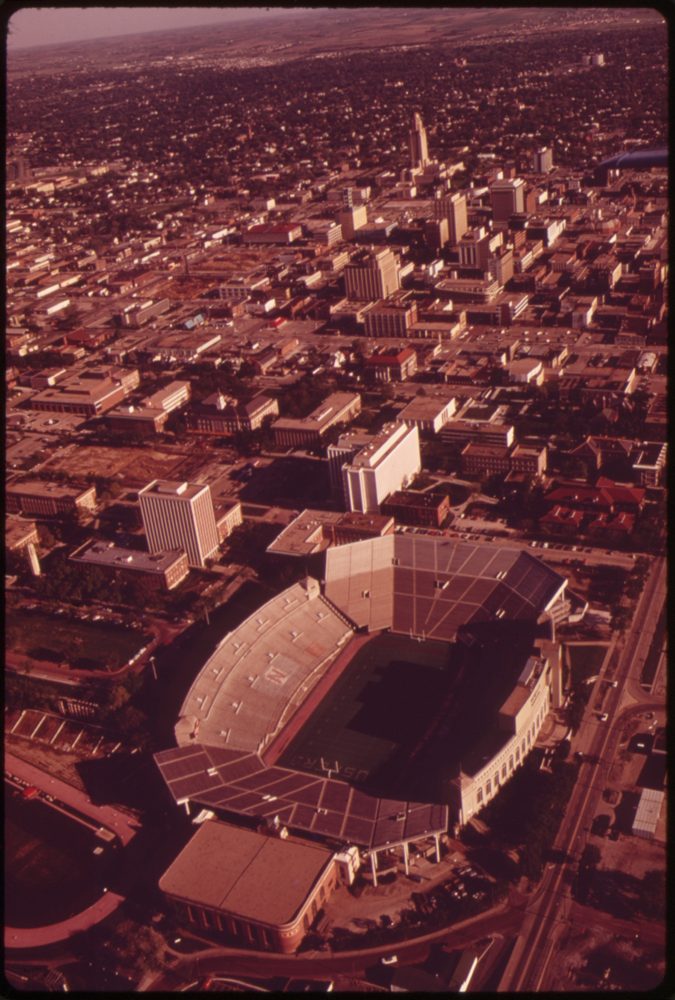
Read the countdown from third to first and test the reasoning against your own priorities. Each entry explains both its strongest argument and why it does not automatically end the debate. Our Notre Dame Heisman winners ranking offers a related discussion if you prefer comparing individual college careers rather than whole teams. The stadium photographs are clearly dated illustrations of the programs' home settings, not images of these title games or proof of a hypothetical contest. With the boundaries established, would you put Nebraska's repeated separation first, choose Miami's complete-team appeal, or reward LSU for sustaining its championship run across fifteen victories?
Source: Google Trends · NCAA.
Photo: LINCOLN, THE CAPITAL CITY, SEEN FROM THE AIR. IN FOREGROUND IS THE UNIVERSITY OF NEBRASKA STADIUM - NARA - 547431.jpg · Charles O'Rear · Public domain — U.S. EPA / NARA. Dated archive illustration of a home setting, not an image of the ranked team or its championship game. Resized and recompressed without cropping; source rights retained.
