
Nebraska 1995 takes first place because the argument starts with an unusually consistent level of separation. Tom Osborne's Cornhuskers finished 12–0 and beat Florida 62–24 in the Fiesta Bowl on 2 January 1996. Nebraska's official season review records that the closest final margin any opponent managed was fourteen points. That distinction matters under our criteria: the winning record does not conceal a narrow escape. It provides the cleanest case here for sustained dominance within the actual season, capped by a championship result that strengthened rather than complicated the larger argument.
Tommie Frazier gives the offense an identifiable center, but the selection is about the team working around that center. The official review describes a run-focused attack and records Frazier's recognition as the Fiesta Bowl's most valuable player. It is possible to appreciate that identity without claiming the same style would automatically prevail under every later rule set or defensive approach. The evidence concerns what Nebraska did against its own opponents. Its place in this countdown comes from execution and repeated separation, not from an imagined exemption from the difficulties faced by teams in other eras.
Compare the season’s narrowest result
The close-game comparison is especially revealing. Washington State produced Nebraska's narrowest final result, a 35–21 defeat; the official account notes Nebraska led 28–7 after three quarters. A fourteen-point margin should not simply be converted into the word easy, because a final score cannot measure every physical challenge or moment of pressure. Yet the pattern across the season remains important. Compared with Miami's two-point win at Virginia Tech, Nebraska gives us less evidence of a game remaining one decisive late sequence from a different result. That is a meaningful distinction when the criterion is consistency rather than the attractiveness of a roster on paper.
The Florida game supplies the closing proof most fans remember. A 62–24 championship win is a thirty-eight-point margin, and it came against the opponent Nebraska had to beat for its title. We do not need a fabricated prediction about a game against Miami or LSU to see why that carries weight. The strongest argument combines the finish with the full campaign rather than using one famous night as a substitute for it. Read the season results alongside the bowl outcome, and the championship looks like the final expression of an established pattern instead of an isolated performance that makes the rest disappear.
A winner with credible alternatives
There are credible reasons to disagree with first place. LSU won fifteen games, so a perfect record there required more completed contests. Miami's collective lineup gives supporters another powerful route to a different conclusion. Nebraska's twelve-game season should not be silently treated as identical in structure to either later campaign. Our judgment is that its repeated margin of safety and decisive title finish outweigh those competing strengths. That is an editorial weighting, not an objective mathematical theorem. Readers should be able to see exactly which preference they would change to produce a different winner, without having to deny the underlying results.
The verdict therefore belongs to Nebraska for dominance within its season, with Miami and LSU remaining legitimate alternatives under clearly stated priorities. This ranks football performance, not every aspect of a program's history or conduct. It also stays within the 1990–2019 period instead of claiming to settle the entire history of the sport. Our Notre Dame Heisman winners ranking offers a related way to debate individual college achievements after comparing these teams. Which principle would decide your own number one: Nebraska's consistent separation, Miami's complete-team appeal, or LSU's fifteen-win campaign and record-setting passing season?
Source: Nebraska Huskers · Nebraska Huskers.
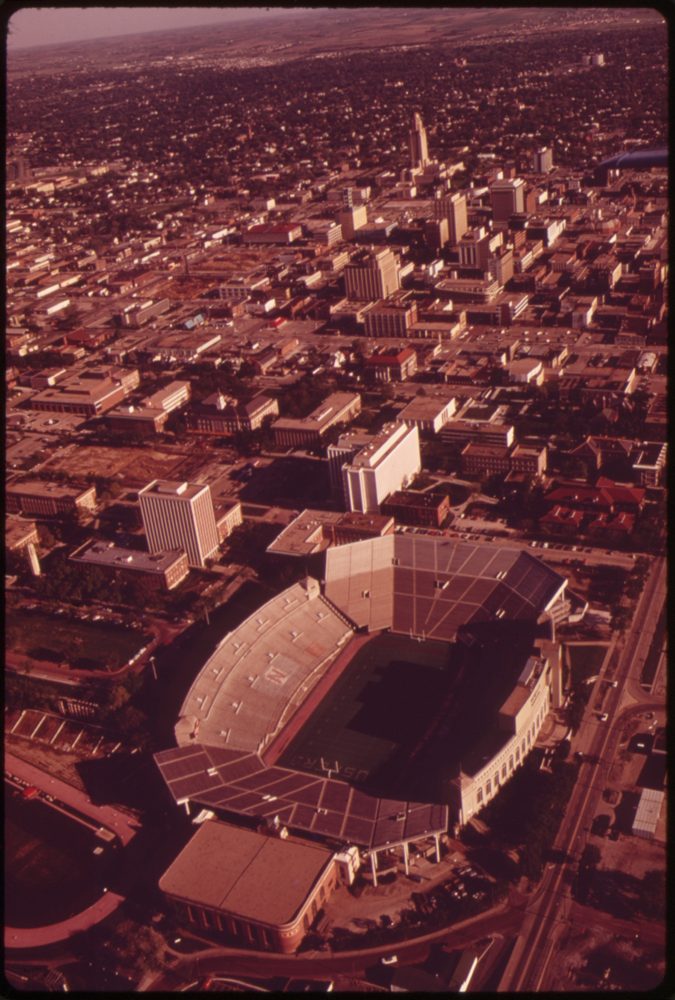
Photo: LINCOLN, THE CAPITAL CITY, SEEN FROM THE AIR. IN FOREGROUND IS THE UNIVERSITY OF NEBRASKA STADIUM - NARA - 547431.jpg · Charles O'Rear · Public domain — U.S. EPA / NARA. Dated archive illustration of a home setting, not an image of the ranked team or its championship game. Resized and recompressed without cropping; source rights retained.
