
Miami 2001 ranks second because its argument extends across the team rather than resting on one extraordinary closing play. Larry Coker's Hurricanes finished 12–0 and defeated Nebraska 37–14 in the Rose Bowl on 3 January 2002. As with LSU, the January date does not change the season label. Miami's official season history supplies both the results and the starting lineup, allowing a reader to compare the actual college team with the reputation that later developed around its names. The strength of the case is collective: a memorable offense, a prominent defense and a championship performance that established authority early.
Ken Dorsey led the offense, with Andre Johnson, Jeremy Shockey and Clinton Portis among the names in the official lineup and statistical record. Ed Reed features prominently on the defensive side. These names help orient a modern reader, but our ranking does not add up their later professional achievements and declare the college argument finished. A roster can be rich in future success without every college game becoming inevitable. Instead, use the lineup to ask how many different parts of the team could contribute to winning. That broader team identity is the most persuasive reason to move Miami ahead of an argument built mainly around one offensive unit.
A spectacular ceiling and a commanding finish
The season also contains two emphatic results that explain the enduring sense of force. Miami defeated Syracuse 59–0 and Washington 65–7 in consecutive games, as recorded in the university's season account. The point is not to turn those scores into a universal formula for comparing opponents across eras. They show the ceiling this actual team reached in consecutive weeks. There is a difference between knowing that a champion won every game and seeing how dramatically it could separate when its performance came together. Those two results give Miami's advocates a concrete place to begin rather than relying only on the phrase most talented.
The championship finish reinforces that impression. Miami led Nebraska 34–0 at halftime before the game ended 37–14. A final margin alone can hide the shape of a contest; the halftime situation helps explain why the Rose Bowl remains so central to the team's reputation. It was not a last-second escape in the title game. For a reader comparing the three candidates, this is Miami's most direct answer to Nebraska's famous championship rout: another undefeated team that made its claim strongly on the largest stage available to it. The resemblance makes the comparison close rather than automatically settling it.
The close games belong in the argument
The counterargument belongs in the same entry. Miami's results include an 18–7 win at Boston College and a 26–24 victory at Virginia Tech. A perfect record does not mean every opponent was comfortably dismissed, and the narrow finish against Virginia Tech matters under a criterion that values sustained separation. It is the clearest reason this list places Miami behind Nebraska. That is not a claim that Miami would lose a hypothetical game between them. It is a choice about how much to reward the evidence of the season itself, including the less comfortable afternoons that a roster-centered argument can sometimes overlook.
Miami can reasonably be your number one if collective quality and a dominant championship peak carry the most weight. To make the strongest version of that case, acknowledge the close games rather than deleting them from memory, then explain why the broader team identity outweighs them. The official lineup and results provide enough material for that discussion without speculative simulations or invented measures of speed. Second place recognizes a genuinely competitive first-place candidate. When you compare it with Nebraska next, ask whether a team's best version should decide greatness, or whether the week-to-week floor deserves just as much attention as the spectacular ceiling.
Source: Miami Hurricanes · Miami Hurricanes.
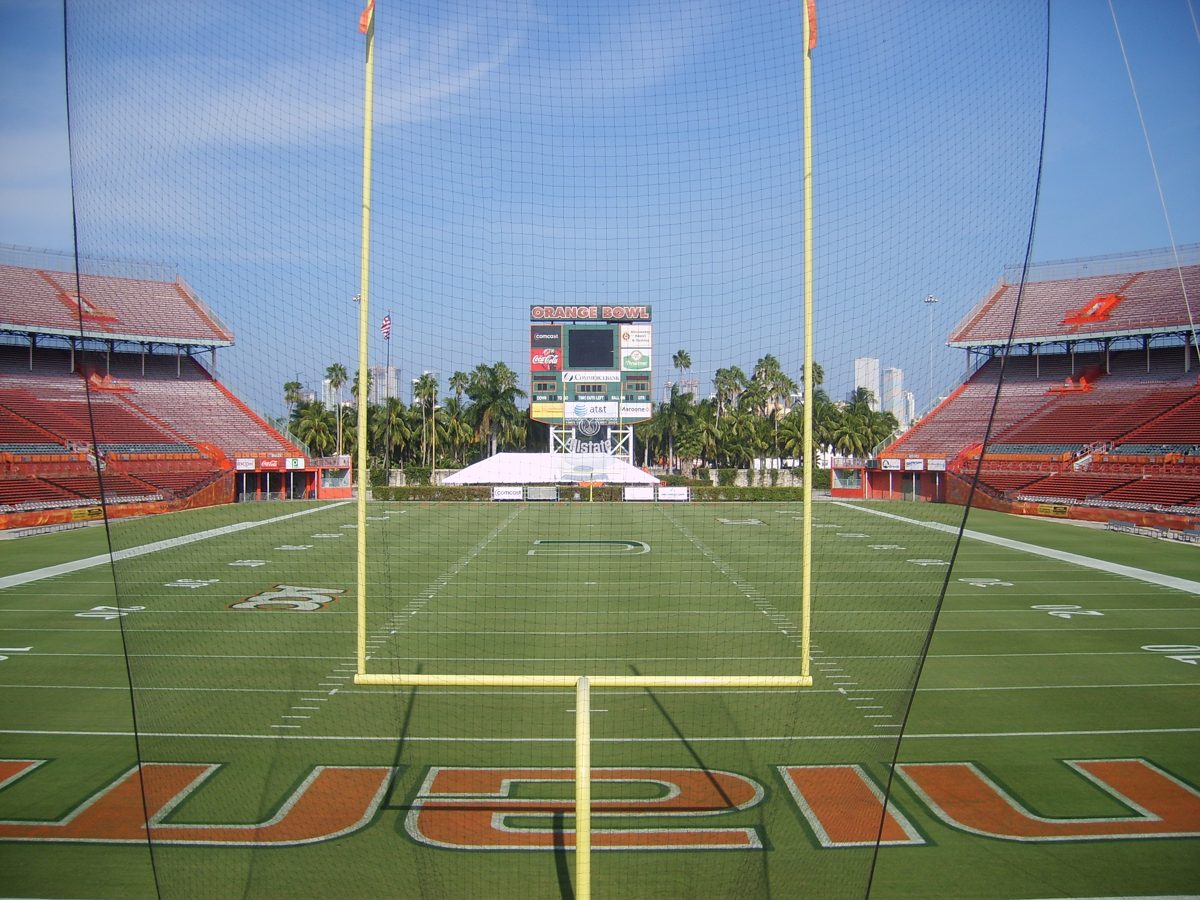
Photo: Orange Bowl.jpg · Totenkopf · CC BY-SA 4.0. Dated archive illustration of a home setting, not an image of the ranked team or its championship game. Resized and recompressed without cropping; source rights retained.
