
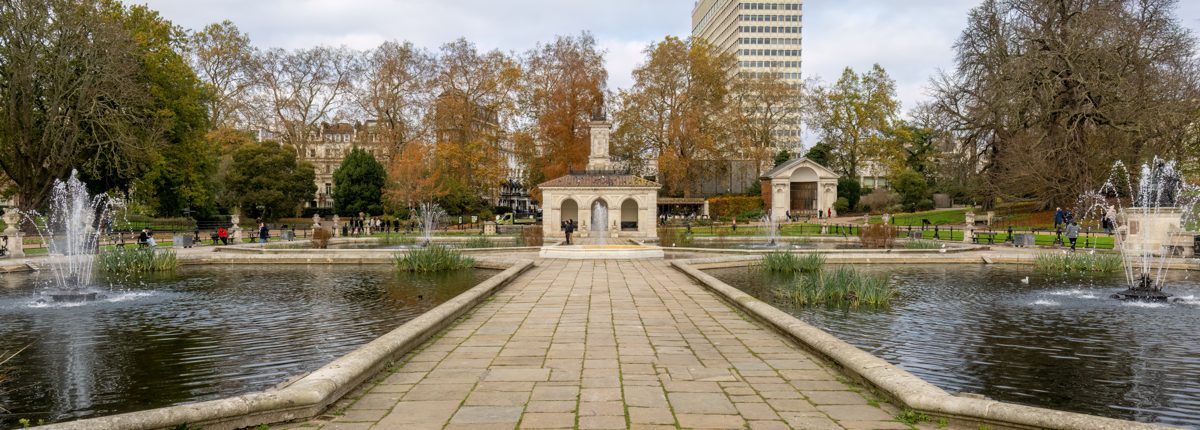
Kensington Gardens ranks fourth for visitors who enjoy designed landscapes and a walk that can be built from several distinct visual episodes. The Royal Parks points to its tree avenues, the Long Water, the Italian Gardens and the Albert Memorial among its landmarks. You do not need to visit all of them to understand the place. The gardens work especially well when you choose a small sequence and allow its changes in scale to register. They sit just below the top three because a first visit can involve more decisions about which corner to emphasise, while rewarding those decisions with a particularly rich mix of water, trees and monumental detail.
One useful focus is the northern water setting around the Italian Gardens and the Long Water. Use the official map to identify the entrance and paths that make this a comfortable outing. The formal pools offer a different rhythm from the longer stretch of water beyond them: a visitor can compare symmetry with a more open line through the landscape. This is an observation exercise as much as a route suggestion. You can spend a satisfying visit within that relationship instead of treating the gardens as a corridor that must be crossed quickly on the way to a better-known building or another park.
A sequence of spaces, not a checklist
A different walk can emphasise the Albert Memorial and broader avenues. Do not automatically add that southern focus to the northern water walk unless the distance and time make sense for the group. The pleasure of a designed garden often comes from noticing a change deliberately: a narrow approach, an open prospect, a detailed structure or a repeated line of trees. If every landmark becomes a target to tick off, those transitions can disappear. Choose one feature that gives the walk a direction, then let the spaces between features provide the substance. That approach also makes it easier to shorten the visit without feeling that it has somehow failed.
Kensington Palace and the surrounding public gardens are not one undifferentiated free attraction. Palace admission and any special visit have their own arrangements. Similarly, the presence of a playground or another facility does not establish that it is available without a current check. This article recommends the ordinary outdoor landscape, which can be enjoyed on its own. A visitor interested in both a building and a walk should plan them as two connected decisions. Keeping the distinction visible avoids using the word gardens to imply entry to everything nearby, and it helps protect a modest budget from an unplanned change of outing.
Neighbours can have different gate times
Autumn makes the avenues and water particularly relevant, but an archive image cannot tell you when leaves will turn or whether fountains will be operating. Notice tree shapes and reflections as well as colour. Check gate times for Kensington Gardens itself rather than assuming its neighbour Hyde Park has identical arrangements. Adjacent green spaces can look continuous on a small map while being managed through different entrances and schedules. Before extending a walk across the boundary, decide where the final exit will be and verify that plan. A pleasant afternoon should not depend on discovering at dusk that the gate you intended to use was only an assumption.
Choose Kensington Gardens over Hyde Park when formal details and a sequence of designed spaces matter more than a broad central lake walk. Choose it over a distant park when you want an outdoor experience that can be paired with nearby cultural plans. Our free London museums guide can help make that second choice more concrete without turning this entry into a building itinerary. Fourth recognises the gardens' richness while leaving a slight advantage to parks that offer an even simpler first-visit focus. A short, attentive walk here can be more memorable than a long one spent collecting landmarks, especially if you give the water and trees as much attention as the monuments.
Source: The Royal Parks.
Photo: Italian Gardens (00375p).jpg · Rhododendrites · CC BY-SA 4.0. Archive illustration, not a report of current weather, foliage or access. Resized and recompressed without cropping; original image license retained.
