
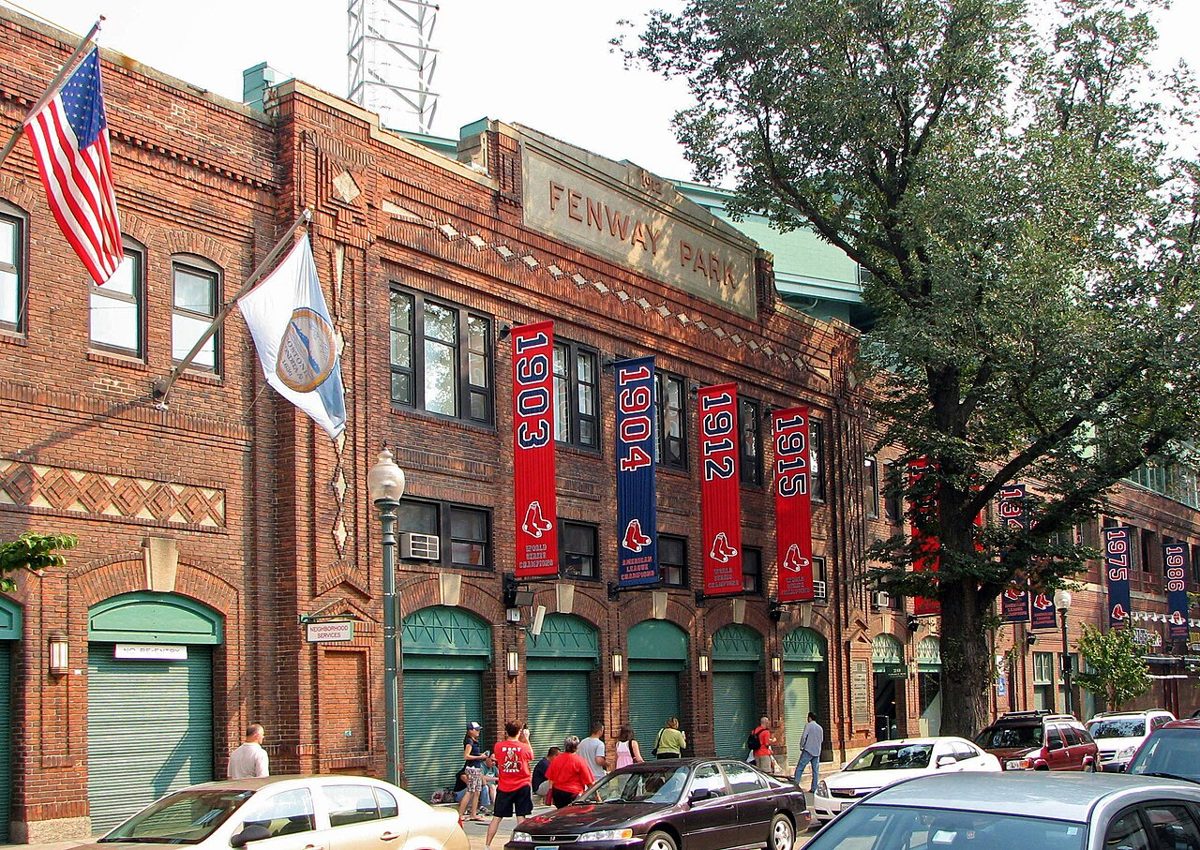
Fenway Park takes fourth place and is our strongest choice when the first visit is primarily about baseball history. The Red Sox venue dates from 1912, and the Green Monster rises along left field. Those two facts create a powerful starting point, but the useful question is how they influence your experience of watching a game. A famous wall makes the shape of the ground immediately recognizable. An old ballpark also encourages you to think about how generations of spectators have encountered a sport that still depends on the same basic relationship between pitcher, batter and fielders.
Do not reduce Fenway to a single photograph of the wall. Look at the way the field, stands and surrounding edges fit together, then notice how your understanding changes once play begins. A ball hit toward an unusual boundary makes a stadium's shape feel more consequential than it does in an empty-ground image. You do not need to predict a particular kind of play to appreciate that possibility. The building provides context, while the game supplies the uncertainty. That combination is why a visit can remain engaging after you have seen the famous feature you originally came to find.
An icon still needs a seat plan
A recognizable stadium does not remove the need to examine the exact ticket. Decide whether you want to watch the whole defensive pattern, feel close to the action or prioritize a particular perspective of the ground. Consult current official seating information and ask about the section if the view is crucial. Avoid assuming that every famous seat category suits every visitor. A historic location may be worth a trade-off for one person and frustrating for another. Naming your priorities first helps turn a romantic idea of Fenway into a practical purchase that your companions are likely to enjoy too.
The Red Sox advertise guided tours throughout the year, with products and schedules described on their official site. That provides a useful option when a Boston trip does not coincide with a suitable game, but availability still belongs to the booking calendar for your actual date. A tour can offer context and selected viewpoints without reproducing the atmosphere of live competition. If you have time for only one, ask whether your strongest interest is hearing the story of the place or joining a crowd as a game unfolds. Both are legitimate ways to make the visit meaningful.
Make history approachable
For a mixed group, give the historical interest a human scale. Choose one feature to investigate together rather than presenting a companion with a compulsory lesson in every retired number. Someone new to baseball can follow the tension of a runner on base or the crowd's reaction without already knowing decades of Red Sox history. Our World Series Game 7 ranking offers optional background for readers who enjoy historic comparisons. Keep the reading separate from a claim that a particular future fixture will repeat a famous moment; the point of going is to discover a new experience in an old setting.
Fenway finishes behind the three leading modern venues because this order gives considerable weight to setting and the balance of a first city-and-baseball day. For a visitor whose priority is history, it can reasonably be number one. That competing case is stronger than any artificial numerical score we could assign. Choose Boston if the Green Monster and the idea of an early twentieth-century ground are what move you to travel. Then use the current Red Sox visitor and tour pages to plan the details, leaving enough time for the stadium to become a real place rather than just a landmark you recognize.
Source: MLB / Redsox · MLB / Redsox.
Photo: Fenway Park01.jpg · Bernard Gagnon · CC BY-SA 3.0. Archive illustration, not evidence of current facilities, weather, crowds or access. Resized and recompressed without cropping; original image license retained.
