
Frank Gehry wins this editorial ranking for making the relationship between ordinary construction, sculptural possibility and public identity unusually vivid. He received the Pritzker Prize in 1989. His Santa Monica residence, associated with 1978 in the prize archive, is an important early reference; the Guggenheim Museum Bilbao followed in 1997, after the award. That sequence prevents the familiar mistake of explaining the 1989 prize as a reward for a building not yet completed. Our first-place argument concerns a career that lets a reader compare domestic experimentation with a major public institution, rather than reducing influence to a single museum photograph.
The residence offers a useful beginning because an existing house and an intervention can remain in tension instead of dissolving into one smooth visual statement. The question is how an addition changes the reading of what was already there. Materials and edges become part of that conversation, inviting a viewer to notice the act of construction rather than only the finished outline. This is an interpretation to test against the documented project, not permission to guess structural details from an image. Its relevance to the ranking is that a relatively small domestic project can carry an architectural proposition with consequences beyond its size and original program.
A domestic experiment and a public museum
Bilbao changes the scale and public setting. The museum's own account places construction between October 1993 and October 1997 on a former industrial and port site beside the Nervión. The building can therefore be discussed in relation to a riverbank and an urban transformation, rather than floating alone as an abstract metal object. That context does not prove that one building single-handedly created a city's economic success. Urban change has many causes, and we do not invent an economic multiplier or tourist total. The architectural point is that form, institution and setting became inseparable in the way the project entered public discussion.
Compare the residence with the museum before deciding that Gehry's influence is simply the popularity of unusual curves. One project begins with an existing domestic situation; the other organizes a cultural institution on a prominent city site. Their shared value for this list lies in challenging the expectation that architecture must present a single settled image of order. The reader can ask how parts meet, how the building changes with the viewpoint and how movement alters its apparent coherence. Those questions make the work useful even to someone who dislikes its appearance. Influence can involve changing the terms of disagreement, not merely producing a style that everyone wishes to copy.
Why the ranking remains debatable
Gehry's strongest rivals remain serious. Hadid can win for pushing spatial imagination further, Ando for making ordinary elements transformative, and Tange for the reach of teaching and urban thought. Our first place rewards the combination of an accessible public argument and the range between intimate and civic scales. It does not imply that sculpture is architecture's highest purpose or that every city needs a signature museum. Architecture also serves through repair, continuity, housing and technical care. A ranking that ignored those responsibilities would misrepresent the field, even if every selected building were visually impressive. That is why the lower entries remain competing cases rather than supporting characters in a predetermined victory.
Would you keep Gehry above Hadid and Ando, or give first place to a quieter or more systemic approach? Begin the answer with one project and one relationship: old and new, building and ground, enclosure and light, or institution and city. Then explain why that relationship matters more than the alternatives. Gehry wins here because his work makes those debates unusually public and difficult to dismiss. The best response is not automatic agreement. It is a more precise way of seeing architecture, crediting its collaborators and explaining why one kind of design ambition changes your understanding more deeply than another.
Source: The Pritzker Architecture Prize · Guggenheim Bilbao.
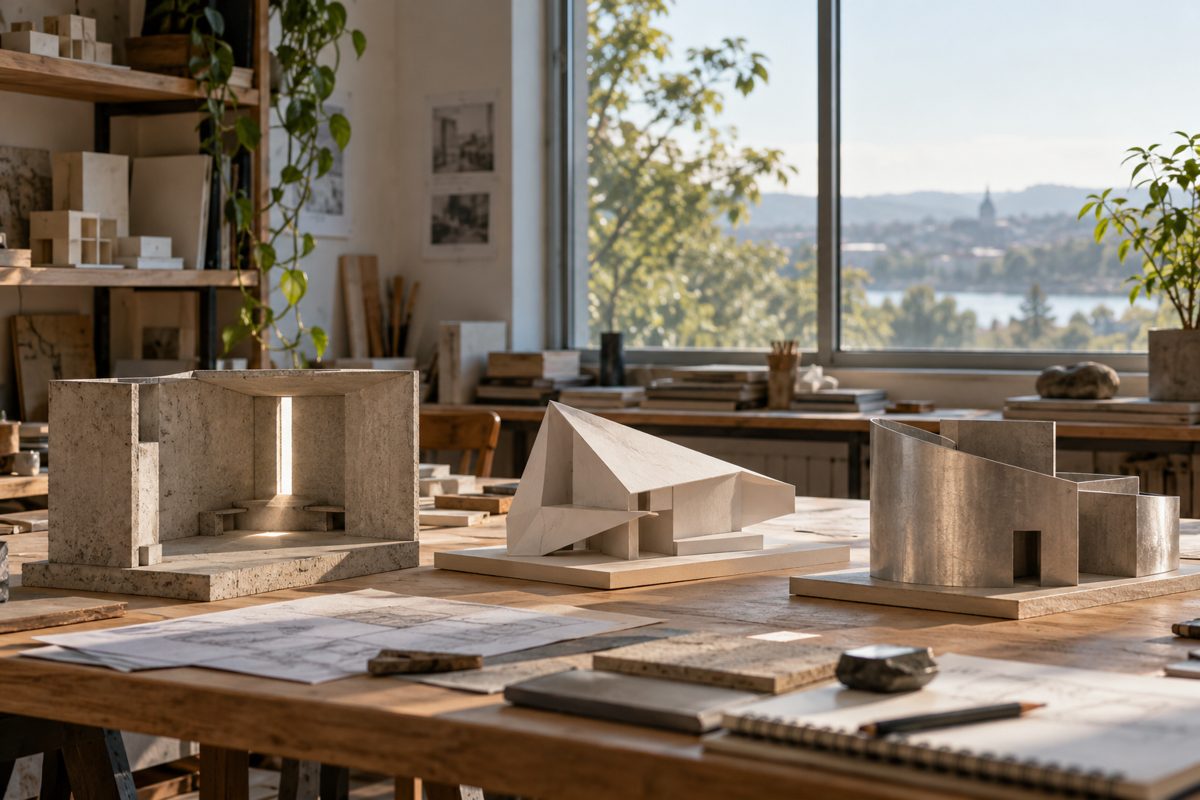
Photo: Topnilo with OpenAI image generation · AI-generated output under OpenAI Terms of Use. AI-generated thematic illustration: imaginary architectural study models; not actual projects, portraits or historical events. Generated on 20 October 2026; generic model study, not any named architect’s studio or real building. Resized and optimized without cropping.