
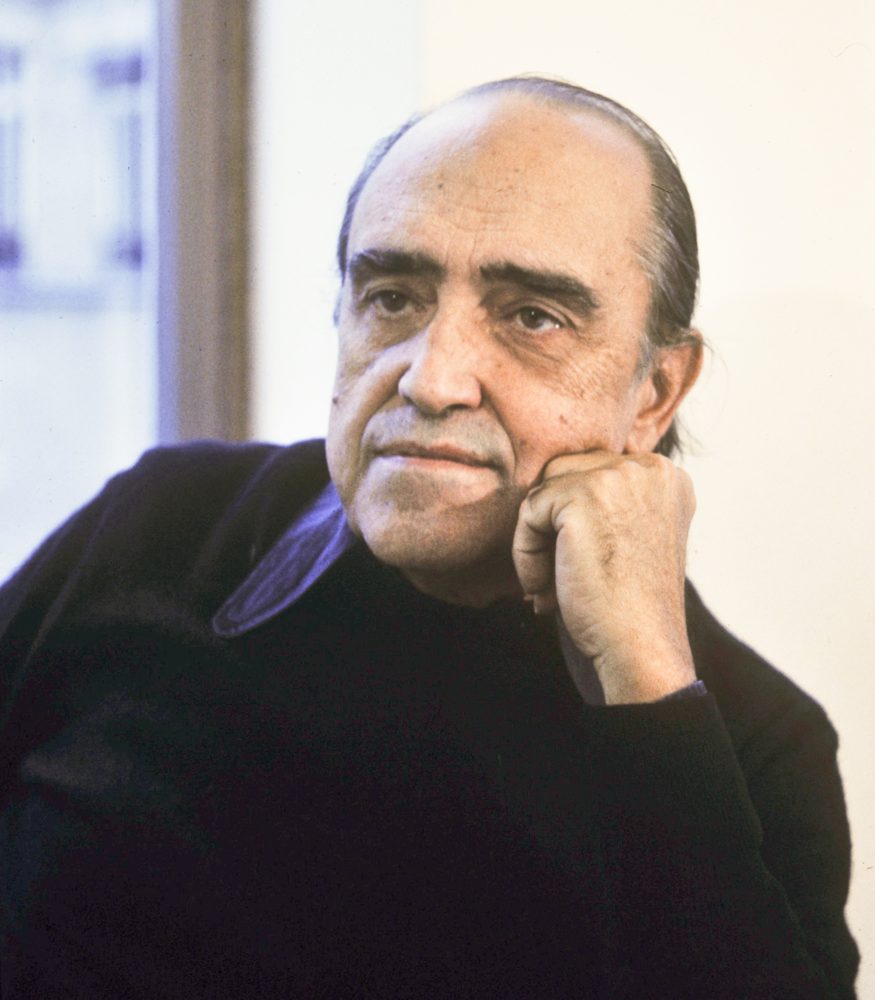
Oscar Niemeyer occupies sixth place for making reinforced-concrete architecture part of an unmistakable public imagination. He was one of two architects honored with the Pritzker Prize in 1988, alongside Gordon Bunshaft; they were separate laureates, not a design partnership. Niemeyer's work includes major civic buildings in Brasília and the Niterói Contemporary Art Museum. The important distinction in Brasília is between Niemeyer's architectural designs and Lúcio Costa's overall urban plan. Crediting the buildings to one and the planning framework to the other prevents a familiar skyline from becoming an inaccurate story about a single author creating an entire capital without collaborators.
Look at the relationship between a broad public space and a concentrated architectural form. A dome, bowl, slender support or sweeping curve can be understood at a distance before the viewer knows the building's internal organization. That immediate readability helps explain Niemeyer's place in this debate. It gives civic institutions a strong visual presence and supplies ordinary observers with something to compare. Yet visual force is only one part of architecture. A photograph cannot tell us by itself how a space works for every user, what its maintenance requires or how it fits the political life of the institution it houses. Those questions remain separate from the first impression.
Civic symbols and landscape
The Congress buildings and cathedral in Brasília offer different ways of bringing sculptural form into civic life. The prize archive dates them to 1960 and 1970 respectively. The difference in dates matters because a city's architectural identity develops over time; it is not necessarily produced in one simultaneous moment. Compare the relationship between the low forms and vertical elements of the Congress with the concentrated upward movement of the cathedral. That comparison is an invitation to look, not a claim that one simple diagram explains each building completely. Plans, construction records and the experience of movement would add evidence that an exterior image cannot supply.
Niterói offers a different setting for the same broader question. The museum, dated 1996 in the Pritzker archive, places a strongly legible form in relation to landscape. Its significance here is not that an unusual silhouette automatically makes a museum successful. It is that the encounter between ground, support and raised volume can become the central architectural idea. The reader can ask where the building seems heavy or light, how the approach prepares the view and how the surrounding panorama enters the interpretation. Avoid turning visual lightness into a claim that the structure literally has little weight. Architectural description and engineering measurement are different activities.
Why visual influence is not the whole story
Niemeyer could rank first if the standard were the power of architecture to establish the visual identity of public institutions. We place Tange, Pei, Ando, Hadid and Gehry higher for the particular combination of spatial proposition and comparative learning value favored here. That is an editorial choice, not a discovery that one national tradition matters less than another. The comparison with Gehry is especially revealing: both make sculptural form central, but the shapes, materials and relationships to place produce different questions. Influence need not mean direct imitation. It can mean expanding the range of things later architects and clients think a public building might be.
To test this entry, sketch a silhouette and then add the ground beneath it. What changes when the building is no longer floating alone on a page? That exercise makes the setting part of the argument and discourages collecting forms as if they were independent sculptures. Niemeyer's sixth place rewards a remarkable ability to create recognizable public architecture while acknowledging the limits of an image-led judgment. Move him upward if civic symbolism is your priority, but explain which building and which relationship support the move. A strong preference remains compatible with accurate credit, careful dates and attention to the people beyond the architect's name.
Source: The Pritzker Architecture Prize.
Photo: Roger Pic derivative work: MrPanyGoff · CC0. Oscar Niemeyer — portrait, 1977. Resized and recompressed without new cropping; existing source edits and license retained.
